Does prepaid electricity cost more per unit than post-paid? The honest answer for 2026: the energy rate is usually the same - the real difference is in the fixed charges and the inclining block tariff. Here's how the two compare per kWh and when prepaid genuinely works out cheaper.
It's one of the most-asked electricity questions in South Africa: is prepaid electricity cheaper than post-paid, per unit? The internet is full of confident answers in both directions - and most of them are wrong, because they compare the wrong thing.
Here's the honest 2026 breakdown. The short version: the energy rate per kWh is usually the same on prepaid and post-paid. The real difference - and where prepaid sometimes wins - is in the fixed charges and how the inclining block tariff treats your usage.
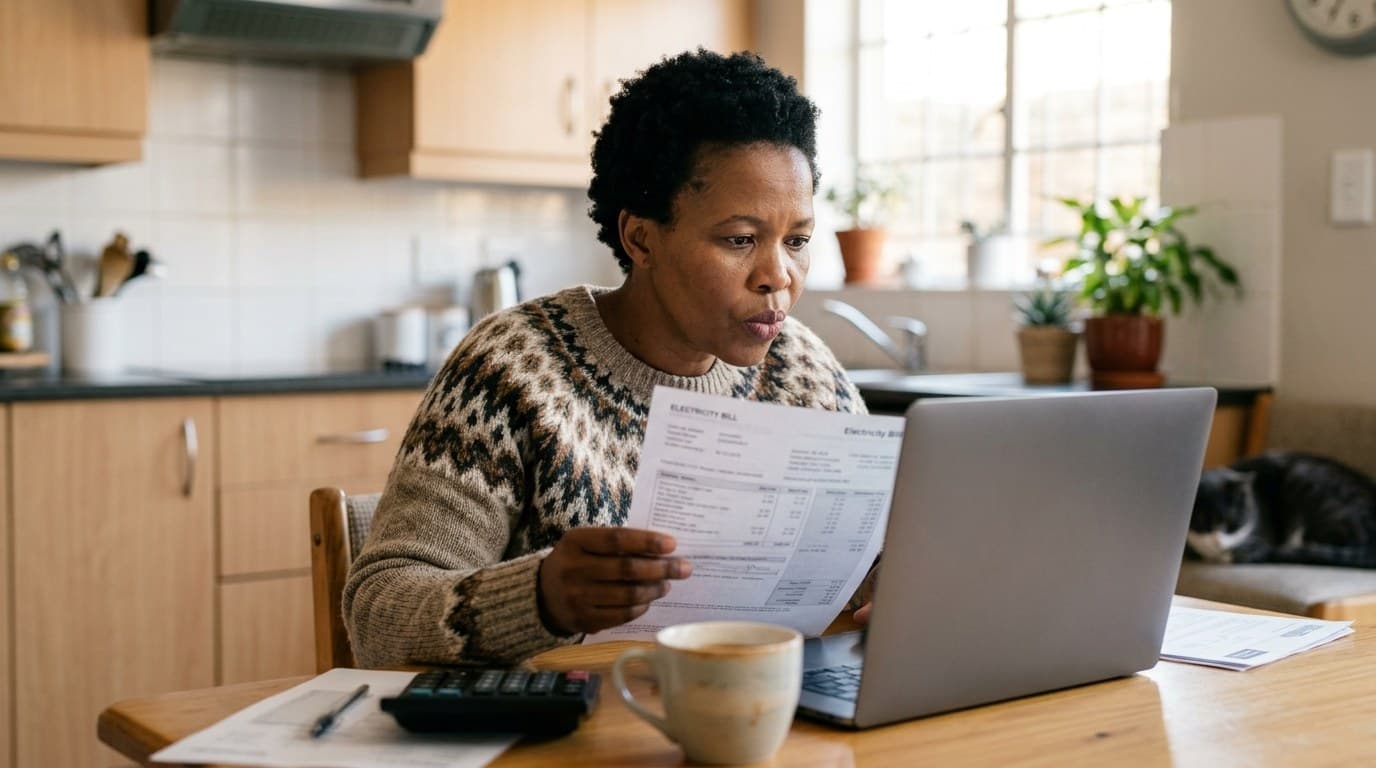
A South African homeowner buying prepaid electricity on a phone at a kitchen table, with a conventional post-paid municipal bill beside it for comparison
The energy rate per kWh is (usually) the same
Start with the myth. Most people assume prepaid units are priced differently from post-paid units. In most municipalities and on Eskom Direct, they aren't - the c/kWh charge for the units themselves is the same whether you buy them at a till or get billed at month-end. A unit is a unit.
So if the energy rate is the same, why do so many households swear prepaid is cheaper (or more expensive)? Because the price of a unit was never the whole story. Two other things do the real work:
1. Fixed charges. 2. The inclining block tariff.
Where prepaid can genuinely be cheaper: fixed charges
This is the real battleground. A conventional post-paid account often carries fixed monthly charges - service, network or capacity charges - that you pay whether you use one unit or a thousand. Some suppliers historically levied lower, or no, fixed charges on prepaid, which is what made prepaid effectively cheaper for lighter users: no standing charge to spread across your units.
But - and this is the honest caveat - that gap is closing. Several metros now apply fixed charges to prepaid too, and Eskom's own tariff reform has been shifting more cost into fixed charges across the board. So "prepaid is cheaper" is true in some municipalities and false in others in 2026. The only reliable test is to compare your own supplier's prepaid tariff against its conventional tariff, for the same usage.
The inclining block tariff hits both
The second factor catches everyone out. Most domestic electricity in South Africa - prepaid and post-paid - is billed on an inclining block tariff (IBT):
The first block of units each month is the cheapest.
The price per unit steps up as you buy more within the same calendar month.
The counter resets at the start of each month.
So on prepaid, your rate per unit genuinely rises as you buy more that month - the tenth purchase can be in a pricier block than the first. This is why your prepaid rate "seems to change": it's not random, it's the block structure. It applies to post-paid too; you just see it as a blended figure on a bill instead of at the till.
If you want to see how this plays out in real rands - how many units a specific amount actually buys once the blocks and charges are applied - we run the numbers in how many units of electricity R500 buys in South Africa →. That's the units-per-rand calculation; this page is about the rate comparison behind it.
See if solar makes sense for your home
Get free, no-obligation quotes. We then introduce you to the installer who will fit it.
So which is cheaper - prepaid or post-paid?
Putting it together for 2026:
Factor
Prepaid
Post-paid (conventional)
Energy rate per kWh
Usually the same
Usually the same
Fixed monthly charges
Sometimes lower or none (varies by municipality)
Often higher standing charges
Inclining block tariff
Applies - rate rises with monthly usage
Applies - same block structure
Budgeting
Tight control, pay-as-you-go
One monthly account
Surprise bills
None
Possible
The verdict: for many lighter-usage households in municipalities that keep prepaid fixed charges low, prepaid works out slightly cheaper per effective unit - not because the units cost less, but because you avoid a standing charge. For heavier users, the inclining block tariff dominates and the meter type barely matters. And in metros that now charge prepaid fixed fees, the gap all but disappears.
Here's what the prepaid-vs-post-paid debate misses: both are ways of renting electricity from the grid at a rate above R3 that climbs every year. Municipal tariffs rose ~9.01% on 1 July 2026; Eskom Direct rose 8.76% in April. The meter you use doesn't change that trajectory - it just changes how you pay for it.
The only thing that fixes your cost per unit is generating your own. A solar-plus-battery system produces power at a fixed effective cost of roughly R1.20-R1.80 per kWh over its lifetime, against a grid price above R4 and rising. At that point the prepaid-vs-post-paid question shrinks to a rounding error, because you're buying far fewer grid units in the first place.
Prepaid and post-paid usually charge the same rate per unit - the difference is in fixed charges (where prepaid sometimes wins, depending on your municipality) and the inclining block tariff (which hits both). For light users on low-fixed-charge prepaid, prepaid edges it; for everyone else it's close to a wash. And either way, the grid rate only goes up - which is why the households that stop worrying about their meter type are the ones generating their own power.
Prepaid or post-paid, the grid rate only climbs. Want to see what solar would fix your cost per unit at? Tell us your suburb, your monthly spend and your household size, and we'll show you the numbers.
Figures current as of July 2026 and indicative only. Whether prepaid carries lower fixed charges than post-paid varies by municipality and tariff; the energy rate per kWh and the inclining block structure are typically the same on both. The 8.76% Eskom Direct increase (1 April 2026) and ~9.01% municipal guideline (1 July 2026) are as approved by NERSA. Always compare your own supplier's prepaid and conventional tariffs and confirm against your latest purchase or bill. Solar effective-cost figures are lifetime estimates that depend on system size, usage and finance terms.
Frequently Asked Questions
Is prepaid electricity cheaper than post-paid per kWh?
Usually the energy rate per kWh is the same on prepaid and post-paid - most municipalities and Eskom charge the same c/kWh for the units themselves. Where prepaid can work out cheaper is the fixed charges - some suppliers levy lower (or no) monthly fixed and service charges on prepaid than on a conventional post-paid account. But this varies by municipality and by tariff, and several metros now apply fixed charges to prepaid too, so it is not a universal saving. Compare your own supplier's prepaid and conventional tariff for the same block.
Do prepaid meters use inclining block tariffs?
Yes, in most municipalities prepaid domestic electricity is billed on an inclining block tariff - the first block of units each month is cheaper, and the price per unit steps up as you buy more within the calendar month. The block counter resets at the start of each month. This means the more you use, the higher your average rate per unit, on prepaid and post-paid alike.
Why does my prepaid rate per unit seem to change?
Two reasons. First, the inclining block tariff means your later units in a month cost more than your first units, so your rate per unit rises as you buy more that month. Second, fixed charges and levies are sometimes recovered from your prepaid purchase before units are issued, so a small purchase can look like a much higher rate per kWh than a large one. Buying in fewer, larger amounts and spreading usage evenly helps.
Is prepaid or post-paid better for budgeting?
Prepaid gives you tighter control - you only pay for what you load, you see exactly what you are spending, and there is no surprise month-end bill. Post-paid can suit households that prefer a single monthly account and do not want to top up, and it sometimes carries different fixed charges. On price per unit the difference is usually small; the bigger decision is control versus convenience.
Does going solar change the prepaid vs post-paid question?
It changes it completely. Whether you are prepaid or post-paid, you are buying grid units at a rate above R3 and rising every year. Solar generates your own units at a fixed effective cost of roughly R1.20 to R1.80 per kWh, so the meter type stops being the main lever on your bill - how much grid power you buy at all becomes the real saving.
Free - see your savings in seconds
See what you'd save - based on your actual bill
Tell us what you pay Eskom now. We'll show you what solar would cost you a month instead, and what's left over.
No cost, no obligation, no salesperson unless you ask for one.