Two increases in one year - 13.67% in April, roughly 9% more from most municipalities on 1 July - have quietly pushed the typical South African household power bill past R2,800 a month. Load shedding is gone, but the bill keeps climbing. Here's what that number is really made of, and the honest, rand-for-rand maths on how much a home solar system actually takes off it this year.
Published 5 July 2026.
Here's the uncomfortable truth about your electricity bill in 2026: the lights are staying on, and it's costing you more than ever.
South Africa has now gone more than 400 days without load shedding. The blackouts that defined the last decade are, for now, a memory. And yet the number at the bottom of your municipal bill has quietly done the opposite of what you'd expect - it's gone up, twice, in a single year.
If it feels like you're paying more to keep the same lights on, you're not imagining it. Here's exactly what happened, what the "average" bill now looks like, and the honest, rand-for-rand maths on how much a home solar system actually takes off it this year.
Two hikes in one year: how the bill got here
The pain came in two waves.
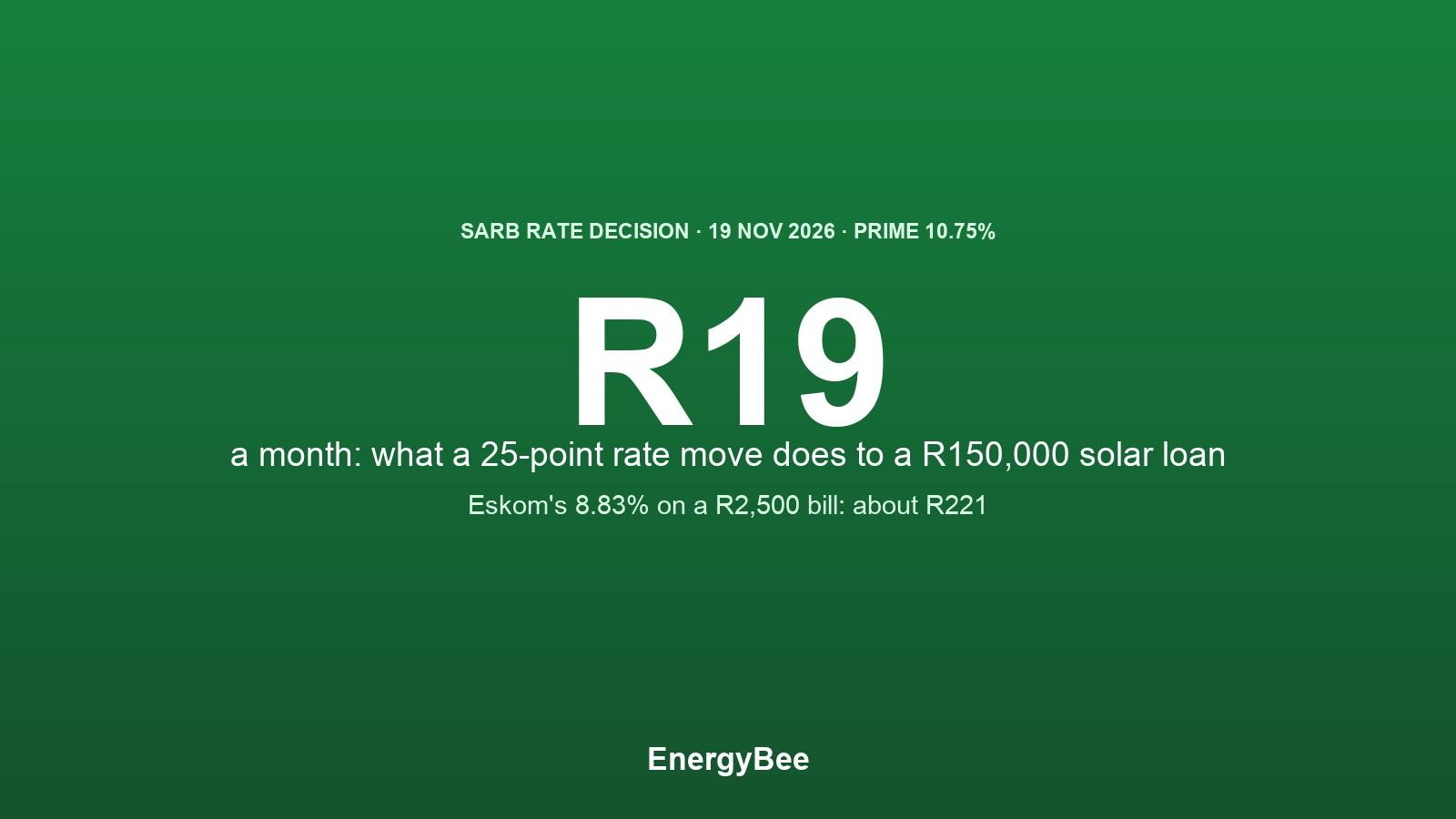
April 2026: Eskom's NERSA-approved tariff rose 13.67% - the direct-supply increase that filters into almost everything.
1 July 2026: Most municipalities passed on their roughly 9% bulk increase to households, because the municipal financial year starts in July. If you buy your power from a metro - City Power, City of Cape Town, eThekwini, Tshwane - this is the one that just hit your account.
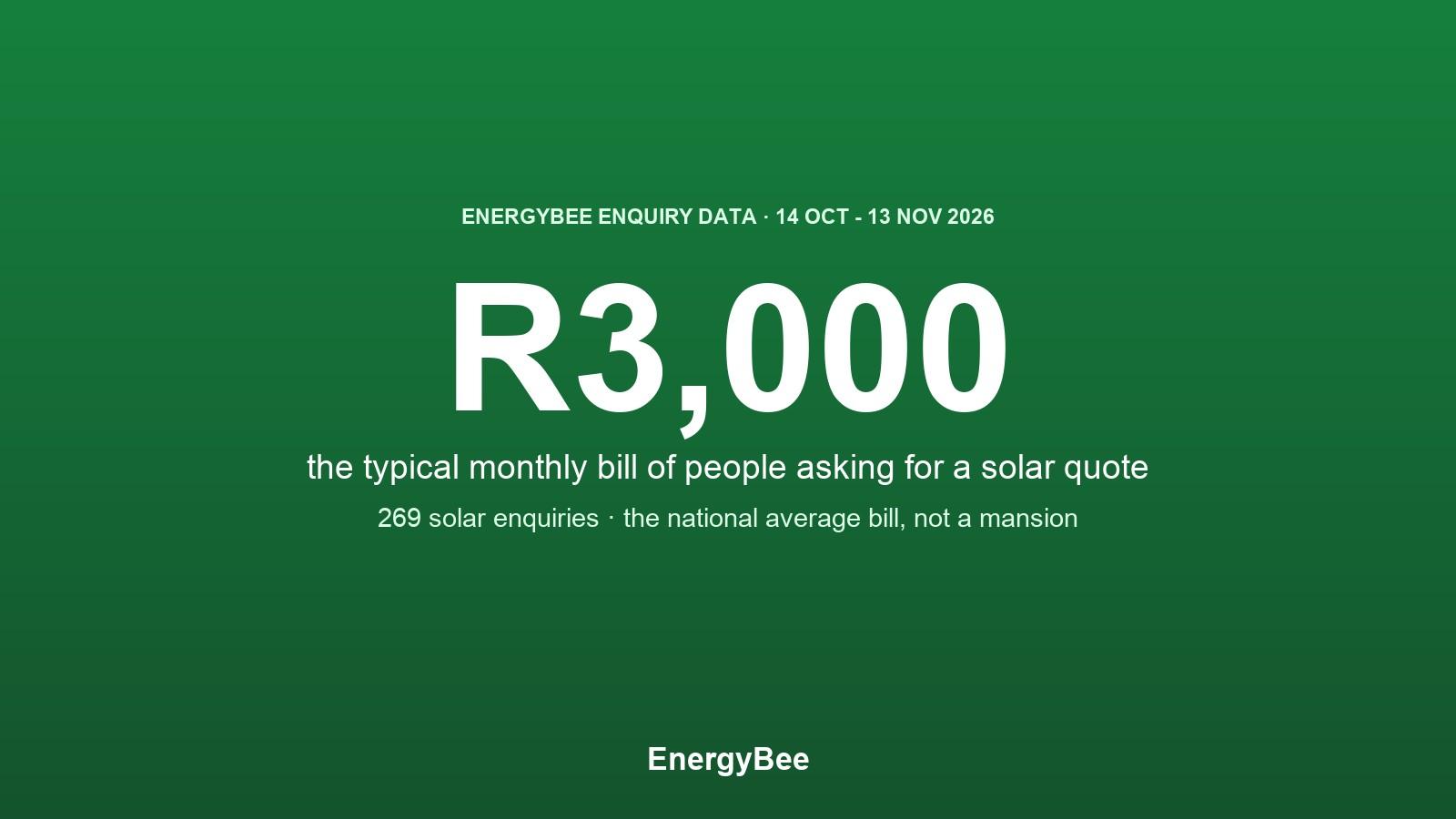
Stack those on top of years of above-inflation increases and the result is stark. A typical suburban household using around 900 to 1,000 units (kWh) a month is now paying somewhere in the region of R2,800 to R3,200 for electricity - comfortably past the R2,800 mark for the "average" home, and climbing.
The bill hasn't risen because you're using more. It's risen because each unit costs more - and there's no sign of that reversing.
What your R2,800 is actually paying for
Break a modern bill down and a pattern jumps out: most of it is a handful of hungry, everyday appliances running on the most expensive power you can buy - grid electricity at full retail price.
Where the money goes
Share of a typical bill
Why it's so expensive in winter
Geyser (water heating)
30-40%
Runs hardest in cold weather; heats on demand
Space heating
15-25%
Electric heaters are brutal on a per-hour basis
Fridge / freezer
10-15%
Runs 24/7, all year
Pool pump, lighting, everything else
20-30%
Constant background draw
Notice what's true about every line in that table: it's a daytime and evening load, and it's being fed entirely by the grid at a price you don't control. That's the exact gap a home solar system is built to close.
A South African family in a warm, well-lit suburban living room in winter, relaxed and unbothered by their electricity bill, with soft daylight coming through the windows.
See if solar makes sense for your home
Get a free, no-obligation written quote. We then introduce you to the installer who will fit it.
The honest maths: how much solar really takes off the bill
Solar doesn't make your electricity free overnight - but a properly sized system does something powerful: it converts most of your consumption from full-price grid power into power you've already paid for.
For a typical grid-tied solar-plus-battery system, matched to the home, real-world savings usually land between 60% and 85% of the bill. Here's roughly how that plays out across different starting points (illustrative ranges - your exact figure depends on usage, roof and tariff):
Your bill now
Typical monthly use
Realistic solar saving
Roughly what you'd pay after
R1,500
~500 kWh
55-70%
R450-R680
R2,800 (the "average")
~950 kWh
60-80%
R560-R1,120
R4,500 (all-electric home)
~1,450 kWh
65-85%
R680-R1,575
On that average R2,800 bill, that's roughly R1,700 to R2,300 a month staying in your account instead of going to the municipality. Over a year, that's the price of a good holiday. Over the 20-plus-year life of the panels, it's a small fortune - and it grows every time the tariff goes up.
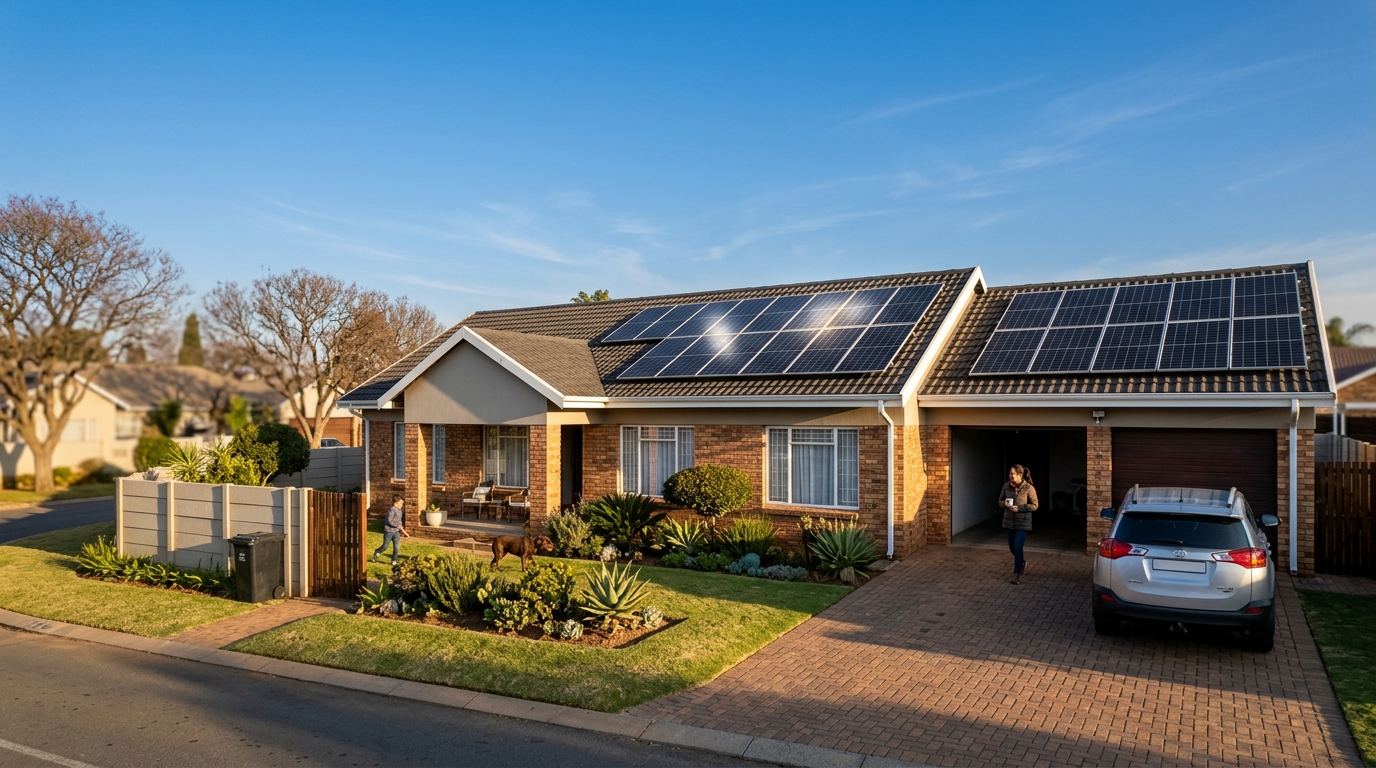
Rows of solar panels on the tiled roof of a South African suburban home, glinting in the low golden light of a clear winter morning, quietly cutting the household's electricity bill.
There are two reasons the savings run this deep:
1. You offset power at full retail price. Every unit your panels make and your home uses is a unit you didn't buy at R3-plus. That's worth far more than the few cents you'd earn exporting it back to the grid. 2. A battery lets you keep your own sunshine. Instead of selling daytime surplus cheaply and buying it back expensively at night, a hybrid inverter stores it and releases it during the evening peak - when grid power is priciest. That's what pushes a system from "nice saving" into "most of the bill gone".
Why 2026 is a genuinely good year to do the maths
Three things have quietly lined up in the homeowner's favour:
Panel and battery prices have fallen while electricity prices have risen - so a well-sized system now typically pays for itself in around 5 to 7 years, after which its power is effectively free for the rest of the panels' life. Every future tariff hike shortens that further.
Registration is free, with no deadline for systems up to 50kW under Eskom's fee waiver, which Eskom extended until further notice on 1 October 2026. Registration is still legally required, but for direct Eskom customers the fees (up to around R10,000 for urban customers) are waived, so getting your system registered is money saved on day one. (See our full guide on registering your solar system →.)
The savings are inflation-proof. You're fixing a big chunk of your energy cost at today's value. When the next increase lands - and NERSA has already approved further rises - the households on solar simply feel less of it.
The one number that matters is yours, not the average
"R2,800 a month" is a useful headline, but nobody actually pays the average. Your bill is a product of your roof, your appliances, your municipality's markup and how your household lives. The saving solar delivers is just as specific.
The good news is that it's now a straightforward thing to work out. From your last two or three bills, a solar assessment can tell you what size system your home needs, what it would cost, and - the part everyone actually wants - the real rand figure it would take off your monthly bill.
With no load shedding to force the decision, going solar in 2026 is a purely financial one. And on the numbers above, for most households, it's a decision that pays.
Frequently Asked Questions
What is the average South African household electricity bill in 2026?
After April's 13.67% Eskom increase and the roughly 9% municipal bulk increase that took effect on 1 July 2026, a typical suburban household using around 900-1,000 kWh a month is now paying in the region of R2,800-R3,200 a month for electricity. Lower-usage homes on prepaid may sit closer to R1,200-R1,800, while all-electric homes with a pool, geyser and electric heating in winter routinely push past R4,500. The exact figure depends on your municipality's markup, your tariff and how much you use - but almost everyone is paying materially more than they did a year ago, despite there being no load shedding.
How much does a home solar system actually save per month?
For a typical grid-tied solar-plus-battery system sized to your home, real-world savings usually land between 60% and 85% of the electricity bill, because you generate and use most of your own power during the day and store the surplus for the evening. On an average R2,800 bill that's roughly R1,700-R2,300 a month back in your pocket; on a R4,500 bill it can be R2,900-R3,800. Savings are highest when the system is sized to your actual consumption and paired with a battery so you self-consume rather than export cheaply. The single biggest driver is that every unit you make and use yourself offsets electricity at full retail price - a price that just went up again.
Does solar still make financial sense now that load shedding has stopped?
Yes - arguably more than during load shedding. When the grid was failing, people bought solar for backup and the savings were a bonus. With 400-plus days without load shedding, the maths has flipped: the reason to go solar in 2026 is purely the bill. Tariffs have risen far faster than inflation for years and are locked in to keep rising, so the value of every self-generated unit grows automatically over time. Solar is one of the few ways to fix a large part of your energy cost at today's price instead of paying next year's, and the year after that.
How long does it take for solar to pay for itself in South Africa in 2026?
Payback has been shortening because panel and battery prices have fallen while electricity prices have climbed. A well-sized residential solar-plus-battery system typically pays for itself in around 5 to 7 years, after which the electricity it produces is effectively free for the remaining 15-plus years of panel life. Systems without a battery, or sized tightly to daytime use, can pay back even faster. The faster tariffs rise, the sooner that break-even point arrives.
What size solar system do I need to cut my bill the most?
It comes down to matching the system to your consumption, not to a fixed 'kilowatt' number. As a rough guide, a home with a R1,500-R2,500 bill is often well served by a 3-5kW system with a small battery; a R2,500-R4,000 bill by a 5-8kW system with a medium battery; and a R4,500-plus all-electric home by an 8kW-plus hybrid system with a larger battery. Oversizing wastes money on capacity you can't use; undersizing leaves you buying expensive top-up power. A proper assessment based on your last few bills is the only way to size it correctly.
Free - see your savings in seconds
See what you'd save - based on your actual bill
Tell us what you pay Eskom now. We'll show you what solar would cost you a month instead, and what's left over.
No cost, no obligation, no salesperson unless you ask for one.