how much electricity does a house use per month south africaaverage electricity usage per month south africahow many kwh does a house use per monthaverage household electricity consumption south africa
Most South Africans have no idea how much electricity their house actually uses until the bill lands. The answer for a typical suburban home in winter 2026 is about 900 units (kWh) a month - roughly R3,750 at today's tariffs. Here's how much homes of every size really burn, exactly where those units disappear, and the one move that caps the number for good.
Published 8 July 2026 · Here's a question almost nobody can answer off the top of their head: how much electricity does your house actually use? Not what it costs - what it uses, in units, every month. Most South Africans genuinely have no idea until the bill lands and the number stings.
So let's fix that. For a typical suburban family home in the middle of a cold July, the honest answer is about 900 units - 900 kilowatt-hours - a month. At 2026 tariffs that's roughly R3,750. But "typical" hides a huge spread: the house next door might be using half that or double it. Below is how much homes of every size really burn, exactly where those units vanish, and why yours climbs so hard the moment winter arrives.
How much a South African home really uses
There's no single national number, because a two-person townhouse and a five-bedroom all-electric home live on different planets. But grid-connected suburban homes cluster into fairly predictable bands. Here's the realistic monthly picture for winter 2026:
Home type
Typical monthly use
Roughly what it costs (at ~R4.17/kWh)
1-2 person flat / townhouse
300-500 units
~R1,250-R2,100
Small family, gas cooking
500-700 units
~R2,100-R2,900
Typical 3-bed family home
700-900 units
~R2,900-R3,750
Large / all-electric + pool
1,200-2,000 units
~R5,000-R8,300
A useful gut-check: most family homes run between 20 and 35 units a day. If your daily average is comfortably above that and you don't have a pool, something is quietly eating power - usually an ageing geyser, poor insulation, or a fault.
These are winter figures. In summer the same homes typically drop 20-35% lower, because the single hungriest appliance in the house - the geyser - has far less work to do.
Where all 900 units actually go
The number feels abstract until you follow it around the house. In a normal SA family home, the split looks roughly like this:
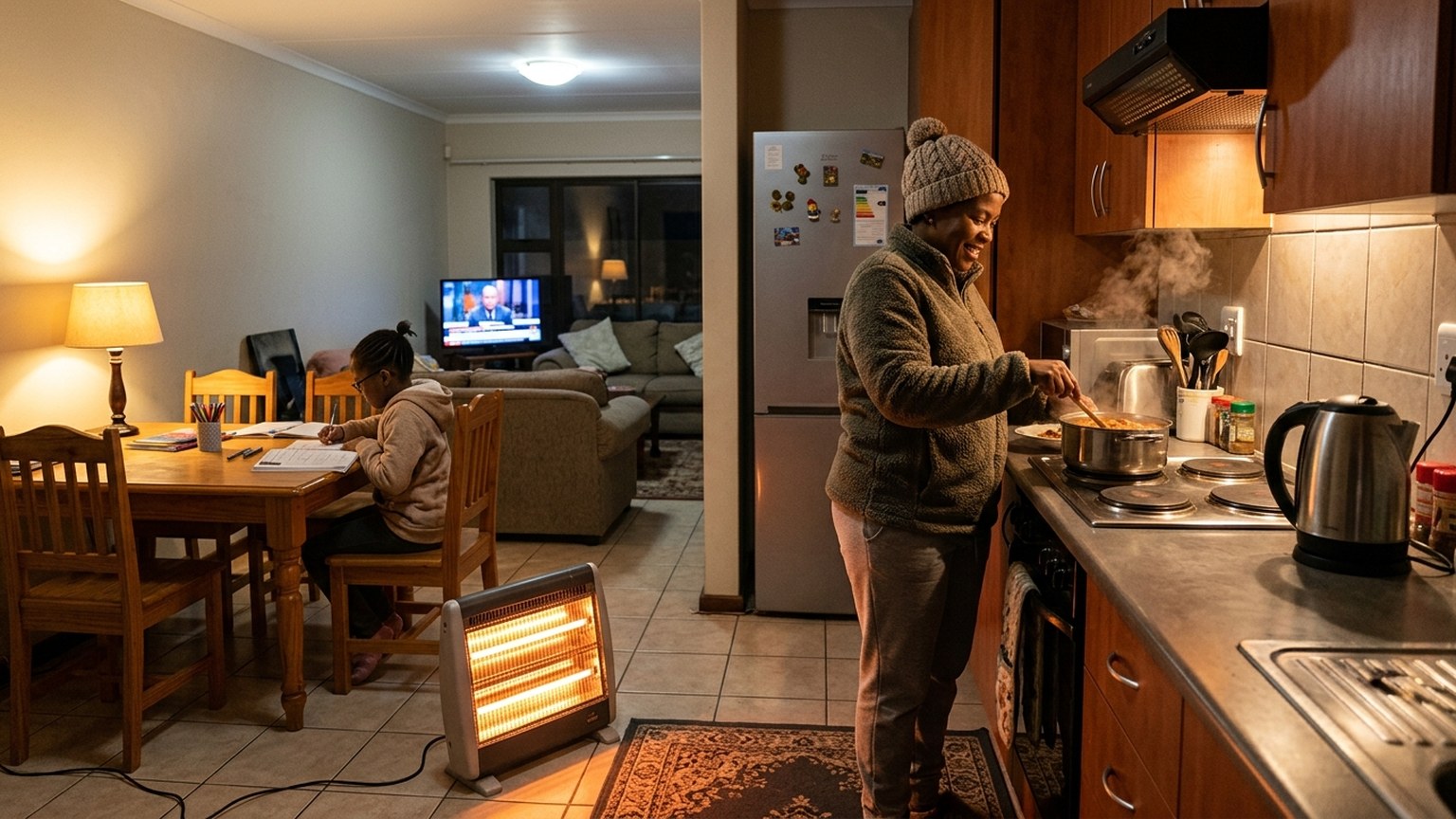
A South African family kitchen and living area on a cold winter evening, an electric bar heater glowing warm orange on the floor, a kettle steaming on the counter, the fridge and ceiling lights on, a parent cooking on an electric stove while a child does homework at the table - an ordinary home quietly working through its monthly units
Water heating (geyser): 30-40%. By a wide margin the biggest single drain. A standard 150L electric geyser can chew through 250-350 units a month on its own, and more in winter when the incoming water is colder.
Space heating: 10-20% in winter (near zero in summer). This is the reason your bill balloons from June to August. A single 2 kW heater running four hours a night adds ~240 units a month.
See what a system sized for your own usage would cost
You just saw where your units go every month. Get a free, no-obligation quote sized to your home - we then introduce you to the installer who fits it.
Why your house uses far more in winter than you think
If your July bill looks like a mistake, it usually isn't. Two things stack up in the cold months:
1. The geyser works overtime. Municipal water arrives colder in winter, so the element runs longer to reach the same temperature - and everyone lingers in a hot shower. A geyser that costs you 250 units in January can cost 350+ in July for the exact same number of showers. 2. Heaters are electricity monsters. Plug-in bar heaters, oil heaters and fan heaters typically draw 1.5-2 kW each. Two of them running through a cold evening can quietly out-consume everything else in the house combined.
Put together, these push a typical home's usage up 30-40% for three months - which is why the same house on the same tariff can cost R2,700 in summer and R3,750 in the depths of winter. You didn't do anything wrong; the season did it to you.
How to find your own number in two minutes
Don't guess - measure. It's the first step to controlling the bill:
On a normal account: find the total units (kWh) on your latest statement and divide by the days in that period. That's your daily average.
On prepaid: add up a month of recharges in units (not rands), or check your meter's cumulative reading a month apart.
Do it for two or three months and you'll see your true baseline and exactly how much winter adds. That single number - your monthly units - is the one that decides everything about your bill and about how big a solar system you'd need.
The only way to stop the number costing more every year
Here's the uncomfortable part. You can trim usage - a geyser timer and a thermostat drop of 10°C claw back real units - but you cannot control the price of each unit, and that price only moves one way. Electricity has roughly tripled in a decade, and 2026 alone stacked an 8.76% Eskom increase (1 April) on top of a ~9.01% municipal rise (1 July). Your 900 units will cost more next winter than they do this one, guaranteed. (This is why your bill keeps rising even with no load shedding. →)
The households that have opted out did one thing: they stopped buying most of their 900 units and started making them. A solar-plus-battery system produces power at a fixed effective cost of roughly R1.20-R1.80 per kWh over its lifetime, against a grid price already above R4 and rising every year. Add a solar geyser or heat pump and you knock out that 30-40% water-heating slice almost entirely. The 900-unit bill that defines your home today simply stops being the number that runs it. (Here's how much solar actually knocks off a typical bill. →)
The bottom line
The average South African family home uses around 900 units of electricity a month in winter 2026 - about R3,750 - with smaller homes closer to 400-500 and large all-electric ones well over 1,200. Two-thirds of it goes on heating water and heating rooms, and the season alone adds a third to your bill. You can measure your own number in two minutes and trim it with a timer and a thermostat. But the only way to stop those units getting more expensive every single year is to fix your own price per unit at a fraction of the grid's.
Want to know exactly how many of your monthly units solar could take off the grid - and what that would save you? Tell us your suburb, your monthly spend and your household size, and we'll size it for your home.
Figures current as of 8 July 2026 and indicative only. Household usage bands are typical winter estimates and vary widely with home size, insulation, appliances, occupancy and behaviour. Per-unit costs use the ~R4.17/kWh Durban rate as published by eThekwini and the ~9.01% NERSA municipal guideline; other metros vary by tariff, block structure and fixed charges pending each municipality's 2026/27 tariff book. Solar effective-cost figures are lifetime estimates dependent on system size, usage and finance terms. Always confirm against your own latest bill, meter reading and tariff.
Frequently Asked Questions
How much electricity does the average South African household use per month?
A typical grid-connected suburban home uses roughly 700 to 1,000 units (kWh) a month, and in winter a busy family home lands around 900 units. It varies enormously with household size and appliances: a one- or two-person flat might use 300-450 units, a normal three-bedroom family home 700-900, and a large all-electric house with a pool 1,200-2,000. The single biggest swing factor is water heating - an electric geyser alone accounts for 30-40% of the total.
How many kWh does a 3-bedroom house use per month in South Africa?
A typical three-bedroom family home uses about 700 to 900 kWh a month, rising toward 900-1,100 in the cold months when the geyser and heaters run far longer. At 2026 metro tariffs of about R3.70-R4.50 per unit, that's roughly R2,800 to R4,500 a month, or R35,000-R50,000 a year. If your three-bedroom home is using well above 1,000 units with no pool, it usually points to an old geyser, poor insulation, or a standing fault worth investigating.
Why does my house use so much more electricity in winter?
Two appliances do almost all the damage: the geyser and space heaters. In winter your geyser works far harder because incoming municipal water is colder and everyone showers longer, and plug-in or oil heaters can each pull 1.5-2 kW for hours every evening. Together they can push a home's monthly usage up by 30-40% between June and August - which is why the same house that costs R2,700 in summer can cost R3,750 or more in July on an identical tariff.
How do I calculate how much electricity my house uses?
Take your latest bill or prepaid history and find the total units (kWh) used in one full month. Divide by the number of days to get your daily average - most SA family homes land between 20 and 35 units a day. Multiply your monthly units by your tariff (around R4.00-R4.50 per unit in the metros in 2026) to see the rand cost. Doing this two or three months running shows you your real baseline and how much winter adds.
How much would it cost to run my house on solar instead?
A solar-and-battery system generates power at a fixed effective cost of roughly R1.20-R1.80 per kWh over its lifetime - the system price spread across every unit it produces - versus a grid price already above R4 and climbing every year. For a 900-unit home, shifting most of that consumption onto self-generated power is where the saving lives. The exact system size depends on how many of those 900 units you use during daylight versus after dark, which is what a proper assessment works out for your home.
Free - see your savings in seconds
See what replacing your usage would cost
You've just seen what your home actually uses. Tell us your bill and we'll show what solar sized to that usage would cost - and save.
No cost, no obligation, no salesperson unless you ask for one.