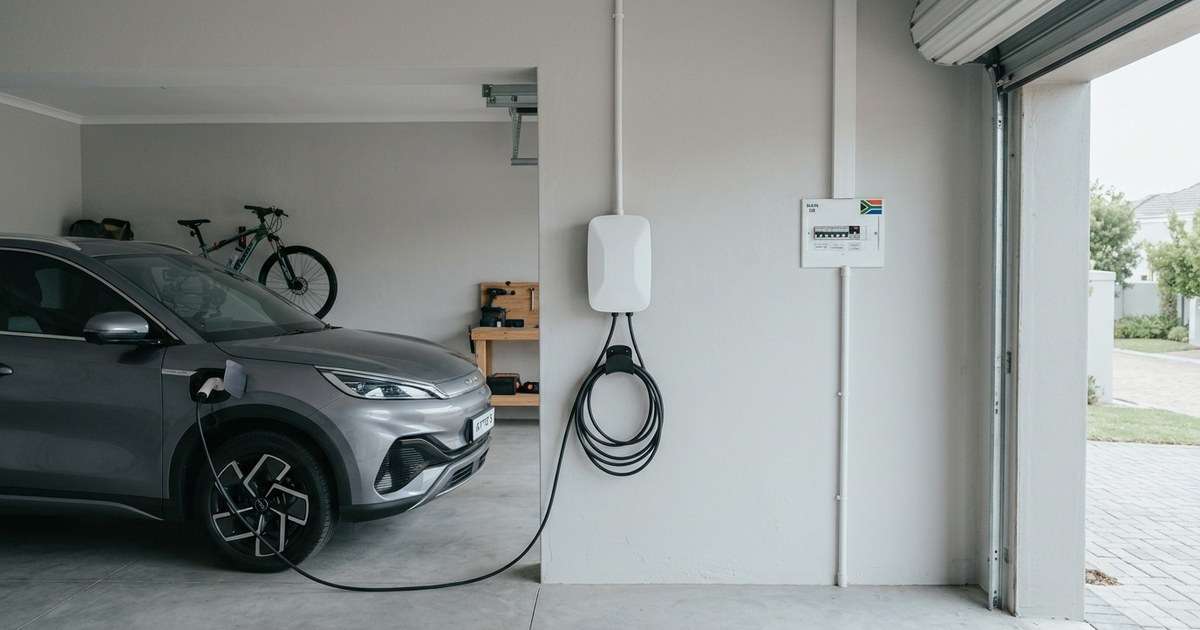
- Single-phase home: Wallbox Pulsar Plus 7.4kW, unit R12,000-R16,000.
- Three-phase home: Zaptec Go 22kW, unit R15,000-R22,000.
- Victron, Huawei, SolarEdge, Sigenergy or Solax inverter: check the maker’s own charger first; it reads the inverter directly.
- Sunsynk or Deye: neither makes a charger, so use a brand-agnostic unit with its own meter.
- Budget, no solar mode: Voltacon 7kW, R6,000-R9,000, timer only.
Want a solar-ready charger fitted?
Compare free, no-obligation quotes from installers for the charger that fits your inverter.
What does a solar-ready EV charger cost in South Africa?
A solar-ready 7.4kW charger costs R12,000-R16,000 for the unit and R17,000-R35,000 installed. Installation (dedicated circuit, isolator, Certificate of Compliance) adds R4,500-R15,000 and rises if the DB board is far from the wall or has no spare capacity. Unit prices below are from EnergyBee product data, checked 19 November 2026.
| Charger | Power | Solar surplus mode | Unit price | SA stock (19 Nov 2026) |
|---|---|---|---|---|
| Wallbox Pulsar Plus | 7.4kW single-phase | Yes, via Wallbox app with a compatible meter. OCPP 1.6J | R12,000-R16,000 | In stock at 3 listed retailers |
| EVBox Elvi | 7.4kW single-phase | Dynamic load management with a meter; solar surplus needs extra configuration. OCPP 1.6 | R14,000-R18,000 | In stock at 2 listed retailers |
| Zaptec Go | 22kW three-phase | Dynamic load balancing; solar steering via OCPP or an energy-management system. OCPP 1.6J | R15,000-R22,000 | 1 of 2 listed retailers in stock |
| Voltacon 7kW | 7kW single-phase | None. Timer only, no OCPP | R6,000-R9,000 | In stock at 3 listed retailers |
Browse the full list on the EV chargers page; that page owns the buy click and live pricing.
Which EV chargers work with solar?
Three kinds of charger work with solar: ones made by your inverter brand, brand-agnostic units with their own meter, and OCPP chargers an energy-management system can steer. OCPP on its own only means the charger can be remote-controlled. It does not mean the charger can see your roof.
- Inverter-native: reads the inverter directly, usually the least setup. Locked to that brand.
- Brand-agnostic with a meter (Zappi, Wallbox Pulsar Plus): reads a CT clamp or meter on your supply. Works with any inverter and survives an inverter change.
- OCPP with an energy-management system (Zaptec, EVBox): the most flexible, and the most setup. Needs someone who can configure it.
For the full battery and inverter sizing behind this, see our solar system for an EV guide.
Which EV charger works with my inverter brand?
Match by inverter first. If your brand makes its own charger, start there; if not, you need a charger with its own meter. We do not publish rand prices for inverter-native chargers because they are quoted per installation, not listed.
| Your inverter | Own-brand charger? | Brand-agnostic route |
|---|---|---|
| Sunsynk | No | Wallbox Pulsar Plus or Zappi with its own CT clamp or meter |
| Deye | No | Wallbox Pulsar Plus or Zappi with its own CT clamp or meter |
| Victron | Yes, Victron EV Charging Station via GX device | Wallbox or Zappi with a meter |
| Huawei | Yes, Huawei AC charger with SUN2000 | Wallbox or Zappi with a meter |
| SolarEdge | Yes, SolarEdge Home EV Charger | Wallbox or Zappi with a meter |
| Sigenergy | Yes, Sigenergy AC charger with SigenStor | Wallbox or Zappi with a meter |
| Solax | Yes, Solax EV charger | Wallbox or Zappi with a meter |
Which solar EV charger fits my home?
Three answers pick the charger: your supply, your inverter brand and your car. No email needed to see the match.
What does solar surplus charging need?
Surplus charging needs two things: something that measures your surplus (a CT clamp, a meter or the inverter itself) and a charger that can drop its current to match. Without the measurement the charger cannot tell the roof from the grid, and it simply charges at full power.
- A meter or CT clamp on the supply side, so the charger sees what the house exports.
- A minimum of 6A. A single-phase charger starts at about 1.4kW of surplus; a three-phase one at about 4.1kW, because all three phases carry at least 6A.
- No battery required. It runs on live surplus. If you have a battery, set the system so the car does not drain it overnight.
Single-phase or three-phase EV charger for solar?
Match the charger to the supply you have, not the fastest one on the shelf. A 22kW three-phase unit on a single-phase house will not deliver 22kW, and most home solar systems cannot feed it from the roof anyway. For most single-phase homes a 7.4kW charger is the right size.
Three-phase surplus charging also needs more sun to start (about 4.1kW against 1.4kW), so on a modest roof a single-phase unit will follow the sun for more hours of the day.
What should I check before buying a solar EV charger?
Check four things before you pay: the meter, the phase, the OCPP claim and your car. These are the usual reasons a “solar charger” ends up charging from the grid.
- Surplus mode without a meter. The feature exists in the app, but with nothing measuring the surplus it cannot work. Confirm the meter is in the quote.
- Three-phase units on single-phase homes. A 22kW charger on one phase is limited to the single-phase supply and wastes the extra cost.
- OCPP does not mean solar-aware. It is a control protocol. Ask who configures the solar logic and whether it is included.
- Your car’s onboard charger. If it is capped at 7kW, a faster charger changes nothing.
- Inverter headroom. A 7.4kW charger plus the house can exceed a small inverter. See our solar batteries for EV charging guide.
- Prices and stock are checked on 19 November 2026 and move; recheck before you commit.
The bottom line
Choose the charger around your inverter and your supply. Own-brand if your inverter maker has one, a Wallbox Pulsar Plus or Zappi with a meter if it does not, a Zaptec Go only if you have three-phase and a car that can use it. Budget R17,000-R35,000 installed for a 7.4kW unit.
Get a solar-ready charger fitted
Compare free, no-obligation quotes from installers for the charger that fits your inverter.
Frequently asked questions
Which EV chargers are solar compatible?
Any charger can run on a solar home, but only a solar-aware one will charge from your surplus. In South Africa that means three groups: chargers made by your inverter brand (Victron, Huawei, SolarEdge, Sigenergy, Solax), brand-agnostic units with their own meter such as the Zappi and the Wallbox Pulsar Plus, and OCPP chargers an energy-management system can steer. A basic charger like the Voltacon 7kW has no solar mode at all.
Will solar panels charge my EV?
Yes, but only while the sun is out and only with the surplus your house is not using. A 7.4kW charger running flat out needs more than most roofs make, so a solar-aware charger throttles itself to the surplus. If the car is away all day, you charge from the battery or the grid at night instead.
Do I need a special charger to charge my EV from solar?
Only if you want it to follow the sun automatically. A solar-aware charger reads your surplus through a CT clamp or meter and adjusts its current. A basic charger can still be used on a timer during peak sun hours, but it will pull from the grid whenever the roof is not covering the load.
How much does a solar-ready home EV charger cost in South Africa?
A solar-ready 7.4kW charger like the Wallbox Pulsar Plus costs R12,000-R16,000 for the unit (EnergyBee product data, checked 19 November 2026). Installation adds R4,500-R15,000 for the dedicated circuit, isolator and Certificate of Compliance, so most homes land at R17,000-R35,000 installed.
Can I charge my EV directly from solar panels without a battery?
Yes. A solar-aware charger works off live surplus, so no battery is needed. The catch is the minimum: a single-phase charger cannot go below 6A, about 1.4kW, so it only starts when your roof is making at least that much beyond the house load.