Quick Answer
Most SA homes with existing solar need a battery upgrade to 20-30kWh and an inverter rated at 8kVA+ to comfortably charge an EV. Use our calculator below to find your exact requirements. Typical upgrade cost: R80,000-R200,000.
The Problem with Your Existing System
You got an EV to save money. But if your solar system wasn't sized for EV charging, you'll end up importing more Eskom power than before you went solar.
Here's why: a typical SA home uses 12kWh/day. Charging an EV for 50km of daily driving adds another 8-10kWh/day of demand. Most residential solar installations in South Africa were designed with 5-10kWh of battery storage - barely enough for the household, let alone an EV.
What a Kilometre Costs: Petrol vs Grid vs Solar
An EV on Eskom's Homepower rate costs about R0.64 per kilometre. Petrol, at R30.25 a litre (October 2026, per AutoTrader, IOL and Daily Maverick), works out to about R2.42 per kilometre for a car using 8 litres per 100km. Here is the full comparison, using an EV that draws 18kWh per 100km in the real world, including charging losses, over an 18,250km year.
| How you fuel it | Rate (sourced, Oct 2026) | Per 100km | Per km | Per year (18,250km) |
|---|---|---|---|---|
| Petrol car, 8L/100km | R30.25/litre | R242.00 | R2.42 | about R44,200 |
| Diesel car, 6.5L/100km | R33.29/litre | R216.39 | R2.16 | about R39,400 |
| EV, public DC fast charger | R6.50/kWh | R117.00 | R1.17 | about R21,350 |
| EV, municipal top block | about R4.50/kWh | R81.00 | R0.81 | about R14,800 |
| EV, Eskom Homepower (standard) | R3.56/kWh | R64.08 | R0.64 | about R11,700 |
| EV, Homeflex summer off-peak | R1.31/kWh | R23.58 | R0.24 | about R4,300 |
Sources: petrol 95 inland and diesel prices per AutoTrader, IOL and Daily Maverick, October 2026. Eskom Homepower (R3.56/kWh) and Homeflex summer off-peak (R1.31/kWh) rates from the Eskom 2025/2026 tariff booklet, effective April 2026 after NERSA's 8.76% increase. The 18kWh/100km EV efficiency is an EnergyBee working assumption.
Solar charging is not free. Some calculators show it as "R0". It is not: the panels and install are a real up-front cost, so what each unit costs you depends on that price and how much of the system's output you use.
Grid charging beats petrol by a wide margin, but it leaves you exposed to every tariff increase - Eskom's Homepower rate rises most Aprils. Solar fixes your fuel cost for the life of the system and keeps the car charging when the grid is down. And the gap only widens: every R1 a litre that petrol rises adds about R1,460 a year to what a typical commuter saves by driving on sunshine, which is why fuel hikes keep pushing drivers towards solar.
The Battery Sizing Formula
Apply this formula to find your minimum battery requirement:
(Daily household kWh + Daily EV kWh) × 1.2 = Minimum battery capacity (kWh)
Worked Example
How Many Solar Panels to Charge a Car
To cover a 50km-a-day commute you need to generate about 9kWh a day for the car, which is roughly 2kWp of extra panels - around four 550W panels - sized on top of the system that already runs your home. The car adds demand; it does not replace your household load.
| Daily driving | Energy for the car | Extra solar to generate it | Battery note |
|---|---|---|---|
| About 30km/day (light) | about 5.4kWh/day | about 1.2kWp (3 × 550W panels) | Day charging, little extra battery |
| About 50km/day (commute) | about 9kWh/day | about 2kWp (4 × 550W panels) | Day charging, or add battery to charge at night |
| About 100km/day (heavy) | about 18kWh/day | about 4kWp (8 × 550W panels) | Day charging preferred, or more battery for night |
Two practical points settle the battery question. Charge the car in the middle of the day and you draw straight from the panels, so you need very little extra storage. If the car is only home at night, you need enough battery to hold the day's generation until you plug in - which pushes you up a size.
On the charger, a 7kW wall charger refills a 9kWh commute in well under two hours, while a standard plug at about 2.3kW takes around four. Either works overnight; the faster unit just gives you more room.
Sizing for the house first, the car second: if an EV is likely in the next few years, a slightly larger array and an inverter that can take more panels later is far cheaper than redoing the job. Browse ready-to-go options on our solar power kits page.
LV vs HV Battery for EV Owners
Battery voltage architecture matters a lot when you're adding EV charging. Here's how low voltage (48V) and high voltage (100-400V) systems compare:
| Feature | Low Voltage (48V) | High Voltage (100-400V) |
|---|---|---|
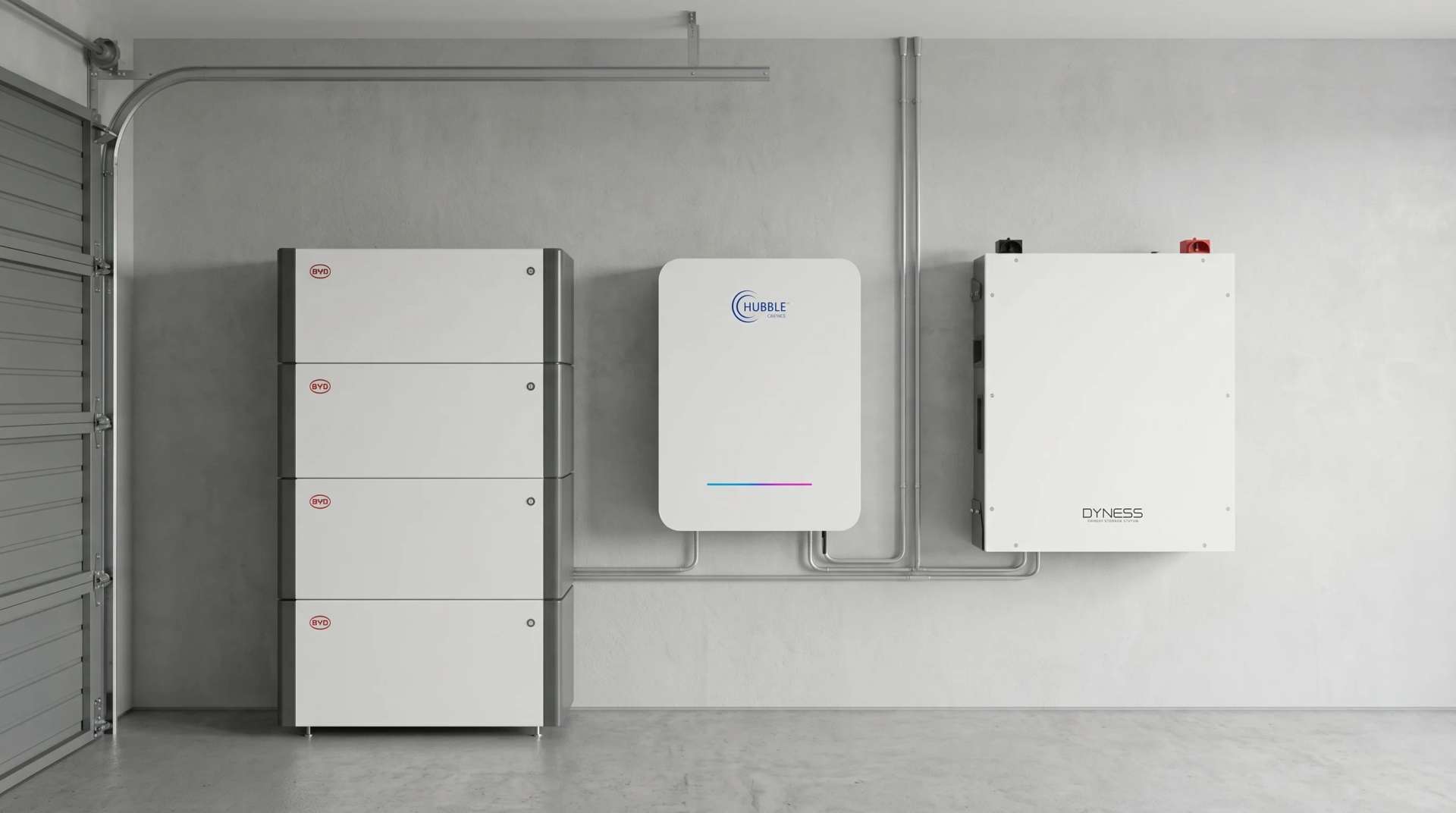
| Common brands | Pylontech, Freedom Won LTE, Hubble | BYD HVS, Huawei LUNA2000, Sungrow |
| Max practical storage | 15-20 kWh | 30 kWh+ |
| EV charger compatibility | Limited (7kW max AC) | Better (7kW+ AC, DC-ready) |
| Existing system retrofit | Usually requires inverter swap | Requires compatible HV inverter |
| Cost range (battery only) | R40,000-R80,000 | R80,000-R160,000 |
| Future-proofing | Adequate for 1 EV | Excellent (2 EVs, V2H ready) |
Recommendation: If you're adding EV charging, strongly consider a High Voltage system. It's future-proofed for second EVs, vehicle-to-home (V2H), and scales beyond 30kWh without a second inverter.
For a deeper dive, see our HV vs 48V battery guide.
Inverter Sizing for EV Charging
Your inverter needs to output enough continuous power to charge the car and run your house at the same time.
7kW AC wallbox + 5kW house load = 12kW peak demand
Most 5kVA inverters cannot handle this. You need 8kVA or higher.
For full inverter specifications and pricing, see our inverter sizing guide.
OCPP Smart Charging
For tech-savvy EV owners, OCPP-compatible chargers (Open Charge Point Protocol) can automatically adjust their charging rate based on real-time solar output. If your panels are generating 5kW of excess power, the charger pulls exactly 5kW - zero grid import.
How it works
- 1. Solar production sensor feeds data to the cloud
- 2. OCPP charger receives dynamic power limit command
- 3. Car charges at whatever rate the sun allows - throttling up and down in real time
- 4. Result: zero Eskom import during the day, maximum solar self-consumption
Compatible chargers: Wallbox Pulsar Plus, Zappi, ABB Terra AC, Delta AC Mini Plus
What an EV-Ready Solar Upgrade Looks Like
EV Solar Sizing Calculator
EV Solar Sizing Calculator
Find out if your current system can handle EV charging - and what upgrade you need.
Check your monthly Eskom bill - divide kWh by 30
Get Your EV Solar Assessment - Free
Get yours before your car arrives - we size your system, send a written quote and introduce you to the installer.
Book Free Assessment