Eskom has quietly confirmed it will not fine or disconnect residential customers who miss the SSEG registration deadline. Don't celebrate yet - your municipality can still fine you up to R30,000, and consumer body OUTA is now asking whether either of them ever had the legal right to. Here's exactly who can fine you, who can't, and how to be sorted while the fee waiver still applies.
Here's a headline that's easy to get wrong: Eskom has confirmed it will not fine or disconnect homeowners purely for not registering their solar - and on 1 October 2026 it also scrapped the fee-waiver deadline. If you stopped reading there, you'd think the pressure is off. It isn't - because Eskom was never the only one with the power to come after you, and the body that actually can is the one most homeowners haven't thought about: their own municipality.
This matters right now because the clock on the free registration window is running out fast, and the story people are sharing - "Eskom backs down on solar fines" - is only half true.
What Eskom actually said
Eskom has walked back its earlier threats of fines and disconnections for unregistered small-scale embedded generation (SSEG) - the formal term for a grid-tied home solar system. It has also previously admitted, in fairly blunt terms, that it never had clear legal authority to impose a fine on a residential customer for this in the first place. So for Eskom Direct customers, the immediate legal threat has genuinely eased.
That's a real, welcome shift. But it only covers customers who buy their electricity directly from Eskom. It says nothing about what your municipality can do - and in South Africa, most urban households are on a municipal supply, not Eskom Direct.
Your municipality is a different story
Municipalities regulate solar connections through their own electricity supply bylaws, and several treat an unregistered grid-tied system as a straightforward contravention. Cape Town is the clearest example: running solar without registering it is a criminal offence under the city's bylaw, punishable with a contravention notice, a compliance deadline, and - if you don't sort it out - disconnection and a reconnection fee once you do.
The pattern repeats, with variations, in other metros. Fines reported by homeowners and industry bodies in 2026 range from roughly R6,000 at the low end to R30,000 for more serious or repeat cases, with the most extreme scenarios (large systems, repeated non-compliance) reportedly reaching R50,000 plus forced removal of the installation. There's no single national number - each municipality sets and enforces its own rules - which is exactly why "Eskom won't fine me" is such a dangerous half-truth to act on. Some municipalities are also adding charges of their own for solar homes, such as Emfuleni's proposed R463 a month and Thaba Chweu's R582.64 monthly charge on off-grid homes →.
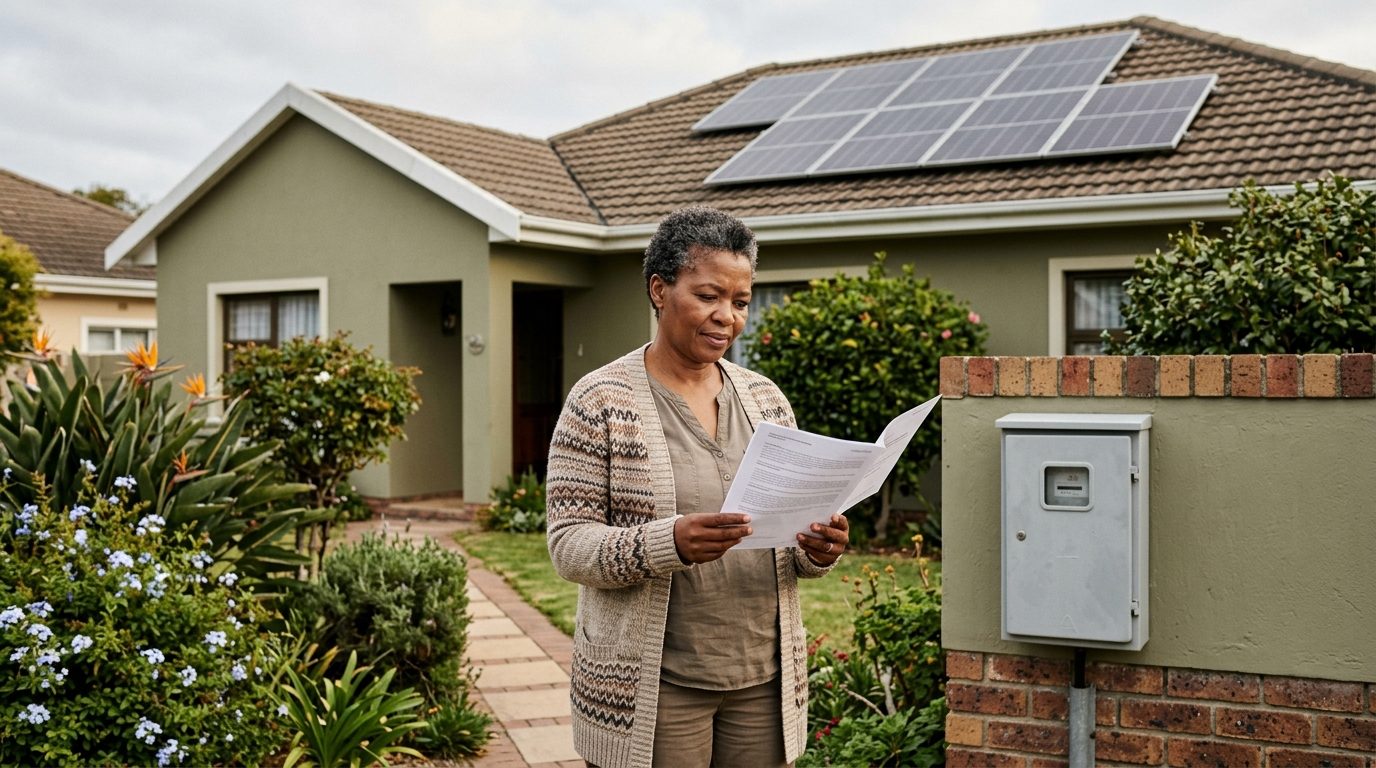
A South African homeowner reading an official notice in her front garden, with rooftop solar panels and a municipal electricity meter box visible behind her
Who supplies you
Can they fine you for unregistered solar?
Eskom Direct
No confirmed fines or disconnection - but registration is still legally required
City of Cape Town
Yes - criminal offence under the Electricity Supply By-law, contravention notice, possible disconnection
Other metros (Tshwane, Ekurhuleni, eThekwini, City Power)
Enforcement varies by municipality - most retain the legal power to act, even where it's used less visibly
See if solar makes sense for your home
Get free, no-obligation quotes. We then introduce you to the installer who will fit it.
Is any of this even legal? OUTA isn't so sure
This is where the story stops being simple. Consumer body OUTA has publicly pushed back on the entire premise that municipalities - or Eskom, for that matter - have unambiguous legal standing to fine a private homeowner over an unregistered rooftop system. Their argument isn't that safety rules don't matter; it's that the fines being handed out haven't been properly tested against the actual law, and that homeowners are being asked to pay penalties under bylaws that may not hold up to scrutiny.
That's a live dispute, not a settled one. Until it's tested in court or clarified by NERSA, the safest assumption for your own household is the boring one: the bylaws exist on the books, municipalities are using them, and "it might not be legally watertight" is not a defence that stops a contravention notice landing in your postbox. Fight the principle if you want to - but register first.
The one loophole that isn't a loophole
The most common excuse for skipping registration is "my system doesn't feed power back to the grid, so it doesn't count." NERSA closed that door in February 2026, clarifying that what triggers the registration requirement is having a point of connection to the grid at all - not whether you actually export. A grid-tied inverter running in zero-export mode still needs to be registered, because the safety issue is a live circuit that a maintenance crew might reasonably believe is dead, not the direction the electrons happen to be flowing on a given day.
The only households genuinely exempt are those running a true off-grid system with no physical connection to the municipal or Eskom network at all - which, for the vast majority of South African homes using solar as a backup to grid power, simply isn't the setup they have.
Why 30 September is the date that actually matters
None of this changes because of a deadline - registration has been a legal requirement all along. What would change if the waiver were ever withdrawn is the cost. Right now, Eskom is waiving SSEG registration and connection fees, including a free bi-directional smart meter, for systems up to 50kW - worth up to roughly R10,000 for urban customers and R36,000 for rural ones. That waiver now runs until further notice, after Eskom scrapped the deadline on 1 October 2026. The City of Cape Town runs a parallel waiver on its own registration and meter costs.
There's no deadline to miss any more, but staying unregistered still carries a cost. If Eskom ever withdrew the waiver, the fees it and Cape Town are currently covering would land back on the homeowner, on top of whatever a slow-moving municipal process was already going to cost you. Registering while the waiver is in place isn't about dodging a fine that may or may not be enforceable; it's the cheapest this process will ever be.
What to actually do about it
1. Work out who supplies you - Eskom Direct or your municipality - because that determines both your process and your real exposure to a fine. 2. Assume you need to register if you're grid-tied at all, export settings included. See our step-by-step guide to registering your solar system (SSEG) in South Africa → for the documents, costs and timelines by metro. 3. Register while the fee waiver is in place - it now runs until further notice, after Eskom scrapped the deadline on 1 October 2026 - to keep the free smart meter. Full detail on what's free where is in our piece on why Eskom solar registration is now free indefinitely →. 4. Don't rely on the "Eskom won't fine me" headline as your compliance plan - it only covers one supplier, and it's a policy position that could shift again.
The honest summary: Eskom easing off is genuinely good news, but it closes off only one of two ways this can cost you. Your municipality's bylaws are still on the books, OUTA's challenge to their legality hasn't been resolved, and the registration requirement itself was never optional. Getting it done while the fee waiver still applies is the only move that protects you regardless of how the legal argument eventually lands.
Want a system that's registration-ready from day one, or help getting an existing install sorted while the fee waiver still applies? Figures current as of August 2026, drawn from Eskom's fee-waiver communications, NERSA's February 2026 clarification, municipal bylaw reporting and public statements by OUTA. Municipal enforcement varies and changes - confirm the current position with your own supplier before acting.
Frequently Asked Questions
Will I be fined for unregistered solar now that registration is free?
Not by Eskom. Eskom has confirmed it will not fine or disconnect residential customers purely for not registering, and has previously conceded it has no clear legal power to impose such fines in the first place. Your municipality is a separate matter - several, including Cape Town, treat an unregistered grid-tied system as a bylaw contravention and can issue a fine and a disconnection notice. Whether you're at risk depends entirely on who supplies your electricity, not on Eskom's policy.
Can Eskom actually disconnect my power for not registering solar?
As things stand, no - Eskom has said it will not disconnect residential customers over unregistered solar. That is a policy position, not a permanent legal guarantee, and it applies to Eskom Direct customers specifically. If you're supplied by a municipality rather than Eskom, disconnection risk is set by that municipality's own electricity supply bylaw, and some are stricter than Eskom's stance.
Is it even legal for a municipality to fine me for unregistered solar?
It's disputed. Municipalities point to their electricity supply bylaws, under which an unregistered grid-tied connection is framed as a contravention or, in Cape Town's case, a criminal offence. Consumer body OUTA has publicly questioned whether that framework was ever properly tested against homeowners' rights, and whether the fines being issued are proportionate or even lawfully enforceable. Until a court settles it, the practical reality is that the bylaws exist and municipalities are using them - so treat the risk as real even while the legal argument continues.
Does my system need to be registered if it doesn't export power to the grid?
Yes. NERSA has clarified that registration is triggered by having a point of connection to the grid, not by whether you actually export. A grid-tied inverter set to zero-export still has to be registered, because the safety risk - back-feeding a line a maintenance crew believes is dead - exists regardless of your export setting. Only a true off-grid system, physically disconnected from the municipal or Eskom supply, is exempt.
What's the actual deadline and what happens after it?
Eskom's fee waiver on SSEG registration and connection - including the free smart meter, worth up to R10,000 for urban customers and R36,000 for rural ones - now runs until further notice, after Eskom scrapped the deadline on 1 October 2026. If the waiver is ever withdrawn, those fees come back. The waiver is about cost, not legality: your system has needed to be registered since before this waiver existed, so registering now simply locks in what is currently free.
Free - see your savings in seconds
See what you'd save - based on your actual bill
Tell us what you pay Eskom now. We'll show you what solar would cost you a month instead, and what's left over.
No cost, no obligation, no salesperson unless you ask for one.