Registering your home solar with Eskom is now free for good. On 1 October 2026 Eskom dropped the old deadline and extended its fee waiver until further notice for direct customers with systems up to 50kVA - no registration fee, no connection fee, and a free smart meter worth up to R10,000. Here's exactly what's covered, who still pays, and why the fee going away is the reason to register now, not a reason to wait.
If you've put solar on your roof in the last couple of years, there's a piece of admin you may have quietly skipped: registering the system with Eskom or your municipality. You're not alone - South Africa has an estimated 7.3 GW of rooftop solar (more than Eskom's entire renewable IPP fleet), and the grid operator can only guess at most of it because so much is unregistered. Industry body SAPVIA puts the number of systems sitting outside the formal process at roughly 30,000.
Here's the part that changes the maths for good: on 1 October 2026 Eskom scrapped the deadline. Its registration fee waiver, which had been set to close at the end of September 2026, is now extended until further notice for direct Eskom customers with grid-tied systems up to 50kVA. No registration fee, no connection fee, and a free smart meter - a package Eskom values at up to R10,000 for urban and residential customers and up to R36,000 for rural ones. The old "register before the window shuts" clock is gone. What hasn't gone is the reason to register in the first place - and, as this piece explains, the fee disappearing is the argument for getting legal now, not against it.
The short version, by who supplies you:
1. Eskom Direct customers: R0 registration and connection fees plus a free smart meter, now with no deadline. 2. City of Cape Town: its own no-cost registration window on registration and meter costs - confirm the current terms with the City. 3. Every other municipality: the applicant pays - usually the meter plus applicable charges, no flat fee published in most metros.
Is Eskom solar registration still free?
Yes - and now permanently, as far as Eskom has said. On 1 October 2026 Eskom announced it was extending its waiver of registration-related charges until further notice, removing the end-September 2026 cut-off that had been in place. Consumer body OUTA, which had pushed for exactly this, welcomed the move while reminding everyone that the bigger question - whether compulsory registration is even lawful - is still unresolved.
So for a direct Eskom customer with a system up to 50kVA, the position today is simple:
Registration and connection fees: R0.
Bi-directional smart meter: free.
Deadline: none - "until further notice."
One caveat worth stating plainly: this is a fee waiver, not an exemption. Registration is still a legal requirement under Schedule 2 of the Electricity Regulation Act for grid-tied systems. The waiver removes the cost of doing it, not the obligation to do it. (Waiver status verified 5 October 2026 - Eskom can revise the terms, so check its current notice before you act on it.)
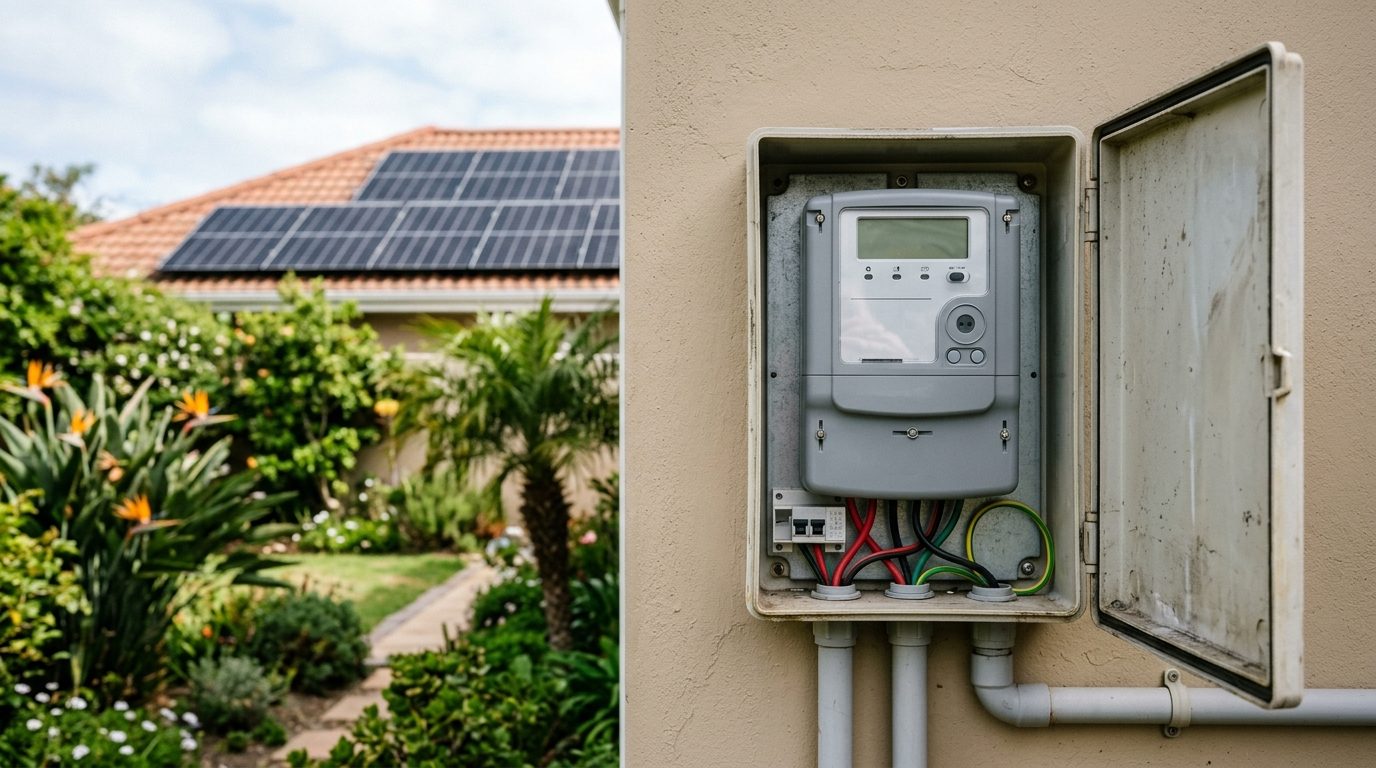
A bi-directional smart electricity meter in an open meter box on the wall of a South African suburban home, with solar panels visible on the roof behind
Does the waiver apply to me if a municipality bills me?
This is where most of the confusion lives, so be precise about who you pay. Eskom's indefinite waiver covers Eskom's own direct customers - the homes and businesses Eskom supplies and bills. If a municipality sends your electricity bill, you're outside it.
Eskom Direct: covered. R0 fees, free meter, no deadline.
City of Cape Town: the City has run its own no-cost window on its registration and AMI-meter costs. That single-phase AMI meter normally costs R6,043 (incl VAT) - it replaced an older R10,508 unit - so a Cape Town homeowner who registers in the window skips that bill. This is the City's arrangement, separate from Eskom's, so confirm the current terms with the City.
City Power (Joburg), Tshwane, eThekwini and others: the Eskom waiver does not reach you. You follow your city's SSEG process and its charges.
First, the myth: "my system doesn't export, so I don't need to register"
This is the single most common misconception, and in 2026 it was put to bed for good. On 2 February 2026, NERSA clarified that the trigger for registration is whether your installation has a point of connection to the grid - not whether it exports electricity. A grid-tied system with a zero-export setting and anti-islanding still has to be registered.
The reason is safety, not bureaucracy. A grid-tied inverter that isn't properly registered and certified can back-feed a power line that maintenance crews believe is dead - a genuine electrocution risk. That's why Eskom calls unregistered grid-tied systems "illegal" even when they never push a single kilowatt back to the grid.
The only home that's genuinely exempt is a true off-grid system with no connection to the municipal or Eskom supply at all. If you're still connected to the grid as a backup - which the vast majority of South African homes are - you're in.
What does it cost everywhere else - by who supplies your power?
Outside the two waivers above, most municipalities follow the same blunt rule: "the applicant pays all costs." What those costs actually are isn't published as a single neat number in most places, so be wary of anyone quoting you an exact municipal "registration fee" for Tshwane, Ekurhuleni or eThekwini - those figures aren't officially published. Here's the honest picture:
Who supplies you
What you pay to get legal (2026)
Eskom Direct
R0 + free smart meter, no deadline (waiver extended until further notice on 1 Oct 2026)
City of Cape Town
R0 registration + AMI meter (normally R6,043 incl VAT) while the City's own window runs - confirm current terms
City Power (Joburg)
No flat one-off registration fee. The real cost is moving from a prepaid account (~R230/month) onto a postpaid SSEG account (~R1,070-R1,360/month) - an ongoing monthly charge, not a registration fee
Tshwane / Ekurhuleni / eThekwini
"Applicant pays all costs" - meter + applicable tariff charges; no flat residential fee published
One trap to avoid: in Johannesburg you may see eye-watering figures like "R30,000+" attached to solar registration. Those are commercial grid-impact study fees for large installations (0-1 MVA and up) - they are not what a homeowner pays for a rooftop system. For a normal home, the City Power cost is the monthly postpaid account, not a one-off bill.
The bit that also got cheaper
It's not just the Eskom fees. Since 1 October 2025, most residential solar no longer needs a sign-off from an expensive ECSA-registered professional engineer (a job that used to run around R20,000). A registered Installation Electrician can now issue the paperwork for a standard home system. Add a standard electrical Certificate of Compliance (CoC) at roughly R1,500-R2,500, and the professional side of getting legal is dramatically lighter than it was a year ago.
See if solar makes sense for your home
Get free, no-obligation quotes. We then introduce you to the installer who will fit it.
If the deadline's gone, why register now?
Fair question - and the honest answer is that the deadline was never the real reason. The fee was the thing that made people hesitate, and that's exactly what's just been removed. Three reasons to get it done while the meter and fees are free:
Your municipality can still act. In Cape Town, running an unregistered grid-tied system is a criminal offence under the Electricity Supply By-law. The City can issue a contravention notice giving you five working days to comply, supply a CoC, and apply - and it can cut your supply until the system is authorised and a service fee paid. For the full picture of what the penalties actually are, city by city, see our Eskom solar registration (SSEG) guide →, and for who can lawfully fine you at all, Eskom won't fine you for unregistered solar, but your municipality still can →.
Your insurer can walk away. This is the one that quietly costs people the most. Insurers like iWYZE (Old Mutual Insure) require a solar system to be SANS-compliant with a valid CoC - without it, "your claim could be rejected." A non-compliant installation can void cover not just for the panels, but potentially for an unrelated house fire. No CoC, no claim.
You're locked out of getting paid. No registration means no bi-directional meter, which means no Cape Town cash and no Eskom credit. You give your surplus to the grid for free.
The question was never really "will I get fined before the deadline?" It's "do I want to be uninsured, possibly disconnected, and giving away free power - when the fix is now free, for good?"
Register, and in two metros you actually get paid
Getting registered isn't only about avoiding trouble. In two of the three biggest supply areas, it's the gateway to actually getting paid for your surplus solar:
Cape Town - the only one paying real cash. Through its "Cash for Power" programme, the City pays a feed-in credit of 101.23 c/kWh plus a 25 c/kWh incentive - about 126 c/kWh (excl VAT) combined for a registered home user (2025/26 rates). Credits offset your bill first, and once your credit balance passes R1,000, the City pays the surplus out in cash. You must be registered with a bi-directional AMI meter to qualify.
Eskom Homeflex - credits, not cash. Eskom's residential solar tariff is a time-of-use offset, not a flat buyback. The realistic credit for the times your panels actually overproduce (midday standard and off-peak) is roughly 131-185 c/kWh, applied as a bill credit and capped at what you consume - there's no cash payout. (You'll see a headline "peak" rate above 650 c/kWh quoted online; ignore it. Home solar rarely exports during the evening peak, so that number is not what you'll earn.)
Johannesburg - the cautionary tale. City Power makes registration mandatory and moves you onto a pricier postpaid account, but it still has no active residential feed-in tariff. A ~86 c/kWh rate was proposed back in 2023 and has never been switched on. Joburg homeowners carry the obligation without the payout - which makes "do it while it's free" the only sensible play there.
Work out your own position in two questions
The free-waiver headline is true, but whether it applies to you comes down to two things the general news can't answer for your house:
1. Who supplies you - Eskom Direct, or a municipality? That decides whether the waiver reaches you at all. 2. What size is your system - up to 50kVA (almost every home system) keeps you inside the Eskom waiver band.
The bottom line: this is the cheapest it has ever been - and, for direct Eskom customers, now the cheapest it will stay - to get a home solar system fully legal in South Africa. Free for Eskom Direct, free in Cape Town's window, and far cheaper everywhere else than it was a year ago. The deadline that used to push people is gone; the insurance, the municipal rules and the money you can earn back are all still very much here.
Thinking about solar, or want a system that's set up right and registration-ready from day one? Figures current as of 5 October 2026 and sourced from Eskom, OUTA, the City of Cape Town 2025/26 tariff book, NERSA and SAPVIA. Municipal fees, waivers and feed-in rates are reviewed periodically - confirm current terms with your own supplier before you apply.
Frequently Asked Questions
Is Eskom solar registration still free?
Yes. On 1 October 2026 Eskom extended its registration fee waiver until further notice, dropping the previous end-September deadline. For direct Eskom customers with grid-tied systems up to 50kVA, registration and connection fees are R0 and the bi-directional smart meter is free - Eskom values the waiver at up to R10,000 for urban and residential customers and up to R36,000 for rural ones. It is a fee waiver, not an exemption: registration itself is still legally required. Verified 5 October 2026; Eskom can change the terms, so check its current notice before you rely on it.
Does the waiver apply to me if a municipality bills me, not Eskom?
Not automatically. Eskom's indefinite waiver covers its own direct customers - homes and businesses that Eskom supplies and bills. If a municipality sends your electricity bill (City Power in Johannesburg, Tshwane, eThekwini and others), you follow that city's SSEG process and its fees, which the Eskom waiver does not touch. The City of Cape Town has run its own no-cost registration window on its registration and meter costs, so Cape Town customers have also been able to register free - confirm the current terms with the City. Everywhere else, assume the applicant pays the meter and any applicable charges.
Do I still have to register if my system doesn't feed power back to the grid?
Yes. In February 2026 NERSA clarified that what triggers registration is having a point of connection to the grid - not whether you export. A grid-tied system with a zero-export or anti-islanding setting still has to be registered. The only home that's genuinely exempt is a true off-grid system with no connection to the municipal or Eskom supply at all. The safety reason is real: an unregistered grid-tied inverter can back-feed a line that maintenance crews believe is dead.
Can Eskom fine me or cut off my power if I don't register?
Eskom cannot lawfully fine you. In February 2026 it halted fines on unregistered solar and conceded it has no legal power to impose them - energy analyst Chris Yelland put it bluntly: 'There is nothing in law that empowers Eskom to impose fines.' But no Eskom fine is not the same as no risk. In Cape Town, running an unregistered grid-tied system is a criminal offence under the city's by-law, and an uncertified, unregistered system can give your home insurer grounds to reject a claim - often the most expensive consequence of all.
If registration is free with no deadline, why not just leave it?
Because the fee was never the only cost of staying unregistered. Your municipality can still act - Cape Town can issue a contravention notice and disconnect you until you comply. Your insurer can reject a claim on a non-compliant system. And you stay locked out of getting paid for surplus power: no registration means no bi-directional meter, so no Cape Town cash credits and no Eskom Homeflex bill credits. The fee going away removes the one cost that used to make people hesitate - which is exactly why registering now, while the meter and fees are free, is the sensible move.
How much does it cost to register if I'm not covered by a waiver?
Outside Eskom Direct and Cape Town, most municipalities apply the rule 'the applicant pays all costs' - typically the bi-directional meter plus any applicable tariff charges, with no single flat residential 'registration fee' published in most metros. Be wary of anyone quoting an exact municipal registration fee for Tshwane, Ekurhuleni or eThekwini. In Johannesburg the real cost is usually not a one-off fee at all but moving from a prepaid account (around R230 a month) onto a postpaid SSEG account (roughly R1,070 to R1,360 a month).
Free - see your savings in seconds
See what you'd save - based on your actual bill
Tell us what you pay Eskom now. We'll show you what solar would cost you a month instead, and what's left over.
No cost, no obligation, no salesperson unless you ask for one.