Updated 8 October 2026
Deye and Sunsynk hybrid inverters are built in the same Deye factory and share the same core hardware. Deye costs about 15-20% less (roughly R25,500 vs R31,500 on a 5kW unit). The split is support and warranty: pick Sunsynk for the 10-year battery-linked warranty and the better app, Deye to bank the saving.
The short answer
- 1.Same hardware. One factory, one platform. Specs, efficiency and battery compatibility are effectively identical.
- 2.Deye is cheaper. About R3,000 to R7,000 less per unit on 5kW and 8kW. The saving can fund extra battery capacity.
- 3.Sunsynk has the better app and warranty story. Sunsynk Connect is more polished, and a Sunsynk battery unlocks a clean 10-year warranty.
- 4.The installer decides the outcome. On either brand your warranty and support run through the distributor and installer, not a factory in China.
Still deciding between Deye and Sunsynk?
Get free quotes from local installers for both so you can compare the real installed price. Free, no obligation.
Are Deye and Sunsynk the same hardware?
Yes. Deye and Sunsynk hybrid inverters are built in the same factory by the same manufacturer and share identical core hardware. Ningbo Deye Inverter Technology Co. (Shanghai-listed, 605117.SH) manufactures both Deye and Sunsynk hybrid inverters in the same China facility. Sunsynk is a rebrand with its own firmware, screen, app and warranty terms, but the power boards, switching electronics and battery support are the same platform.
Deye (Shanghai Stock Exchange, 605117.SH) entered South Africa in 2019 and became the leading hybrid inverter brand by 2020. Sunsynk, owned by Global Tech China Ltd and distributed here through the Herholdt's Group with a training centre in Randburg, took the same hardware up-market on support and brand. So the honest framing is this: you are choosing between the original manufacturer and the premium-marketed version of the same product, and the differences that remain are price, software and who stands behind the warranty.
How do the Deye and Sunsynk specs actually differ?
Barely, on the headline electrical numbers, because they are the same platform. The real, checkable hardware differences are in cooling, the on-device screen and the app. Here is the comparison most pages skip, with sources and check dates.
| Hardware point | Deye | Sunsynk |
|---|---|---|
| Grid-to-battery changeover | 5 ms typical (max 10 ms) | 5 ms typical (max 10 ms) - same platform |
| Cooling (5kW model) | Often passive - large rear heatsink | Active fan cooling |
| Cooling (8kW model) | Active fan cooling | Active fan cooling |
| Battery communication | CAN bus + RS485 (48V lithium) | CAN bus + RS485 (48V lithium) |
| On-device screen | Industrial LCD, functional | Colour touch screen, more polished |
| Default monitoring app | SolarMan (or third-party SolarAssistant) | Sunsynk Connect |
Sources: changeover times from JC Solar Panels changeover comparison (2026); 5kW cooling difference from MacSell Solar's 2026 hardware comparison. Checked October 2026. The 5kW cooling difference varies by production batch - confirm against the exact unit your installer quotes.
What this means in practice
The electrical performance you get is the same. Where the difference shows up is heat and noise: a fan-cooled 5kW Sunsynk pushes heat out more aggressively in a hot, enclosed cupboard, while a passively cooled 5kW Deye runs silent but wants more breathing room around the heatsink. On the 8kW models both use fans, so that difference disappears. Either way, ventilation is an install decision, not a reason to pick a brand.
Which batteries work with Deye and Sunsynk, and how fast do they switch?
Both switch over in about 5 ms typical, 10 ms worst case, and both talk to the same 48V lithium batteries - Pylontech, Dyness, Hubble, Freedom Won and BYD - over CAN bus and RS485. Same platform, same approved list. So the battery rarely forces the inverter choice. Where it does bite is the warranty, not the wiring, and that is the one row people miss.
| Battery brand | Deye | Sunsynk | Link | What to know |
|---|---|---|---|---|
| Pylontech (US2000/US3000/US5000) | Yes | Yes | CAN bus | The most-fitted third-party pack in SA. Works on both, but a third-party battery does not unlock either brand's battery-linked 10-year cover. |
| Dyness (PowerBox / B4850) | Yes | Yes | CAN bus | Widely stocked and budget-friendly. Confirm the exact model sits on your inverter's current firmware list. |
| Hubble (AM-2 / AM-5) | Yes | Yes | CAN bus | SA-assembled and a common pairing with both brands. |
| Freedom Won (eTower / Lite Home) | Yes | Yes | CAN bus / RS485 | SA-made. Check firmware for the newest eTower models before you commit. |
| BYD (Battery-Box Premium) | Yes | Yes | CAN bus | Tier-one pack, usually matched to larger builds. |
| Own-brand battery (Deye or Sunsynk) | Yes | Yes | CAN bus | A Sunsynk inverter plus a Sunsynk battery is the only pairing that unlocks the clean 10-year warranty; a Deye-plus-Deye build keeps the distributor 10-year path open. |
Changeover times from the JC Solar Panels changeover comparison (2026). Compatibility reflects each brand's published approved-battery lists; a firmware update can add or change supported packs, so confirm your exact inverter model's current list with your installer before you buy (checked October 2026). For the batteries themselves, see our solar battery prices page.
If you want the full electrical datasheet for the two most-fitted residential models, they are on our Deye 5kW hybrid inverter review and Sunsynk 8kW hybrid inverter review. For sizing the inverter to your home, see what size inverter you need.
Deye vs Sunsynk price in South Africa
Deye is the cheaper brand by about R3,000 to R7,000 per unit on 5kW and 8kW inverters, roughly a 15-20% saving for the same core hardware. On a 5kW unit SolarSmartAdvisor quotes a Sunsynk at R18,000-R28,000 against a Deye SUN-5K at R13,000-R20,000 (2026). Here are indicative installed-market unit prices we reviewed for this refresh (October 2026).
| Inverter model | Deye | Sunsynk | Deye saving |
|---|---|---|---|
| 3.6kW single phase | R18,500 | R21,160 | R2,660 (13%) |
| 5kW single phase | R25,500 | R31,500 | R6,000 (19%) |
| 8kW single phase | R32,000 | R38,900 | R6,900 (18%) |
| 8kW three phase | R34,500 | R42,000 | R7,500 (18%) |
| 12kW three phase | R42,500 | R50,500 | R8,000 (16%) |
Inverter unit prices only (not a full installed system). Street prices move with the exchange rate and the distributor, so treat these as a guide and get a written quote. Corroborated against Smart Tech Distributors and SolarSmartAdvisor (2026). The saving matters most on bigger systems, where it can cover extra battery capacity. To see the whole range, including Victron and Luxpower, visit our solar inverters page.
Deye or Sunsynk - which should I pick?
The honest answer depends on two things: the size you are building and the battery you are pairing with it. Tell us both and we will say which way to lean and the installed price range for that system - no email needed to see it.
App and monitoring comparison
Sunsynk ships with the Sunsynk Connect app; Deye ships with SolarMan; both are cloud-based, but Sunsynk Connect is more polished. The option most owners miss is SolarAssistant, a third-party tool that runs locally on your own Raspberry Pi and works with both brands. The app is where Sunsynk earns part of its premium, but it is also the gap a Deye owner can close for a small hardware spend. Here is how the three compare.
| Sunsynk Connect | SolarMan (Deye) | SolarAssistant | |
|---|---|---|---|
| Comes with | Sunsynk inverters | Deye inverters | Bought separately - works with both |
| Where it runs | Cloud (via dongle) | Cloud (via dongle) | Locally, on your own Raspberry Pi |
| Works without internet | Limited | Limited | Yes - no cloud dependency |
| Home Assistant / MQTT | Community only | Community only | Native (MQTT, WebSocket, REST) |
| Cost | Included | Included | One-time licence + a Raspberry Pi |
| Best for | Sunsynk owners who want a clean, no-setup app | Deye owners happy with basic monitoring | Owners who want local control and automation |
SolarAssistant details from solar-assistant.io (checked October 2026): it supports 15+ inverter brands including Deye, Sunsynk, Victron, Growatt, Luxpower and Sungrow. The takeaway: the app gap between the brands is real out of the box, but it is not permanent - a Deye owner who cares about monitoring can add SolarAssistant and end up with more control than either stock app offers.
Which has the better warranty in South Africa?
On paper the two are similar - both start at a 5-year standard warranty that reaches 10 years. What differs is how you get to 10 years and who stands behind it. This is the part forums argue about most, so here it is from the primary warranty documents rather than hearsay (checked October 2026).
| Sunsynk | Deye | |
|---|---|---|
| Standard warranty | 5 years | 5 years |
| Path to 10 years | Install with a Sunsynk battery | A SA distributor's extended plan - typically 5 years full, then 5 years on major components |
| Who issues it | Manufacturer's official SA channel | The SA distributor you buy from |
| What SA needs | Certificate of Compliance + registration by an accredited installer | SANS 10142 install + warranty registration (some distributors also require annual servicing) |
| The catch | Missing or incorrect registration can void it | Cover is only as reliable as the distributor behind it |
Both reach 10 years, but by different routes. Sunsynk's is a clean single-brand path if you pair the inverter with a Sunsynk battery; Deye's runs through the SA distributor you buy from. Primary warranty documents are linked in the two panels below.
Sunsynk
- 5-year standard warranty, extending to 10 years when the inverter is installed together with a Sunsynk battery.
- In South Africa the warranty requires a Certificate of Compliance and registration by an accredited installer; incorrect or missing registration can void it.
- Issued and supported through the manufacturer's official channel.
Source: Sunsynk warranty registration & requirements and the Manufacturer's Warranty Terms & Conditions (PDF).
Deye
- 5-year standard warranty, extended to a cumulative 10 years through the South African distributor you buy from - typically 5 years full cover, then 5 years on major components.
- Conditional on buying the system from that distributor, installation by a certified electrician to SANS 10142, and registering the warranty (some distributors also require annual servicing).
- Because cover is distributor-issued, your warranty is only as reliable as the distributor and installer behind it.
Source: a South African Deye distributor's extended-warranty terms and a published Deye 10-year extended warranty agreement (PDF).
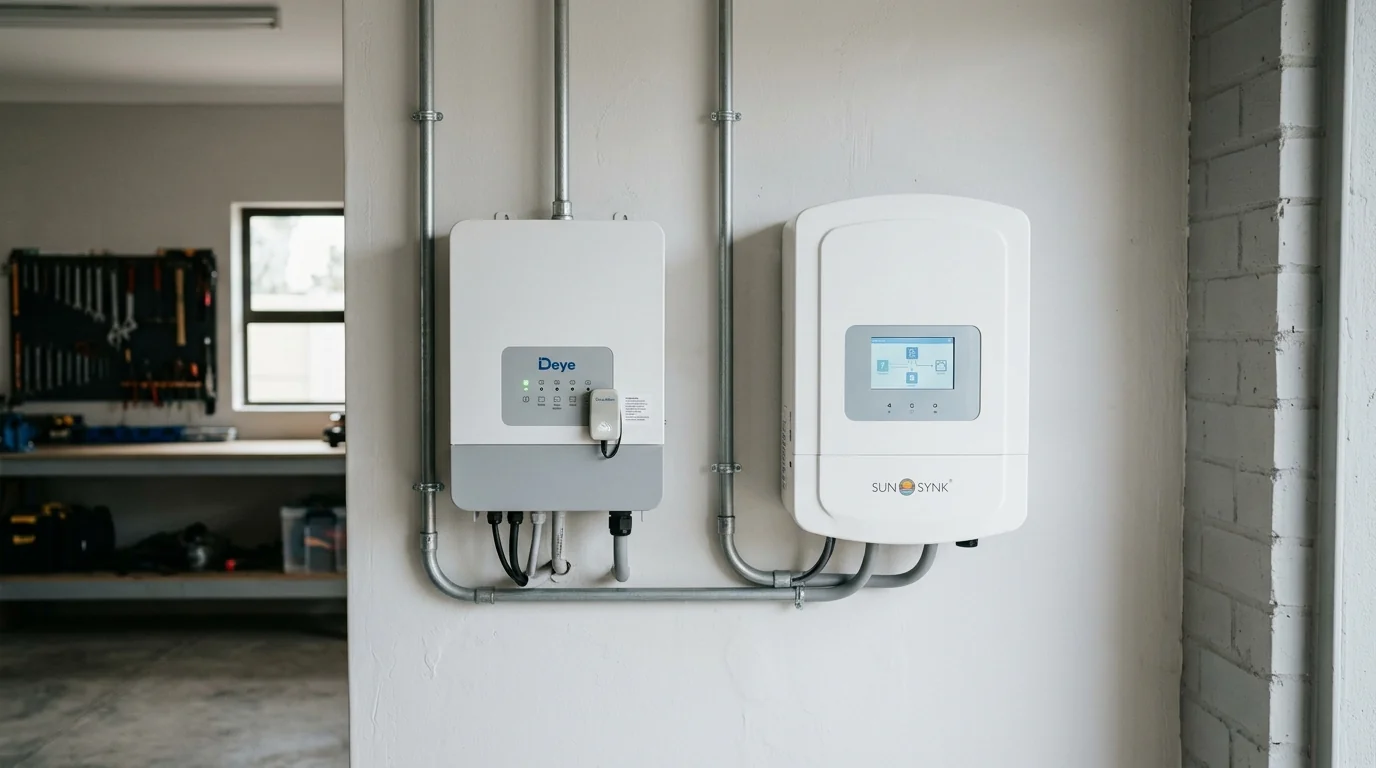
Deye (left) and Sunsynk (right) side by side - same hybrid platform, different monitoring interfaces. Both require an indoor, ventilated, CoC-compliant installation to keep the warranty valid.
The practical takeaway: with either brand, your installer is your real warranty channel. A claim runs through the distributor and the installer who registered the system, not a call centre in China, so choosing an installer who will still be around - and who reads the exact model's current warranty document with you before you sign - matters more than the five-versus-ten-year headline. You can see each brand's full model line-up, current pricing and warranty on the Deye brand page and the Sunsynk brand page.
Which should you choose if...
Because the hardware is the same, the decision comes down to your situation, not a spec sheet. Here is the plain version, updated October 2026.
Choose Deye if...
- •Budget leads, or the system is large enough that the 15-20% saving funds more battery.
- •Your installer is experienced on Deye and has a solid relationship with a reputable distributor.
- •You are pairing it with a Deye or a third-party battery (Pylontech, Dyness, Hubble) and the app is not your priority.
- •You are comfortable adding SolarAssistant later if you want better monitoring.
Choose Sunsynk if...
- •You want the clean path to a 10-year warranty by pairing it with a Sunsynk battery.
- •The polished Sunsynk Connect app and the on-device touch screen matter to you.
- •Your installer is Sunsynk-certified and the local support network gives you peace of mind.
- •The premium is small against the total system cost and you would rather not tinker.
The tie-breaker. If you are genuinely undecided, let the battery and the installer decide. A single-brand Sunsynk inverter-plus-battery build is the simplest warranty story; a Deye build banks the saving. Either way, get a written quote for both and compare the real installed numbers - the pick-for-me tool above sends you both.
When is neither Deye nor Sunsynk the right answer?
For a straightforward grid-tied or hybrid home system, Deye and Sunsynk are the sensible default. But they are not always the best fit, and it is worth being honest about the cases where another brand earns its higher price:
- True off-grid, farms and lodges: Victron is the long-standing choice for properties with no reliable grid. Its modular architecture, VRM monitoring and reputation for surviving harsh conditions are what you pay the premium for.
- Tight budget, simpler backup: Luxpower often undercuts even Deye and has solid local distribution, at the cost of a more basic app - a reasonable trade if price is the deciding factor.
- Complex or three-phase installs: where an installer is more experienced or better stocked on another brand, that experience can matter more than the badge, because a well-installed inverter of any of these brands beats a poorly-installed "better" one.
If that sounds like your situation, compare the full range - including Victron and Luxpower - on our solar inverters page, or read the sibling comparisons: Sungrow vs Deye, Victron vs Deye and GoodWe vs Deye. For the full shortlist, see our best solar inverters in South Africa guide.
Want quotes for Deye and Sunsynk?
Get three free quotes from local installers and compare the installed price, warranty and app side by side. Free, no obligation.
Frequently asked questions
Which is better, Sunsynk or Deye?
Neither is better across the board, because they share the same core hardware. Deye is about 15-20% cheaper. Sunsynk has the more polished Connect app and a clean path to a 10-year warranty when you pair it with a Sunsynk battery. If price leads, choose Deye; if you want a single-brand warranty and the better app, choose Sunsynk. On both brands the installer behind the system matters more than the badge.
Is Deye the same as Sunsynk?
Largely, yes. Ningbo Deye Inverter Technology Co. (Shanghai-listed, 605117.SH) manufactures both Deye and Sunsynk hybrid inverters in the same China factory. Sunsynk is a rebrand with its own firmware, screen, app and warranty structure, but the power boards, switching electronics and battery compatibility are the same platform.
Which is cheaper, Deye or Sunsynk?
Deye. Across 5kW and 8kW units Deye typically runs about R3,000 to R7,000 less than the equivalent Sunsynk, roughly a 15-20% saving (Smart Tech Distributors and SolarSmartAdvisor, 2026). On a 5kW unit SolarSmartAdvisor quotes a Sunsynk at R18,000-R28,000 against a Deye SUN-5K at R13,000-R20,000.
Which inverter has better monitoring and app support?
Sunsynk Connect is the more polished app and comes with Sunsynk inverters. Deye ships with SolarMan, which is more basic. Both are cloud apps. If you want local, cloud-independent monitoring with automation, SolarAssistant runs on your own Raspberry Pi and supports both brands plus Victron, Growatt, Luxpower and others, with native Home Assistant and MQTT integration (solar-assistant.io).
Which has a better warranty, Deye or Sunsynk?
Both start at a 5-year standard warranty that reaches 10 years, but the path differs. Sunsynk extends to 10 years when the inverter is installed with a Sunsynk battery and registered by an accredited installer with a Certificate of Compliance. Deye’s 10-year cover is issued by the South African distributor you buy through, on registration and a compliant SANS 10142 install, so it is only as strong as that distributor. Read the specific model’s warranty document before you buy (checked October 2026).
How fast do Deye and Sunsynk switch over during load shedding?
Both are rated at about 5 ms typical and a maximum of 10 ms to switch from grid to battery, because they run the same platform (JC Solar Panels changeover table, 2026). That is fast enough to keep lights, Wi-Fi and most electronics running through a trip without a visible flicker. Desktop PCs and some sensitive gear may still want a small UPS.
Are Deye inverters good quality?
Deye is a Shanghai-listed manufacturer (605117.SH) and has been the leading hybrid inverter brand in South Africa since 2020, so the hardware is well proven here. Because Deye also builds Sunsynk, the two share the same core engineering. The real quality variable with Deye is the distributor and installer behind it, because your warranty and support run through whoever you buy from.
Are Deye and Sunsynk inverters compatible with all batteries in South Africa?
Both support 48V lithium batteries over CAN bus and RS485, which covers the major South African brands including Pylontech, Hubble, Dyness, Freedom Won, BSL, BYD and the brands’ own batteries. Always check the inverter’s current approved-battery list for your exact model, because firmware updates add and occasionally change supported packs.
Which solar inverter is the best in South Africa?
There is no single best inverter for everyone. For a residential hybrid system, Sunsynk and Deye are the default pair: Sunsynk for the app, support network and battery-linked 10-year warranty, Deye for the same hardware at a lower price. For true off-grid, farms and lodges, Victron is often the better fit; on a tight budget, Luxpower undercuts both. Match the inverter to your priorities and your installer, not to a ranking.
Can you run a hybrid inverter 24 hours a day?
Yes. Deye and Sunsynk hybrid inverters are built to run continuously, switching between solar, battery and grid automatically. What matters is sizing the inverter for your continuous load and mounting it indoors in a cool, ventilated space, because sustained heat is the main thing that shortens an inverter’s life.
See all solar inverter prices in South Africa
Compare every solar inverter available in South Africa - Deye, Sunsynk, Sigenergy, Victron and more - with real ZAR pricing and EnergyBee ratings.
See all inverter prices →