Something quietly changed the way South Africans buy solar this winter. For years, going solar meant booking site visits, waiting on custom quotes, and squinting at three spec sheets that all listed different brands. In 2026, a fast-growing share of homeowners are skipping that entirely - and buying a complete, pre-matched solar kit off the shelf instead.
Two things pushed them there. Municipal electricity jumped around 9% on 1 July 2026 for millions of metro customers, on top of the 8.76% Eskom increase in April - and the price of the panels and batteries inside a solar system has fallen to record lows. The result is a sweet spot: the grid has never been more expensive, and a full solar kit has never been cheaper. So people want the fastest, clearest route in - one box, one price, one system that's already been designed to work together.
Here's exactly what those kits contain in 2026, what a 3kW, 5kW and 8kW setup really costs, and how to make sure the "bargain" you're eyeing isn't just a pile of mismatched parts.
What a "complete" solar kit actually includes
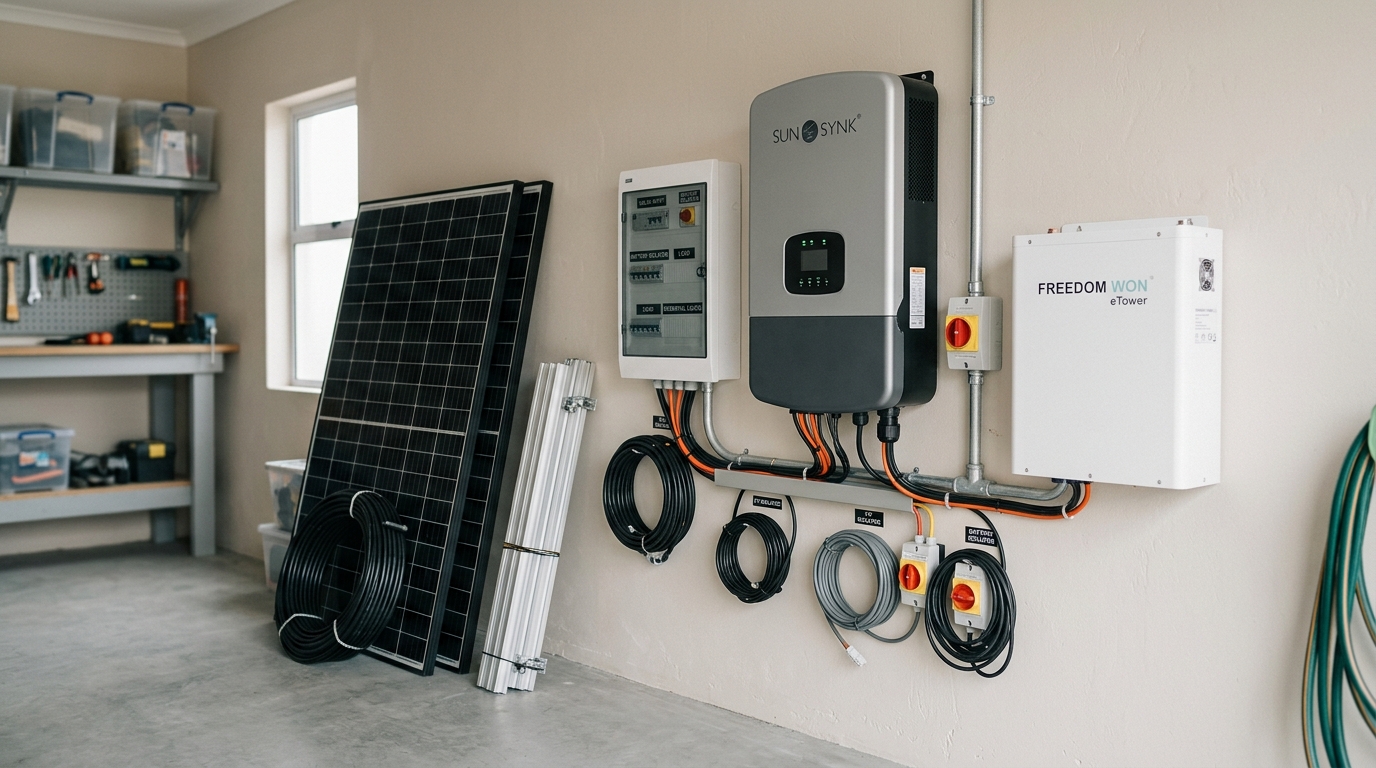
The word complete gets abused. A real complete kit is four matched parts, not a pallet of panels with the expensive bits sold separately:
- Solar panels - typically 450W to 620W mono PERC or TOPCon modules from a brand like JA Solar, Canadian Solar, Jinko or SA-made ARTsolar.
- A hybrid inverter - the brain of the system, sized to the kit. In South Africa that overwhelmingly means Sunsynk, Deye or GoodWe.
- At least one lithium (LiFePO4) battery - Freedom Won, Hubble, Dyness or Pylontech are the usual suspects, so your daytime surplus carries you through the evening peak.
- The balance-of-system - mounting rails, DC and AC isolators, cabling, breakers and connectors. Unglamorous, but it's what makes the install safe and compliant.