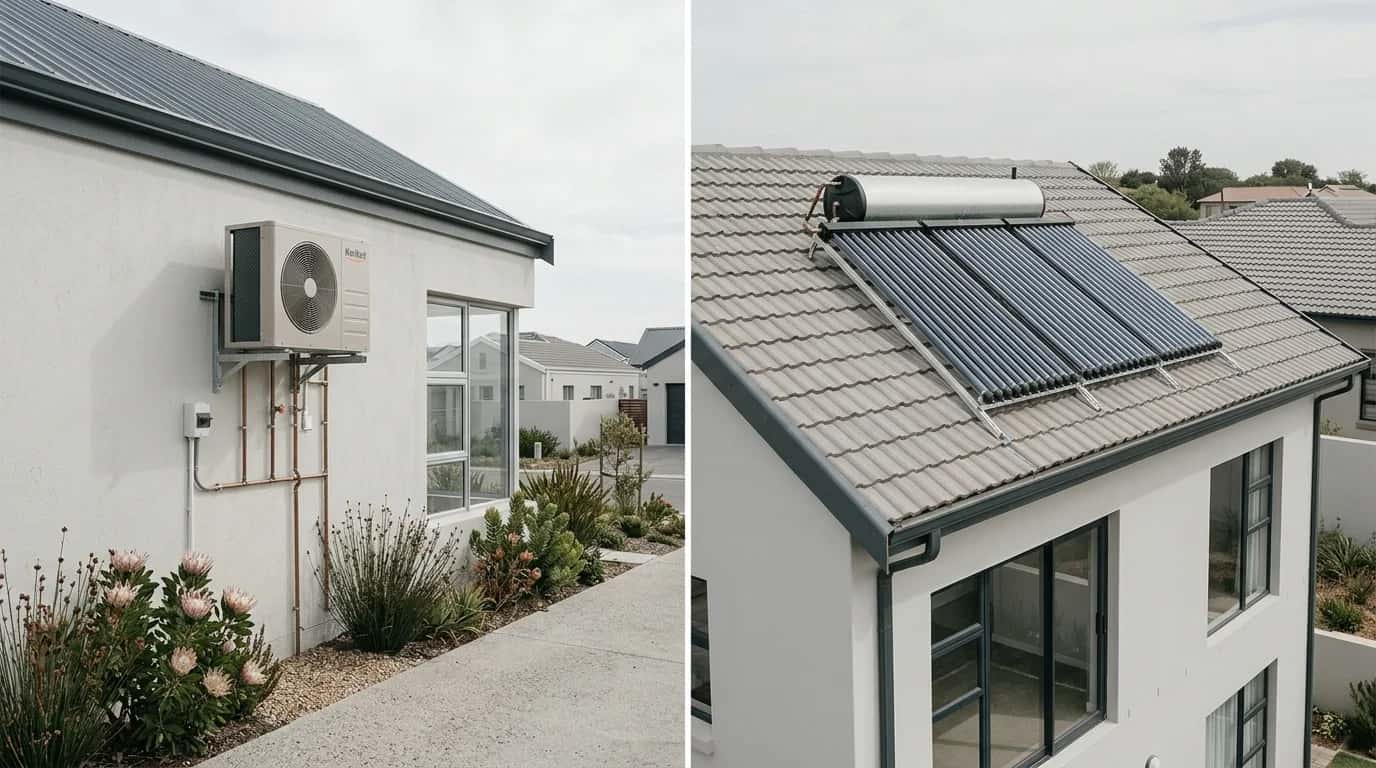
A heat pump geyser is the single biggest lever most South African homes have to cut their electricity bill, because water heating accounts for about 35% of household electricity spend. Swapping a conventional electric geyser for a heat pump geyser (also called a geyser heat pump) typically cuts that slice by about 60% - roughly 21% off a typical total electricity bill. This 2026 guide covers how a heat pump geyser works, real running costs and payback vs an electric geyser, and whether it is worth it for your home. Already decided? Jump straight to real heat pump geyser prices by size and brand.
As of November 2026, a heat pump geyser costs R27,500-R48,000 installed in South Africa vs R8,000-R15,000 for a conventional electric geyser, and cuts the water-heating slice of your bill - about 35% of total electricity spend - by roughly 60%, or about 21% off the whole bill.
Already leaning heat pump? Get your exact installed price.
free, no-obligation quotes, priced off your actual electricity bill.
Quick Verdict: Heat Pump vs Geyser
Heat Pump Wins
- • Running Cost: R200-R350/month
- • Efficiency: 200-400% (COP 2-4)
- • Savings: ~60% off water heating
- • Payback: depends on your bill & installed price
- • Lifespan: 10-15 years
Electric Geyser
- • Running Cost: R850-R1,100/month
- • Efficiency: 90-95% (direct heating)
- • Savings: R0 (baseline cost)
- • Upfront: R8,000-R15,000 installed
- • Lifespan: 8-12 years
Bottom Line: Heat pumps cost more upfront (R27,500-R48,000 installed vs R8,000-R15,000) but cut water-heating electricity by about 60% for the unit's 10-15 year life. How long that takes to pay back is a function of your tariff, your hot-water use and the installed price you are quoted - it is not a number we can put on a page for everyone. For most SA homes, heat pumps are the clear winner unless you have solar panels heating an electric geyser during the day.
Get a heat pump geyser quote - Gauteng installers
Installers across Johannesburg, Pretoria and the East & West Rand. Tell us your geyser size and suburb and we'll come back with an installed heat pump geyser price - free, no obligation.
Heat Pump vs Geyser: How Each Works
How an Electric Geyser Works
A traditional electric geyser (also called an electric water heater) uses electrical resistance elements to directly heat water:
- Heating element: 2-4kW electrical element submerged in water tank
- Direct conversion: Electricity → heat (1:1 conversion)
- Thermostat control: Heats water to 60-65°C, maintains temperature
- Standing losses: Tank loses heat overnight, requires reheating
- Energy consumption: 3-6 kWh per day for typical 150-200L tank
Electric Geyser Energy Use
For every 1 kWh of electricity consumed, an electric geyser delivers ~0.9-0.95 kWh of heating (5-10% losses). While this seems efficient, it's still direct electrical heating-the most expensive form of water heating there is: every unit of heat costs you a full unit of electricity.
How a Heat Pump Works
A heat pump water heater doesn't generate heat-it moves heat from outside air into your water:
- Evaporator: Refrigerant absorbs heat from outdoor air (works even at 5°C)
- Compressor: Compresses refrigerant, raising its temperature to 60-70°C
- Heat exchanger: Hot refrigerant transfers heat to water in tank
- Expansion valve: Refrigerant cools down, cycle repeats
- Energy consumption: 0.8-1.5 kWh per day for same 150-200L tank
Heat Pump Efficiency (COP)
Heat pumps have a Coefficient of Performance (COP) of 2-4, meaning:
- COP 2: For every 1 kWh electricity used → 2 kWh of heating delivered
- COP 3: 1 kWh electricity → 3 kWh heating (most common)
- COP 4: 1 kWh electricity → 4 kWh heating (optimal conditions)
This "free" extra heating comes from the ambient air, making heat pumps 2-4x more efficient than electric geysers.
Source: The COP figures are the published per-brand bands from our heat pump geyser prices guide - 2.8 - 4.5 across the brands we price, which is where the 200-400% efficiency figure and the 60% running-cost cut both come from. An element geyser converts electricity to heat about 1:1, so its 90-95% is the standing and delivery loss, not a coefficient.
Heat pump, solar geyser, or stick with electric?
Compare heat pump, solar-geyser and electric options for your home and see the fully installed price for each.
Cost Comparison: Heat Pump vs Electric Geyser
Upfront Cost Comparison
Electric Geyser, installed
R8,000-R15,000
Heat Pump Geyser, installed
R27,500-R48,000
A typical 200L unit for a 4-person home: R28,000-R38,000
Source: Both figures are published in our heat pump geyser prices guide, by size and brand, supplied-and-installed. We do not break these down into unit, labour and COC line items, because we have no sourced split to publish.
Winner (Upfront Cost): the electric geyser, by roughly R20,000-R30,000. That is the whole of its advantage, it is a one-off, and it is the wrong way to evaluate water heating on its own - what follows is what the gap buys back.
Running Cost Comparison (Monthly)
Typical SA Household (4 people, 200L tank)
Electric Geyser
- • Daily consumption: 4-6 kWh
- • Monthly consumption: 120-180 kWh
- • Published running cost: R850-R1,100/month
Heat Pump (COP 3)
- • Daily consumption: 1.3-2.0 kWh (3x more efficient)
- • Monthly consumption: 40-60 kWh
- • Published running cost: R200-R350/month
Monthly Savings with Heat Pump
About 60% off water heating
Water heating is around 35% of a typical household electricity bill, so that is roughly 21% off the whole bill. The rand figure depends on your tariff and your household's hot-water use.
Source: Water heating is 35% of household electricity spend - published at 39-50% by the City of Cape Town's Water Heating FAQs and by SESSA, and we publish the figure below the floor of that range. A heat pump cuts the water-heating portion by 60%: the published range is 50-70%, and a Coefficient of Performance of 3 - the conservative South African annual figure, and the COP band the heat pump geyser prices guide lists per brand - gives 66%. 60% × 35% = 21% of a total bill. We publish no Rand saving, because a Rand saving depends on your tariff and your household's hot-water use, and one number would be wrong for almost everyone reading it.
Winner (Running Cost): The heat pump takes about 60% off water-heating electricity, every month, for 10-15 years. This is where heat pumps become unbeatable.
Retrofit or new heat pump: what would yours cost?
Three taps, no contact details.
Your bill band decides the saving — get a priced quote in 60 seconds.
Homes on R5,000+ monthly bills see the fastest payback. See your number.
Payback Period Analysis
Payback is the extra upfront cost divided by what you actually save each month. The first number comes off a real installed quote; the second comes off your own bill. Here is how the arithmetic works with the typical installed prices above - put your own figures in and you get your own answer, not an average:
Payback Calculation
Payback Period:
Your bill decides
Extra upfront cost ÷ (your water-heating spend × 60%) = months to pay back
Two households with the same heat pump get very different answers here, because they do not spend the same on hot water. A big family on a high tariff pays it back quickly; a couple who shower at the gym may never pay it back at all. That is why we run the sum against your actual bill rather than printing an average.
Source: Installed prices are the published figures from our heat pump geyser prices guide - R8,000-R15,000 for an electric geyser, R28,000-R38,000 for a typical 200L heat pump, a gap of R20,000-R30,000. We do not publish a payback in years: the sum needs your water-heating spend, which is not a number we have.
Efficiency Comparison: Heat Pump vs Geyser
| Factor | Electric Geyser | Heat Pump |
|---|---|---|
| Energy Efficiency | 90-95% (direct heating) | 200-400% (COP 2-4) |
| kWh per 100L Hot Water | 5-6 kWh | 1.5-2.5 kWh |
| Standing Heat Losses | 1-2 kWh/day (poor insulation) | 0.5-1 kWh/day (better insulated) |
| Works in Cold Weather? | Yes (any temperature) | Yes (down to -5°C) |
| Works in Rain/Clouds? | Yes | Yes |
| Recovery Time (150L) | 2-3 hours | 4-6 hours (slower but constant) |
Efficiency Winner: Heat Pump
Heat pumps are 2-4x more energy efficient than electric geysers. The only "advantage" electric geysers have is faster recovery time-but this comes at 3x the running cost. For most households, the slower recovery is a non-issue if the heat pump is properly sized.
When to Choose Electric Geyser Over Heat Pump
Despite heat pumps being superior for most homes, there are situations where an electric geyser makes sense:
You Have Solar Panels
If you have a solar power system, running an electric geyser during peak sun hours (10am-3pm) is essentially free. In this case, keep the electric geyser and use a geyser timer to heat only when solar is generating. Heat pumps don't provide additional benefit if you already have "free" solar power.
Very Low Hot Water Usage
A percentage saving on a small bill is a small saving. If you live alone or rarely use hot water (1-2 showers per week), your water-heating spend is a small part of an already small bill - taking 60% off it will not justify the R20,000-R30,000 extra for a heat pump.
Renting Short-Term
If you're renting and will move within 2-3 years, you won't recoup the heat pump investment. Stick with electric geyser unless your landlord will install a heat pump.
Budget Constraints
If you need to replace a broken geyser immediately and can't afford or finance the R28,000-R38,000 a typical heat pump costs installed, an electric geyser at R8,000-R15,000 gets you hot water quickly. You can upgrade to heat pump later when finances allow.
Total Cost of Ownership: What Actually Decides It
Over the life of the unit there are only three numbers that matter, and two of them are yours rather than ours: the installed price you are quoted, what you currently spend heating water, and the share a heat pump takes off that spend.
The first is published - see the heat pump geyser prices guide for installed prices by size and brand. The third is about 60%, and the basis for that is below. The second is on your Eskom bill, and it is the reason we will not print a ten-year total here: change the tariff or the household and every figure in such a table moves, which makes a single published total wrong for almost everyone who reads it.
Financing changes the shape rather than the answer: a loan turns the upfront gap into a monthly payment, and whether the saving covers that payment depends on your bill and your rate. Worth checking against your own numbers before you sign anything.
Source: Water heating is 35% of household electricity spend - published at 39-50% by the City of Cape Town's Water Heating FAQs and by SESSA, and we publish the figure below the floor of that range. A heat pump cuts the water-heating portion by 60%: the published range is 50-70%, and a Coefficient of Performance of 3 - the conservative South African annual figure, and the COP band the heat pump geyser prices guide lists per brand - gives 66%. 60% × 35% = 21% of a total bill. We publish no Rand saving, because a Rand saving depends on your tariff and your household's hot-water use, and one number would be wrong for almost everyone reading it.
Heat Pump vs Geyser: Other Considerations
Noise Levels
- Electric Geyser: Silent operation (no moving parts)
- Heat Pump: 40-55 dB noise from outdoor compressor unit (similar to fridge hum). Can be an issue if installed near bedroom windows. Mitigate with proper placement away from bedrooms.
Space Requirements
- Electric Geyser: Compact, fits in ceiling/cupboard, no outdoor space needed
- Heat Pump: Requires outdoor space for compressor unit (1m × 0.5m) plus indoor tank. Not suitable for apartments without balcony/outdoor access.
Installation Complexity
- Electric Geyser: Simple 1-2 hour installation, any plumber can do it
- Heat Pump: More complex (4-6 hours), requires refrigeration-certified installer plus plumber. Make sure installer is qualified.
Climate Suitability
- Electric Geyser: Works in all climates equally well
- Heat Pump: Works in all SA climates, but efficiency drops in very cold areas (Drakensberg, Sutherland). COP drops to 2-2.5 in winter vs 3-4 in summer. Still saves money, just less. In extreme cold (<0°C), may need backup electric element.
Best Heat Pump Brands in South Africa
If you've decided on a heat pump, these are the top brands:
- Midea: R27,500 - R34,500 installed, COP 3.5 - 4.0 - tightest budget, coastal/mild climates
- ITS: R25,000 - R32,000 installed, COP 4.0 - 4.5 - highest COP, cold Highveld winters (to −7°C)
- Megaflow: R25,000 - R34,000 installed, COP 2.8 - 3.2 - lowest premium-tier price, warmer regions
Source: Prices and COP above are from our heat pump geyser prices guide. See the full brand table there for the complete breakdown.
Read our complete heat pump buying guide →
See full heat pump geyser prices by size & brand (installed) →
What About Solar Geysers?
Solar geysers are a separate category with a different value proposition - best suited to homeowners with north-facing roof space who want the lowest long-term running costs. If you're deciding between a solar geyser and a heat pump (rather than a standard electric geyser), read our dedicated solar geyser comparison guide for a full breakdown of which suits your home.
Cut the Whole Bill, Not Just the Geyser
Water heating is the biggest single line on a South African electricity bill - but it is still only one line. Pairing it with a home solar system attacks the rest of the bill too: see the combined monthly saving for your home.
Still comparing heat pump, solar geyser and electric?
Compare all three water-heating options for your home and get an installed quote. Free, no obligation.
Frequently Asked Questions
Is a heat pump geyser worth it in South Africa?
Yes - for most South African homes. A heat pump geyser uses 3-4 times less electricity than a conventional electric geyser, cutting the water-heating part of your bill by about 60% - around 21% of a typical household electricity bill. It costs more upfront (R27,500-R48,000 installed vs R8,000-R15,000 for an electric geyser), so how quickly that pays back depends on your tariff, how much hot water your household uses and the installed price you are quoted. The unit lasts 10-15 years.
How does a heat pump geyser work?
A heat pump geyser does not generate heat directly - it moves heat from the surrounding air into your water tank using a refrigeration cycle, much like an air conditioner working in reverse. Because it moves heat rather than creating it, it delivers 2-4 kWh of heating for every 1 kWh of electricity (a COP of 2-4), making it far cheaper to run than a standard element geyser.
What size heat pump do I need for a 200L geyser?
A 200L geyser generally pairs with a 3.5-4.5 kW heat pump for a typical 4-person household. As a guide: a 150L tank needs roughly 2.5-3.5 kW, a 200L tank 3.5-4.5 kW, and a 250-300L tank 4.5-5.5 kW. Correct sizing keeps recovery time reasonable while maximising efficiency.
Is a heat pump geyser cheaper to run than a normal geyser?
Yes, substantially. Because it moves heat rather than generating it, a heat pump geyser uses roughly a third of the electricity an element geyser needs for the same hot water - about 60% off the water-heating part of your bill, which is around 21% of a typical household electricity bill. What that is worth in rands depends entirely on your tariff and your hot-water use, so we work it out against your actual bill rather than quoting an average.
How much does a heat pump geyser cost vs an electric geyser?
A heat pump geyser costs R27,500-R48,000 installed depending on size and brand, versus R8,000-R15,000 for an electric geyser - typically a R20,000-R30,000 difference. See our full breakdown of heat pump geyser prices by size and brand for exact installed figures.
Do heat pump geysers work in cold weather and during load shedding?
Heat pump geysers work in all South African climates, even down to about -5°C, though efficiency (COP) drops from 3-4 in summer to 2-2.5 in mid-winter - you still save, just a little less. Like any electric appliance they need power to run, so they will not heat during load shedding without backup, but their efficiency lets them pre-heat the tank before a scheduled outage.
Should I keep my electric geyser if I have solar panels?
Yes, if you have solar panels, keep your electric geyser and use a geyser timer to heat water during peak sun hours (10am-3pm). This gives you essentially free hot water. Heat pumps don't provide additional benefit when you already have free solar electricity. Save your money for more solar panels or batteries instead.
Are heat pump geysers noisy?
Heat pump geysers produce 40-55 dB noise from the outdoor compressor unit (similar to a refrigerator hum). Electric geysers are silent. The noise can be an issue if installed near bedroom windows. Mitigate by installing the compressor away from bedrooms, ideally on the opposite side of the house or in a utility area.
Can I install a heat pump geyser in an apartment?
Only if you have outdoor space for the compressor unit (balcony, patio, or allocated outdoor area). Heat pump geysers require about 1m × 0.5m of outdoor space with good airflow. If you don't have outdoor access, stick with an electric geyser or consider an instant gas geyser if gas is available.
Why is my electricity bill still high after installing a heat pump?
A handful of things commonly explain this, and none of them mean the heat pump is faulty. First, check the obvious: is the old electric geyser's backup element still switched on and heating in parallel? Second, winter cuts COP from 3-4 in summer to 2-2.5 in mid-winter (see the Climate Suitability section above) - you still save, just less, and a cold snap can make a single month's bill look disappointing against a summer baseline. Third, a heat pump undersized for the household (see "What size heat pump do I need for a 200L geyser?" above) runs longer to hit temperature, narrowing the gap. And finally, remember the 60% saving is on the water-heating slice of the bill, which is about 35% of the total - if other usage went up (more people home, a new appliance, higher tariff), the whole bill can rise even while the geyser line itself is doing its job.
What are the disadvantages of a heat pump water heater?
Three real ones, all covered above: it costs R20,000-R30,000 more upfront than an electric geyser; the outdoor compressor unit makes 40-55 dB of noise (similar to a fridge hum) and needs about 1m × 0.5m of outdoor space, so it doesn't suit most apartments; and installation takes longer (4-6 hours vs 1-2) because it needs a refrigeration-certified installer as well as a plumber. None of these make it the wrong choice for most homes - they are the trade-offs the Quick Verdict and the "When to Choose Electric Geyser" section above already weigh against the running-cost saving.
Ready to Switch to a Heat Pump?
A heat pump cuts water-heating electricity by about 60% - roughly 21% off a typical total electricity bill. Tell us what you pay now and which geyser you have. We send you an installed price and what it saves against your own numbers, then introduce you to the installer.
Final Verdict: Heat Pump vs Electric Geyser
Winner: Heat Pump, for most homes
Unless you have solar panels, very low hot water usage, or are renting short-term, a heat pump is the better buy for most households. The extra upfront cost is a one-off; the roughly 60% cut in water-heating electricity repeats every month for the unit's 10-15 year life.
On a bill where water heating is a real line item, it is one of the best investments you can make in your home - and the only honest way to know how long it takes to pay back is to run it against your own bill and a real installed price.
Stick with Electric Geyser If:
- You have solar panels (heat geyser during peak sun hours with timer)
- Very low hot water usage (live alone, rarely shower)
- Renting and moving within 2-3 years
- Apartment with no outdoor space for heat pump unit
- Budget constraints require cheapest option NOW
For the vast majority of South African homeowners, switching from electric geyser to heat pump is a no-brainer decision that will save thousands over the years while reducing your carbon footprint.
Related Guides:
- What Is a Heat Pump? How It Works →
- Heat Pump Geyser Prices South Africa 2026: Cost by Size & Brand →
- Geyser Prices South Africa 2026: All Types Compared →
- Complete Heat Pump Buying Guide →
- Solar Geyser Comparison Guide →
- Load Shedding Solutions & Backup Power →
- Financing Options for Energy Upgrades →
- Compare All Heat Pump Geysers South Africa 2026: Prices, Reviews & Ratings
- Kwikot Heat Pump Review South Africa 2026: Complete Model Range, Performance & Price Guide
- Geyser Buying Guide South Africa 2026: How to Choose the Right Water Heater for Your Home
- 150L vs 200L vs 250L Geyser Size Comparison South Africa 2026: Which Capacity is Right for Your Home?
- Kwikot 150L Electric Geyser Review South Africa 2026: Complete Model Range, Specifications & Price Guide