Quick answer
What are solar geyser prices in South Africa? (2026)
Solar geyser prices in South Africa run R22,500-R42,500 fully installed for the 100L-200L systems most households buy. A 100L system starts at R22,500; a 200L for a family of four is R29,500-R42,500; a 300L split system runs R32,000-R50,000. Tank, collectors, mounting, labour, plumbing and the CoC are all included.
| Solar geyser (by size) | Installed price |
|---|---|
| 100L (1-2 people) | R22,500 - R29,500 |
| 150L (2-3 people) | R25,500 - R34,500 |
| 200L (family of 4) | R29,500 - R42,500 |
| 300L (5+ people) | R32,000 - R50,000 |
Installed solar geyser price, South Africa 2026
Updated 19 November 2026. The ranges above and the brand and size table below are built from EnergyBee installer-panel quotes, checked 27 October 2026; the supply-only retail figures further down were checked against PriceCheck and Unlimited Solar listings on 20 October 2026.
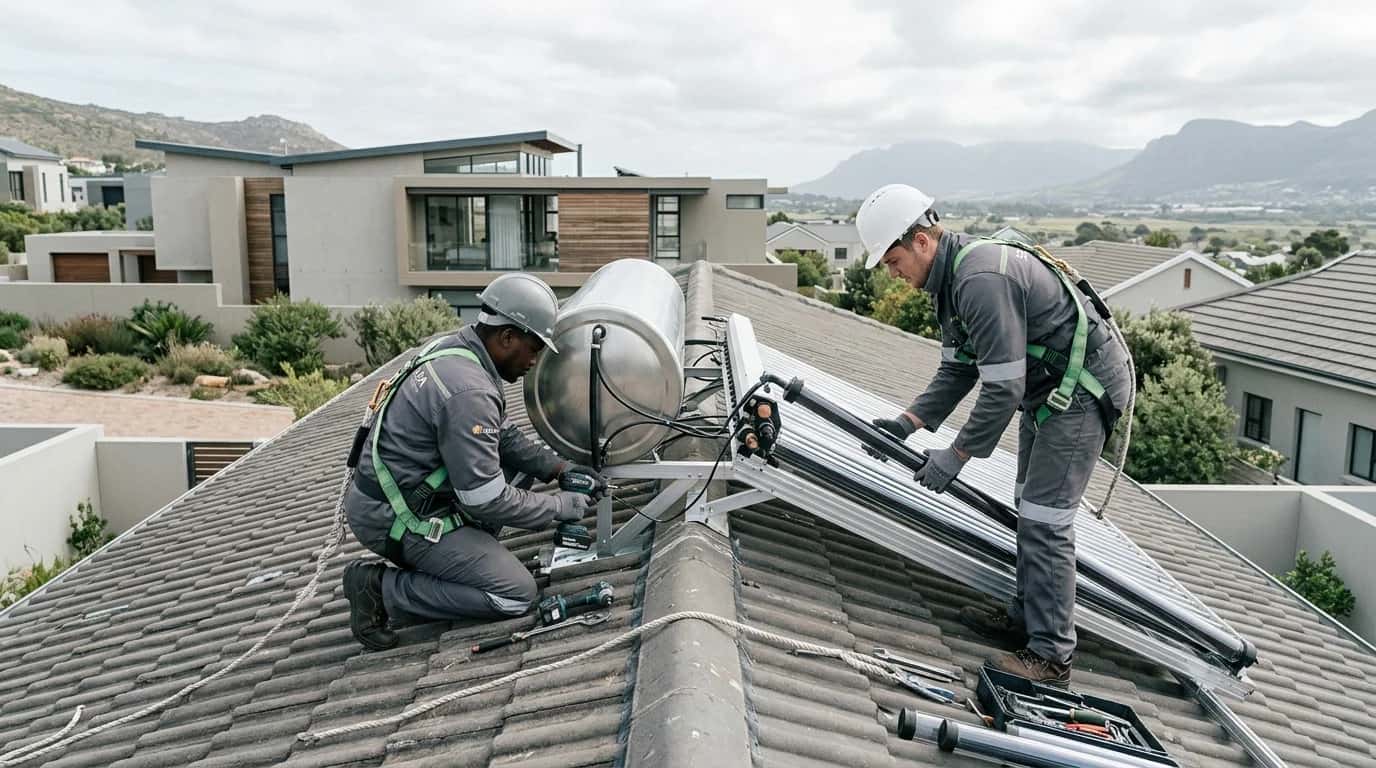
The most recent solar geyser job I can give you a real number for was a 150-litre retrofit with evacuated tubes in Johannesburg. The whole installation, timer included, came to about R26,500, and it's performing really well. Johannesburg suits a solar geyser: plenty of sun in summer, and a really good amount of sunshine through winter too.
I live in Cape Town, and I probably wouldn't put a solar geyser on my own house here. I do have one, an old evacuated-tube system, but if I had to choose one thing on the coast, I'd choose a heat pump. I've lived in two homes with one, and the saving is very noticeable.
So this page gives you the prices, and then where I'd put a solar geyser and where I wouldn't. - Neil Berrow
Solar geyser prices at a glance
- 1. 100L (1-2 people): R22,500 - R29,500 installed
- 2. 150L (2-3 people): R25,500 - R34,500 installed
- 3. 200L (family of 4): R29,500 - R42,500 installed
- 4. 300L (5+ people): R32,000 - R50,000 installed
- 5. Supply only (150L tank + collectors): R13,400 - R19,900 before install
- 6. Running cost: R100 - R250/month on the backup element (vs R900 - R1,400 electric)
Shopping by size? The 150L geyser prices and 200L geyser price guide compare electric, gas, solar and heat pump at that one size. Weighing solar against gas? Read the solar vs gas geyser comparison.
A solar geyser is only ever bought installed. The number that matters is the all-in one: tank, collectors, mounting, labour, plumbing and the mandatory CoC. If a retailer price looks far lower, it is supply only - a 150L tank and collectors list at about R13,400-R19,900 (PriceCheck and Unlimited Solar, checked 20 October 2026) before the R4,000-R9,000 of fitting that turns a box on a pallet into hot water. The spread runs even wider on the shelf: a complete 100L-200L unit, still supply only, was listed from R14,999 on promotion at Carrim Online up to R19,879 excl. VAT at ACDC Dynamics (checked 29 October 2026) - neither price includes mounting, plumbing, labour or the CoC. This guide prices all four common sizes across the brands South African installers actually fit, shows what moves the figure in your quote, and gives you the line items to audit any quote you are handed.
How much does it cost for a solar hot water system?
A solar hot water system costs R22,500-R50,000 installed in South Africa in 2026, and the size of the tank is what sets the figure. Here is the installed range for each size, what that price buys, and the household it suits.
| Size | Installed price (2026) | What is included | Household |
|---|---|---|---|
| 100L | R22,500 - R29,500 | Tank, one flat-plate collector, thermosiphon loop, mounting, labour, plumbing, CoC | 1-2 people |
| 150L | R25,500 - R34,500 | Tank, one or two collectors (or 15-20 tubes), mounting, labour, plumbing, CoC | 2-3 people |
| 200L | R29,500 - R42,500 | Tank, two collectors (or 20-30 tubes), mounting, labour, plumbing, CoC | Family of 4 |
| 300L | R32,000 - R50,000 | Split system: indoor tank, collectors, pump station, mounting, labour, plumbing, CoC | 5+ people |
Installed ranges across certified installers, VAT included, checked 27 October 2026. 300L figures assume a split-pump system. Three things move the figure inside each range: system type (thermosiphon costs less; a split pump system costs more but suits more roofs), collector type (evacuated tubes cost more than flat plate) and roof complexity (a single-storey tiled roof is the cheapest job; double storey, IBR sheeting or a flat concrete roof add labour).
Pick your size - see the solar geyser installed price now.
fitted by a partner installer
Free, no obligation - supply and installation included.
Replacing an electric geyser like for like? free, no-obligation quotes below. Want a heat pump instead? See the heat pump bundle price now.
What are solar geyser prices by brand and size?
Across the four brands South African installers fit most, a 150L-200L solar geyser costs R25,500-R42,500 installed, with Apollo the cheapest way in and Kwikot the dearest. These are installed prices - supply plus labour, plumbing and CoC - at 2026 market rates, VAT included.
| Brand | 100L Installed | 150L Installed | 200L Installed | 300L Installed |
|---|---|---|---|---|
| Kwikot | R25,500-R29,500 | R28,500-R34,500 | R32,500-R40,500 | R38,000-R50,000 |
| SunCity | R23,500-R27,500 | R26,500-R32,500 | R30,500-R38,500 | R34,000-R46,000 |
| Solsquare | R24,500-R28,500 | R27,500-R33,500 | R31,500-R39,500 | R36,000-R48,000 |
| Apollo | R22,500-R26,500 | R25,500-R31,500 | R29,500-R37,500 | R32,000-R44,000 |
* Ranges across certified installers, checked 27 October 2026. 300L figures assume a split-pump system. Your quote moves with roof type, plumbing runs and location. Always ask for an itemised quote.
Know your size? See the actual systems.
Every solar geyser we price in South Africa - Kwikot, SolarBeam, Solsquare, Geyserwise and Apollo - with specs, warranties and installed pricing per model. Jump straight to the 100L thermosiphon, the 150L thermosiphon or the family-size 200L thermosiphon.
Answer two questions for your price
Tell us how many people use the hot water and whether you want a new solar tank or a retrofit. We match it to a system size and its installed range from the tables on this page - no email needed to see it.
When I'd recommend a solar geyser, and when I wouldn't
My rule is simple. If you're not planning on solar panels, my first option is a PV geyser optimiser. If you are planning on solar and you live in the northern part of South Africa, I'd go for a solar geyser. In the south, I'd go for a heat pump. Here's how I get there.
| Your situation | What I'd pick | Why |
|---|---|---|
| No plans for solar panels, or a small home | PV geyser optimiser | A lot cheaper than a solar geyser, no pump, no glass tubes, robust panels |
| Planning solar, northern South Africa (Johannesburg, for example) | Solar geyser, evacuated tubes | Strong sun all year, and a simple system with few moving parts |
| Coastal or southern (Cape Town is the clearest case) | Heat pump | Heats on demand whatever the weather, at far lower running cost than an element |
| Big hot-water user, say a family of five | Solar geyser and a heat pump together | The sun keeps the water warm, so the heat pump only lifts it the last part of the way |
| Already have PV panels and a battery | Extend the array; heat pump if you need hot water after dark | Don't run a geyser element off the battery |
Why I'd skip a solar geyser on the coast
In coastal areas, and Cape Town is a very good example, I'd choose a heat pump. Heat pumps are very efficient, and their electricity running cost is far lower than a normal geyser's. You switch it on and it heats, whatever the weather. A solar geyser has to wait for the sun to warm the water. If I had to choose one over the other, it's the heat pump. I've lived in two properties with one, and the saving is very noticeable.
When it's worth having both
If you use a lot of hot water, say a family of five, the perfect balance is both. The solar geyser keeps the water warm, so when the heat pump comes on it only has to lift the water the last part of the way to temperature, not from stone cold, which takes a lot of energy. Keeping the water warm as often as possible is the best energy saving you can get.
Evacuated tubes or flat plate?
For effectiveness, it's always going to be evacuated tubes. That's what I have on my own (old) system. Tubes heat the glycol in the system far more effectively and get hotter quicker, mainly because the vacuum around each tube stops the heat escaping on cold, windy or cloudy days. Flat plate isn't as performant, but it does look better on a roof, especially next to solar panels. The price difference is in the table below.
Simplicity or performance
Servicing is often forgotten about, including by me: I haven't serviced my heat pump. A heat pump has moving parts and is a more complex system than a solar geyser. A retrofit solar geyser has one small circulation pump, and a tank-on-roof system has none. So for simplicity, a solar geyser is your best option. If you want performance and hot water on demand, it's the heat pump. On brands, I'd choose one that's well supported locally. We've used one heat pump brand for a long time and I haven't had any issues, so I haven't had much experience with the others. Heat pumps are very popular internationally right now and the technology keeps getting better.
The cheaper option: a PV geyser optimiser
There's another option now: a PV optimiser, which runs your existing geyser straight off a few solar panels. There are several brands; Elon is one that's getting quite popular in South Africa. It's a great option if you're not planning on full solar, or for a small house or dwelling. No moving parts, no pump, no glass like the evacuated tubes, and the panels are quite robust. It does have a limit, so you can't extend it. And it's a lot cheaper than a solar geyser. Prices and sizing are in the PV geyser diverter guide.
If you already have solar panels and a battery
If there's no room for a solar geyser, a smart geyser element or controller helps a lot. The heating itself isn't more efficient (any element turns electricity into heat at close to 100%), but it controls the temperature, times the heating to your solar hours and cuts the standing losses. An old-style element has a thermostat and nothing else, almost like a kettle you turn on and off. See the geyser timer guide and the best geyser timers.
Then I'd extend my array to cover the geyser. I wouldn't run it off the battery; that isn't a good idea. If you need hot water outside sunlight hours, that's where a heat pump wins: it draws a fraction of an element's power for the same hot water, so it's cheaper to panel up and run a heat pump than to add battery for an element. And if you do extend the battery bank, it's only carrying a heat pump, not the much heavier load of an element. Compare running costs in the solar geyser vs heat pump comparison.
Neil Berrow's own view. EnergyBee doesn't sell or endorse any one brand named here.
What's the price difference between direct and indirect, or flat-plate and evacuated-tube?
A flat-plate direct system is the cheapest configuration to install and an indirect (pumped) evacuated-tube system the most expensive. For a 200L system: flat-plate direct runs R25,000-R32,000 installed, evacuated-tube direct R29,000-R39,000, flat-plate indirect R28,500-R36,500, and evacuated-tube indirect R32,500-R42,500. A solar water heater is simply another name for a solar geyser - our solar water heaters guide walks through each of these system types and how to choose between them.
| System | 150L Installed | 200L Installed |
|---|---|---|
| Flat-plate, direct | R22,500-R28,500 | R25,000-R32,000 |
| Evacuated-tube, direct | R26,500-R32,500 | R29,000-R39,000 |
| Flat-plate, indirect (pumped) | - | R28,500-R36,500 |
| Evacuated-tube, indirect (pumped) | - | R32,500-R42,500 |
Why indirect costs more: an indirect (closed-loop) system circulates a glycol fluid through the collector and hands the heat to your tap water through a heat exchanger. The exchanger, glycol, pump and extra fittings add roughly R3,500-R4,500 to the installed price over a direct system of the same size. Worth it in frost-prone inland areas; unnecessary on the coast. See how a solar geyser works for the mechanism.
Why evacuated tube costs more: vacuum-sealed glass tubes cost more to make than a flat absorber plate behind glass, adding roughly R4,000-R7,000 to the installed price for the same size and loop type. The trade-off is better performance on cold mornings and overcast days - see the full flat-plate vs evacuated-tube comparison for region-by-region recommendations.
What does the installed price exclude?
The installed price covers the system and a standard fit on a sound roof. It does not cover roof repairs, a new electrical circuit, pipe upgrades or the extras a frost or hard-water region needs - and those are what turn a R32,000 quote into R38,000 on the day.
Roof repairs or reinforcement
A full 200L thermosiphon tank weighs about 300kg when full. Rotten purlins, cracked tiles under the mounting point or a roof that needs a load-spreading frame are quoted separately, usually R1,500-R6,000.
A new electrical circuit for the backup element
The electrical CoC for the element is included. A new dedicated circuit from the distribution board, or a board upgrade, is not - budget R1,500-R3,500 if your geyser point has no isolator.
Pipe upgrades and long runs
Old galvanised pipework, a pressure-control valve past its life or a tank that sits far from the collectors adds materials and labour. Lagged copper runs beyond the standard 3-5m are charged per metre.
Frost regions (Gauteng, Free State, Highveld)
A direct system can freeze on a sub-zero night. Inland homes need an indirect glycol loop or an evacuated-tube system with freeze protection - that is the R3,500-R4,500 indirect premium above, not an optional extra.
Hard-water areas (Pretoria, the dolomitic belt)
Scale shortens the life of a direct system. A tempering valve, a sealed evacuated-tube system and an annual valve check (R600-R1,000) keep it running for its full service life.
Coastal corrosion (Durban, the Cape coast)
Stainless-steel or polymer fittings and a sacrificial anode check add R1,500-R2,500 within 5km of the sea.
Scaffolding and access
A double-storey home or a steep pitch may need scaffolding or a cherry picker for the day, typically R1,500-R3,000.
The cost that catches people out: old wiring
People often underestimate how out of date the wiring in their house is, especially in older houses. Over the years electricians have extended rooms or put two rooms on one switch or breaker, which isn't ideal for safety and puts too much load on one breaker in the DB board. Often it hasn't been serviced properly, and many older circuits have no earthing, which wasn't as strict then as it is today.
When solar goes in, electricians often just extend the board or feed in from a separate DB, and the CoC you get is usually a supplementary one for the new work. To be completely compliant, the house may need the main DB and wiring overhauled, with loads spread properly (a kitchen split over two breakers, say, or some circuits consolidated). People are often surprised by that cost.
I see it as part of the job: safety first, and wiring that's ready for what you add later. If you're planning a pool pump or an irrigation pump, prepare for it up front. It does cost, but it's one of those things people don't expect. - Neil
On the CoC itself: an electrical Certificate of Compliance has no fixed expiry date. It covers the installation as it was when issued, so any later change needs its own (often supplementary) certificate, and when a house is sold the transfer needs a CoC no older than two years (Electrical Installation Regulations, 2009).
What still gets checked on the site visit, whatever the quote says: roof orientation and shading, the condition of the existing tank if you want a retrofit, and your water pressure. Any of the three can change the recommended system before a price is final.
Does the installed price change by city?
Yes, by about 10-15%. Labour rates, call-out distances and how many installers compete in a metro move the price inside the national range. Here is what a standard 200L thermosiphon solar geyser (R29,500-R42,500 nationally) costs fully installed in the main metros, checked 27 October 2026:
Cape Town
R32,500-R42,500
Highest demand and premium labour rates put Cape Town at the top of the national range. Within 5km of the coast, budget for corrosion-resistant fittings. See the Cape Town solar geyser guide.
Johannesburg
R29,500-R38,500
The national baseline. A large installer network keeps competition healthy, and there is no coastal uplift. Highveld winters are cold, so evacuated-tube collectors are the standard recommendation in Sandton, Roodepoort and the East Rand. See the Johannesburg solar geyser installation guide.
Pretoria
R29,500-R38,500
Priced with Johannesburg. Outlying suburbs can add a call-out fee of R500-R1,000. Parts of Pretoria and the surrounding dolomitic belt have harder water than average - a sealed evacuated-tube system with a tempering valve handles it. See the Pretoria guide.
Durban
R30,500-R40,500
Good installer density across the metro. The coastal environment needs stainless-steel or polymer fittings in many areas (+R1,500-R2,500), which is what lifts Durban above the Gauteng baseline. See the Durban guide.
Rural and remote areas typically add 20-40% for installer travel and logistics. Confirm the call-out and travel policy before you accept a quote.
What is included in a solar geyser installation quote?
A complete quote lists seven things: labour, the CoC, the tank, the collectors, mounting, plumbing and the connection to your existing hot-water circuit. If any one is missing, ask before you sign.
Labour
A two-person crew for the full day: site preparation, roof work and commissioning.
CoC (Certificate of Compliance)
A plumbing CoC is required by law. If a backup element is wired, an electrical CoC is required too. Both should be included.
Solar geyser unit
The insulated storage tank with inner coating, backup element, thermostat and temperature/pressure relief valve.
Solar collectors
Flat-plate or evacuated-tube collectors sized to your tank, SABS-approved.
Mounting hardware
Roof brackets, collector frame, anti-theft bolts and all weatherproofing. IBR or concrete roofs may need extra stands.
Plumbing
Copper or CPVC piping from collector to tank, insulated lagging, isolating valves, non-return valve and a pressure-reducing valve if required.
Connection to your hot-water circuit
Tying the solar geyser into your home's existing hot-water supply and return lines.
Watch for: suppliers who quote the equipment and add labour later. Ask for the fully installed figure including CoC, materials and VAT, in writing.
How long does solar geyser installation take?
One day. Most homes get a retrofit: the installer adds the collectors and one small circulation pump to your existing geyser, lays the piping and wires the pump to its own switch on the DB board. An all-in-one system with the tank on the roof is less common.
"It only takes a day, including the plumbing and everything else that goes with it. A retrofit extends your existing geyser, and it's quite simple: you lay the piping, fit one small circulation pump, and wire it to its own switch on the DB board. An all-in-one system with the tank on the roof is a different job, but those aren't as popular as the retrofit." - Neil
Site preparation and delivery (1-2 hrs)
The crew unloads, confirms roof access and lays out materials. The old geyser, if any, is drained and removed.
Roof mounting (2-3 hrs)
Brackets fixed, collector frame assembled, collectors positioned and secured, every roof penetration sealed.
Plumbing and electrical (2-3 hrs)
Tank connected to collectors, pipework run and lagged, backup element wired, system filled and pressure-tested.
Commissioning and handover (30-60 mins)
System tested, thermostat set, CoC issued, and you are shown how to use the backup element on cloudy days.
Two-day jobs: split pump systems, multi-storey homes, plumbing reroutes and flat concrete roofs. The installer should confirm the timeline upfront.
How many solar panels do I need for a 200L geyser?
A 200L solar geyser needs two flat-plate collectors (about 2m² each) or one evacuated-tube array of 20-30 tubes. That collector area is already in the R29,500-R42,500 installed price; a 150L needs one or two plates or 15-20 tubes, and a 300L needs three plates or 30 tubes.
If the question is about photovoltaic panels - running your existing electric geyser on solar electricity - that is a different product. A PV geyser diverter runs a 200L electric geyser on roughly four to six 550W panels, with no new tank and no plumbing on the roof. It suits a home that already has or is planning a solar PV system. Compare the two routes in solar panels for a geyser and PV geyser diverters.
What are the disadvantages of a solar geyser?
The honest downsides are a high upfront price (three to five times an electric geyser), a dependence on a sound, roughly north-facing roof, a backup element that still costs money in winter, and an annual service it will not forgive you for skipping.
Upfront cost
R22,500-R42,500 installed against R5,000-R9,000 for an electric geyser. The saving pays it back in two to five years, but the cash outlay is real - see the finance options below if that is the sticking point.
Roof dependence
The collectors want roughly north-facing, unshaded roof with the structure to carry a full tank. A south-facing or heavily shaded roof means a split system with the tank indoors, or a heat pump instead.
Winter and overcast days
The sun pre-heats, the element finishes the job. Expect R100-R250 a month of backup electricity, more in a cold inland winter on a flat-plate system.
Looks
A thermosiphon tank sits on the roof, and not everyone likes it. A split system hides the tank in the ceiling or a cupboard for R3,500-R4,500 more.
Maintenance
An annual service (R600-R1,000): tempering valve, pressure valve, anode, and a glycol top-up every three to five years on an indirect system. Neglect it and a 20-year system becomes a 10-year one.
Frost and hail
A direct system can freeze inland without protection. Evacuated tubes shrug off frost but a hailstone can crack one - replaceable individually at R200-R600 a tube.
How many years should a geyser last?
A solar geyser should last 15-20 years, with the collectors often going past 20. An electric geyser lasts 8-12 years and a heat pump geyser 10-15, so a solar system typically outlives one and a half electric tanks over its life.
What shortens any geyser's life is the same list: hard water and scale, a sacrificial anode nobody checks, pressure spikes from a failed pressure-control valve, and a tank that runs too hot. The annual service above is what protects the 15-20 years. On warranties, expect 5-10 years on the tank and 5-10 on the collectors from the brands in the table above; a warranty under five years on the tank is a reason to look at a different quote.
What are the top 5 solar brands in South Africa?
For solar geysers specifically, the five brands South African installers fit most in 2026 are Kwikot, Solsquare, Apollo, SunCity and Geyserwise/SolarBeam. All five are SABS-approved and all five are priced installed on this page or in the catalogue.
- Kwikot - the biggest geyser name in the country, widest installer and parts network, dearest in the table (R25,500-R50,000 installed by size).
- Solsquare - a specialist solar water-heating brand with strong flat-plate and evacuated-tube ranges (R24,500-R48,000).
- Apollo - the value choice and the cheapest way into a certified install (R22,500-R44,000).
- SunCity - mid-priced thermosiphon and split systems with a good coastal record (R23,500-R46,000).
- Geyserwise / SolarBeam - controllers and integrated systems popular with installers who want fine control of the backup element; priced per model in the catalogue.
Compare models, warranties and installed pricing on the solar geysers catalogue. Wondering what the hardware shops sell? See solar geyser prices at Cashbuild and geyser prices by retailer.
Can you finance a solar geyser?
Yes. A R25,000 solar geyser financed over 36 months at 18% costs about R900 a month, which is roughly what it saves you in electricity, so the repayment is often covered from the first month. Three routes are open to South African homeowners:
Bank green energy or home improvement loans
FNB, Nedbank, Standard Bank and Absa all offer personal or home improvement loans that cover solar water heating. Rates run from prime to prime plus 5% depending on your credit profile; check the current prime rate before you sign, it moves.
Typical terms: 12-60 months | Approval: 1-3 business days
Installer finance partners
Many installers partner with finance companies (Lula Lend, WesBank, DirectAxis) and arrange finance on the day of the quote. Terms are typically 24-36 months.
Example: R25,000 over 36 months at 18% = about R900/month
Access bond
If your access bond has funds available this is usually the cheapest money - home loan rates sit below personal loan rates.
Check your bond balance before applying elsewhere
Full detail in the solar financing guide for South Africa. Finance does not change the installed price, and asking about it does not affect your credit record.
Is a solar geyser cheaper than an electric geyser over 10 years?
Yes, by R70,000-R110,000. A 200L solar geyser costs R29,500-R42,500 installed and about R47,500-R82,500 to own over ten years; the same hot water from an electric geyser costs R5,000-R9,000 upfront and R119,000-R192,000 over ten years. Here is the sum for a family of four:
| Cost factor | Electric geyser (200L) | Solar geyser (200L) |
|---|---|---|
| Installed cost | R5,000-R9,000 | R29,500-R42,500 |
| Monthly electricity | R900-R1,400 | R100-R250 (backup element only) |
| Annual electricity | R10,800-R16,800 | R1,200-R3,000 |
| Annual maintenance | R600-R1,500 (elements, anodes) | R600-R1,000 (annual service) |
| System lifespan | 8-12 years | 15-20 years |
| 10-year total cost | R119,000-R192,000 | R47,500-R82,500 |
R650-R1,300
Monthly electricity saving vs an electric geyser
2-5 years
Payback at 2026 Eskom and municipal tariffs
R70,000-R110,000
10-year net saving vs an electric geyser
Ten-year totals = installed cost + ten years of electricity + ten years of maintenance, at 2026 tariffs with no increases, checked 27 October 2026. Tariffs rise most years, so the real gap is wider. Weighing solar against a heat pump instead? See the solar geyser vs heat pump comparison and current heat pump geyser prices.
Frequently asked questions
How much is a solar geyser in South Africa?
A solar geyser costs R22,500-R42,500 fully installed in South Africa in 2026 for the 100L-200L sizes most homes buy: 100L from about R22,500, 150L R25,500-R34,500, 200L R29,500-R42,500, and a 300L split system R32,000-R50,000, with the tank, collectors, mounting, labour, plumbing and the CoC included. The much lower prices on retail listings are supply only - a 150L tank and collectors sell for about R13,400-R19,900 on PriceCheck and Unlimited Solar listings (checked 20 October 2026) before labour, plumbing, mounting and the CoC, which add roughly R4,000-R9,000 depending on the roof. Always compare the all-in figure.
How much does a 100L solar geyser cost in South Africa?
A 100L solar geyser costs R22,500-R29,500 fully installed in South Africa in 2026, with the tank, a flat-plate collector, mounting, labour, plumbing and the CoC included. It suits 1-2 people. A 100L unit on its own sells for far less on retail sites, but that is supply only, before the fitting and the CoC.
What size solar geyser do I need for a family of 4?
A family of four needs a 200L solar geyser, which costs R29,500-R42,500 installed in 2026. Size by the people, not the house: 100L suits 1-2 people, 150L suits 2-3, 200L suits a family of four, and 300L suits five or more or a home that runs baths back to back. If you are between sizes, go up - the premium is small and you avoid cold showers on high-use days.
Is a solar geyser worth it in South Africa?
Yes for a homeowner staying four or more years with a sound, roughly north-facing roof. A 200L solar geyser costs R29,500-R42,500 installed and then runs on R100-R250 a month of backup electricity, against R900-R1,400 a month for the same hot water from an electric geyser. That is a saving of R650-R1,300 a month, so the system pays for itself in about two to five years and then runs for 15-20 years. It is not worth it for a renter, a shaded or south-facing roof, or a household that is about to move.
Do solar geysers work in winter and on cloudy days?
Yes, with a smaller share of the heating coming from the sun. On an overcast winter day a solar geyser still pre-heats the water, and the backup element tops it up to temperature, which is where the R100-R250 a month of running cost goes. Evacuated-tube collectors hold more heat than flat plates on cold Highveld mornings, which is why installers recommend them for Gauteng and the Free State. Across a year, most South African homes get 60-80% of their hot water from the sun.
Do I need a CoC for solar geyser installation?
Yes. A plumbing Certificate of Compliance is required by law for any geyser installation in South Africa, and an electrical CoC too if the backup element is wired. Without a CoC your home insurance may not cover water damage, and you will need it when you sell. Every installed price on this page includes the CoC - confirm it is a line item on any quote you are handed.
Can I use my existing geyser with a solar system?
Usually, yes. A retrofit connects solar collectors and one small circulation pump to your existing geyser, and it is more popular than an all-in-one system with the tank on the roof. It needs a sound tank and a roof layout that allows it, and the installer checks both on the site visit. A typical retrofit takes a day: a recent 150L evacuated-tube retrofit in Johannesburg came to about R26,500 installed, timer included.
Does a solar geyser need electricity?
Not to heat water on a sunny day. A thermosiphon solar geyser circulates water through the collector with no pump or power at all, and a retrofit or split system only needs a small circulation pump of about 20-40W. Electricity is used by the backup element on overcast days and in winter, which is why a solar geyser still costs about R100-R250 a month to run against R900-R1,400 for an electric geyser. During load shedding the sun keeps heating the tank; only the backup element stops.
Does a solar geyser heat water at night?
No new heating happens after dark, but the tank already holds the day's heat, so hot water at night is normal, not luck. A well-insulated solar geyser keeps its water at temperature overnight, and the small loss over 10-12 hours is why the tank still reads warm at 6am. Run it empty with back-to-back showers before the sun returns and the backup element finishes the job, at the R100-R250 a month quoted above.
Which is cheaper, a solar or gas geyser?
Gas is cheaper to install, solar is cheaper to run. A gas geyser costs R8,000-R18,000 fully installed against R22,500-R42,500 for solar, but a gas geyser then needs a refilled cylinder every few weeks for life, while a solar geyser's R100-R250 a month backup-electricity bill is the only ongoing cost. Over ten years solar wins on total cost for most households - the full numbers and the break-even point are in the solar vs gas geyser comparison guide.
Get your exact solar geyser price - free, no-obligation quotes
The R22,500-R42,500 range above is the market. Tell us your address and tank size and we send an installed quote and introduce the installer. Free, no obligation.