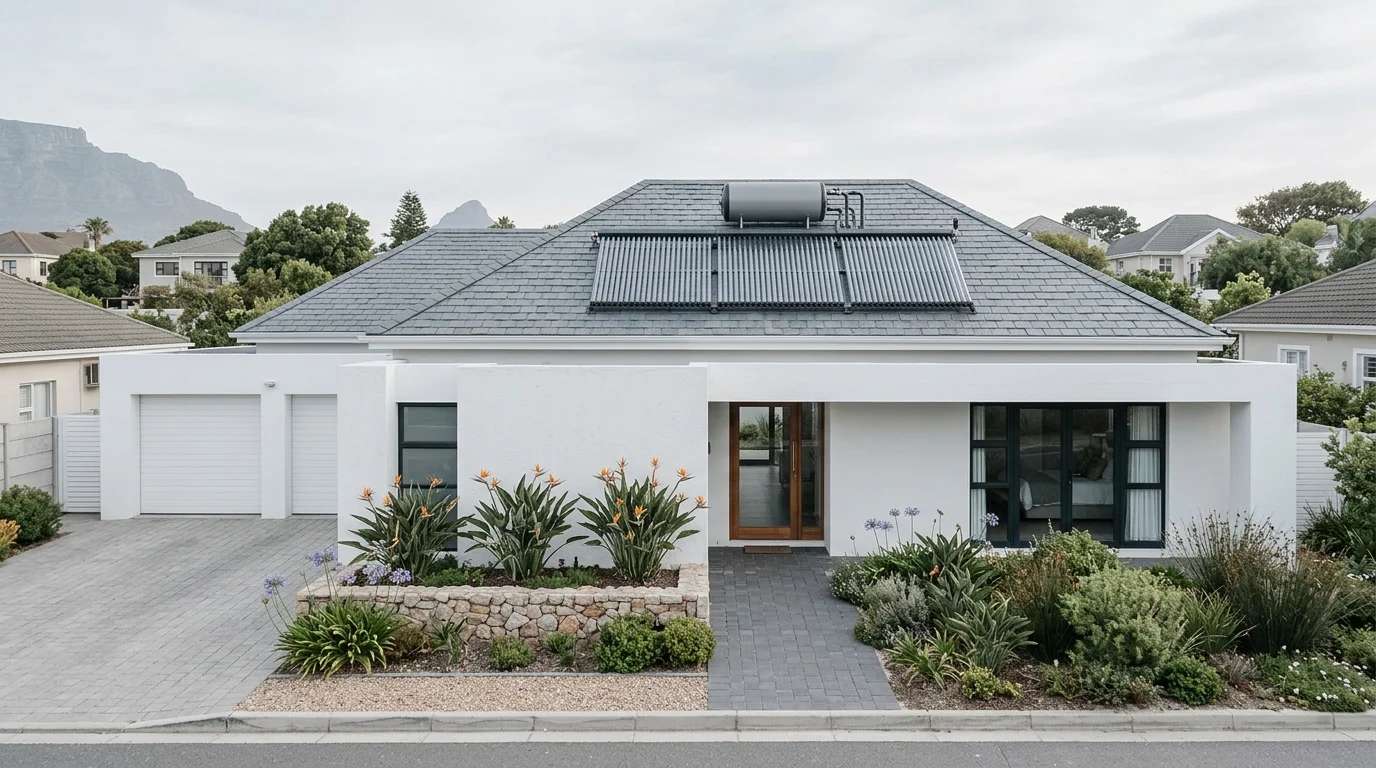
In Cape Town in 2026, a like-for-like 150L electric geyser replacement runs R7,000-R12,000 installed, a 150-200L solar geyser R22,500-R30,000, a 150-200L heat pump R27,500-R40,500 (our ITS installed estimate, tank not confirmed), and a 16L/min gas geyser R6,000-R13,500 - each including the plumbing Certificate of Compliance.
If you have a sunny north-facing roof, a solar geyser is the one to beat in Cape Town: 2,500+ sun hours a year heat 70-85% of your water for free, and every unit it saves is worth the City's R3.56/kWh rate. Choose a heat pump instead for a sectional-title flat, a shaded roof or no roof access, and gas if you want hot water that runs through load shedding. Below: all four compared, how to choose an installer, and what the quote must include.
Geyser Prices in Cape Town Compared: Solar, Heat Pump, Gas and Electric
For a 2-4 person Cape Town household, here is what each option costs to install, what it costs to run, and roughly how long it takes to pay back the extra over a plain electric geyser.
| Type | Installed price (tank size) | Monthly running cost (200L tank) | Payback vs electric | Best for |
|---|---|---|---|---|
| Electric geyser | R7,000-R12,000 (150L) | R1,153 | Baseline | Tight budget, fastest like-for-like swap |
| Solar geyser | R22,500-R30,000 (150-200L) | R288 | Not modelled | North-facing roof, lowest running cost |
| Heat pump | R27,500-R40,500 (150-200L; our ITS installed estimate, tank not confirmed) | R338 | Not modelled | Apartments, shaded roofs, year-round savings |
| Gas (16L/min) | R6,000-R13,500 | R350-R700 | Not modelled | Instant hot water, runs through load shedding |
Running costs are all for a 200L family tank, so the options compare like for like: our assumed 324 kWh a month for an electric element, 81 kWh of solar backup and 95 kWh for a heat pump, each at the City of Cape Town 2026/27 Home User rate of about R3.56/kWh (incl. VAT; see local facts below). Each installed price is for the tank size shown beside it. Gas assumes LPG at about R37/kg. Full national breakdown: solar geyser cost guide.
Which geyser is right for your Cape Town home?
Tell us your current geyser size (150L or 200L) and whether you're replacing an electric geyser or switching to solar, a heat pump or gas - and whether it's an insurance claim. We help you compare quotes with the installed price for your choice and introduce you to a Cape Town installer. Free, no obligation.
How do I choose a solar geyser installer in Cape Town?
Get at least three itemised quotes from PIRB-registered plumbers, and pick the one whose price names the collector, the tank size, stainless fittings if you are near the sea, and both Certificates of Compliance. Quotes for the same job often differ by several thousand rand, so compare like with like before you compare totals.
Before you accept a quote, check that it covers:
- A new system or a conversion. A complete solar geyser replaces your tank with a solar tank and collector. A retrofit conversion keeps your existing geyser and adds a collector or PV panels plus a controller, often for about half the price of a full replacement if the tank is in good condition. See converting a geyser to solar.
- Tank size for your household. 150L suits about 2-3 people, 200L about 3-4. The quote should name the size, not just "solar geyser".
- A SANS 1307-marked system. That is the SABS standard for domestic solar water heaters. Ask for the brand and model, so you can check the warranty yourself.
- Coastal fittings. Within about 5km of the Atlantic Seaboard or False Bay, stainless pipework and brackets (R1,500-R3,000 extra) should be in the price, not added on the day.
- A controller or timer so the backup element only runs when the sun falls short. See the best geyser timers.
- Both CoCs, handed over on completion: the plumbing CoC under SANS 10254 and an electrical CoC for the element. You can check a plumber's PIRB registration on the PIRB website before work starts.
- Approvals. Sectional-title, City Bowl and Bo-Kaap homes need written body corporate or heritage approval before roof work. Ask who arranges it.
EnergyBee sends your request to up to three local installers so you can compare quotes on the same spec. Free, no obligation.
How much does it cost to replace a geyser in Cape Town?
A like-for-like 150L electric geyser replacement costs R7,000-R12,000 fully installed in Cape Town, and a 200L runs up to about R14,500. That covers the unit, the plumber's labour, the pressure and tempering valves, and the plumbing Certificate of Compliance.
The job is usually a half-day swap. Emergency call-outs, a rusted stand that needs replacing, or difficult roof-space access push the price toward the top of the range. Within about 5km of the coast - the Atlantic Seaboard, Bloubergstrand, Muizenberg, Fish Hoek - insist on stainless-steel fittings, which add R1,500-R3,000 to the job.
If the geyser has failed, it is worth deciding now whether to replace like-for-like or upgrade: the labour and CoC are the same either way, so the extra over a solar geyser or heat pump is smaller than it looks once you are already paying a plumber to be on site.
Solar geyser or heat pump in Cape Town?
A solar geyser has the lowest running cost in Cape Town - with 2,500+ sun hours a year it heats 70-85% of your water for free - and it is the right call on a north-facing roof with space and sun. Expect R22,500-R30,000 installed; payback against electric depends on how much hot water you use.
A heat pump wins where solar can't go: a sectional-title apartment with no roof access, a shaded or south-facing roof, or a home where you want a plug-and-play upgrade with no roof penetration. The outdoor unit mounts on a balcony or against a wall and runs at COP 3.5-4.5 through Cape Town's mild winters, using about a third of the electricity of a plain geyser. Expect R27,500-R40,500 (our ITS installed estimate, tank not confirmed).
Both pay back in a similar window, so the deciding factor is usually your roof and whether you own the roof at all. See the full solar geyser vs heat pump comparison and theheat pump geyser price guide.
Is a gas geyser worth it in Cape Town?
A 16L/min gas geyser costs R6,000-R13,500 installed in Cape Town, including the gas line and a SAQCC Gas-registered installation. Unlike a tank geyser it heats water on demand, so there is no standing heat loss and no tank to run empty - and it keeps producing hot water right through load shedding.
Running cost is usage-based and tracks the LPG price (about R37/kg in 2026, verified 2026-10-03 - recheck seasonally), so a typical family spends R350-R700 a month. That is below a plain electric geyser but more than solar or a heat pump, so a gas geyser suits homes that want endless instant hot water, have no roof for solar, or need a geyser that is immune to outages. Many Cape Town homes pair a gas geyser for the kitchen and a solar or heat-pump geyser for the bathrooms.
Gas work must be signed off by a registered installer who issues a SAQCC Gas CoC. Read the full gas geyser guide before you commit.
How much does a geyser cost to run in Cape Town?
A plain electric geyser is the single biggest item on most Cape Town power bills - about R1,153 a month for a 200L family tank (324 units, our assumption) at the City's 2026/27 Home User rate of roughly R3.56/kWh (incl. VAT, Block 1). Heavy users above 600 kWh a month pay Block 2 at about R4.69/kWh, which pushes the geyser higher still.
On the same tank, a solar geyser cuts that to about R288 a month (backup element only), a heat pump to about R338, and a gas geyser lands around R350-R700 depending on the LPG price. Switching a geyser off between uses or fitting a timer helps on electric, but it does not change the fundamentals: the sun and a heat pump are far cheaper than the element.
Does home insurance cover a burst geyser?
Yes - a burst geyser and the water damage it causes are normally covered under your home buildings insurance, because the geyser is a fixture. The catch is compliance: insurers require the installation to meet SANS 10254 with a valid plumbing CoC, and they usually send their own approved plumber to do the replacement.
Keep your CoC on file. Claims are routinely rejected where no compliant certificate exists, and an excess applies - sometimes one excess for the geyser and another for contents damage. If your geyser has already burst, start with the step-by-step in what to do when your geyser bursts.
Who can legally install a geyser in Cape Town?
A geyser install, replacement or repair must be done by a PIRB-registered plumber (Plumbing Industry Registration Board), who issues the plumbing Certificate of Compliance under SANS 10254. Any electrical work - the backup element, a heat-pump compressor circuit - needs an electrical CoC from a registered electrician. Gas work needs a SAQCC Gas CoC.
In Cape Town the installation must also meet the City's water and electrical by-laws. A reputable installer includes every CoC in the quoted price and hands them over on completion. Insist on them: without a valid CoC your manufacturer warranty and your household insurance both fall away.
Cape Town tariffs and schemes (2026, sourced)
Electricity tariff (what the geyser costs to run). City of Cape Town Home User (credit meter) 2026/27: Block 1 (0-600 kWh) about R3.56/kWh and Block 2 (over 600 kWh) about R4.69/kWh, both incl. VAT, plus a service and wires charge of about R424/month. Effective 1 July 2026. Source: City of Cape Town, "The cost of electricity". Checked 2026-10-03.
Geyser ripple-control. The City runs geyser ripple-control - remote peak-time switch-off under Eskom's Residential Load Management Programme - with live testing in Jan-Feb 2026 across Strand, Gordon's Bay, Somerset West, Durbanville, Kuils River and Kraaifontein. It is load management, not a rebate, and needs no action from you. Source: City of Cape Town media. Checked 2026-10-03.
Rebates. No current City of Cape Town cash rebate for solar geysers or heat pumps could be verified for 2026; the national Eskom solar water heater rebate closed in 2015. Check with the City's Energy office before assuming an incentive is open. Checked 2026-10-03.
A solar geyser on its own does not need SSEG registration - that applies to grid-tied PV that exports power. See the Cape Town electricity tariffs update for the full rate breakdown.
What the installed price does not always include
- Coastal fittings. Within ~5km of the sea, stainless-steel pipework and brackets add R1,500-R3,000. Standard brass is a false economy on the Atlantic Seaboard and False Bay.
- Roof or stand repairs. A rusted geyser stand, rotten battens or weak trusses are quoted separately once the installer is on the roof.
- Body corporate and heritage approvals. Sectional title and parts of the City Bowl and Bo-Kaap need written approval before roof-mounted equipment goes up.
- Backup power. A solar geyser's element and a heat pump's compressor still need grid or battery power on overcast days and during outages; only a gas geyser is fully outage-proof.
Cape Town suburbs we cover
EnergyBee quotes geyser installations across the full Cape Town metro, including Milnerton, Table View, Bloubergstrand, Parow, Bellville, Durbanville, Plattekloof, Brackenfell, Kraaifontein, Claremont, Newlands, Constantia, Rondebosch, Wynberg, Muizenberg, Fish Hoek, Sea Point, Green Point, the City Bowl, Woodstock and Mitchells Plain. Coverage extends into the Helderberg (Somerset West, Strand, Gordon's Bay) and the Boland (Stellenbosch, Paarl, Wellington). Installs more than ~50km from the CBD may carry a small travel surcharge.
Frequently asked questions
How much does it cost to replace a geyser in Cape Town in 2026?
A like-for-like 150L electric geyser replacement in Cape Town costs R7,000-R12,000 installed, including the plumbing Certificate of Compliance; a 200L runs up to about R14,500. Switching water-heating type costs more up front but less to run: a 150-200L solar geyser is R22,500-R30,000 installed, a 150-200L heat pump R27,500-R40,500 (our ITS installed estimate, tank not confirmed), and a 16L/min gas geyser R6,000-R13,500. Coastal properties within 5km of the sea add R1,500-R3,000 for stainless-steel fittings. Always get at least three quotes.
Is a solar geyser or a heat pump better in Cape Town?
Both work well in Cape Town. A solar geyser has the lowest running cost - with 2,500+ sun hours a year it heats 70-85% of your water free - and suits a north-facing roof. A heat pump is the better choice for a sectional-title apartment with no roof access, a shaded or south-facing roof, or if you want a plug-and-play upgrade with no roof penetration. Cape Town's mild winters (rarely below 5C) let heat pumps run at COP 3.5-4.5 year-round.
Is a gas geyser worth it in Cape Town?
A 16L/min gas geyser costs R6,000-R13,500 installed in Cape Town and gives instant, tank-free hot water that keeps running through load shedding. Running cost depends on the LPG price (about R37/kg in 2026), so a family typically spends R350-R700 a month. It makes most sense where you want endless hot water, have no roof for solar, or need backup during outages. It does not cut your bill the way solar or a heat pump does.
Does home insurance cover a burst geyser in Cape Town?
Yes - a burst geyser and the resulting water damage is normally covered under your home buildings insurance as a fixture. But insurers require the installation to be SANS 10254-compliant with a valid plumbing Certificate of Compliance, and will usually send their own approved plumber. Keep the CoC on file: claims are commonly rejected where no compliant CoC exists. An excess applies, sometimes per item.
Who is allowed to install a geyser in Cape Town?
A geyser installation, replacement or repair must be carried out by a PIRB-registered plumber (Plumbing Industry Registration Board) who issues a plumbing Certificate of Compliance under SANS 10254, and any electrical work needs an electrical CoC from a registered electrician. In Cape Town the City also requires compliance with its water and electrical by-laws. Never accept an install without both CoCs - it voids your warranty and your insurance.
Does the City of Cape Town offer a geyser rebate in 2026?
No current City of Cape Town cash rebate for solar geysers or heat pumps could be verified for 2026; the old national Eskom solar water heater rebate closed in 2015. The City does run geyser ripple-control (remote peak-time switch-off under Eskom's Residential Load Management Programme), which is load management rather than a rebate and needs no action from you. Check with the City's Energy office before assuming any incentive is open.
Do solar geysers work during load shedding in Cape Town?
Yes. The solar collector heats water from sunlight independently of the grid, so load shedding does not stop solar heating. The electric backup element (used on overcast days) will not run during an outage, but Cape Town's 2,500+ sunshine hours mean the tank is usually pre-heated. A gas geyser also runs right through an outage; a heat pump needs grid power or battery backup to run its compressor.
What are the disadvantages of a solar geyser in Cape Town?
A solar geyser costs roughly three times as much to install as an electric geyser (R22,500-R30,000 against R7,000-R12,000) and needs a sunny north-facing roof with space for the collector. Cape Town's wet, overcast winters mean the backup element does more of the work from about May to August. Within about 5km of the sea, budget R1,500-R3,000 for stainless-steel fittings. Sectional-title and heritage homes also need written approval before anything goes on the roof.
Related guides
Solar Installation Guide: Cape Town 2026
Full rooftop solar system prices, payback and compliance for Cape Town.
Heat Pump Geyser Prices: South Africa 2026
Brands, installed prices and coastal climate notes for heat pump geysers in Cape Town.
Compare Heat Pump Geysers
Browse heat pump models available in South Africa with specs and pricing.
Compare Solar Geysers
All solar geyser systems in South Africa with expert ratings and prices.
Solar Quotes Cape Town: Home & Business Prices
Installed solar PV prices, Cash for Power payouts, SSEG and Section 12B for Cape Town homes and businesses.