Solar Quotes Midrand: Home and Business Installed Prices
A Midrand home solar system costs about R85,000 to R180,000 installed; a business or logistics system starts around R150,000 and scales with your daytime load. City Power does not currently pay for exported power, so a Midrand system is sized to run your own load - every unit you self-consume saves the full ~R3.95 municipal tariff. Some Midrand pockets are on Eskom, so check your bill first.
Free, no obligation. Updated 5 October 2026.
- Fixed installed price, VAT included
- SSEG registration and a compliant meter where you grid-tie
- Sized for self-consumption, not feed-in
- An installer who works Midrand, its estates and the N1 corridor
How much is solar for a Midrand home?
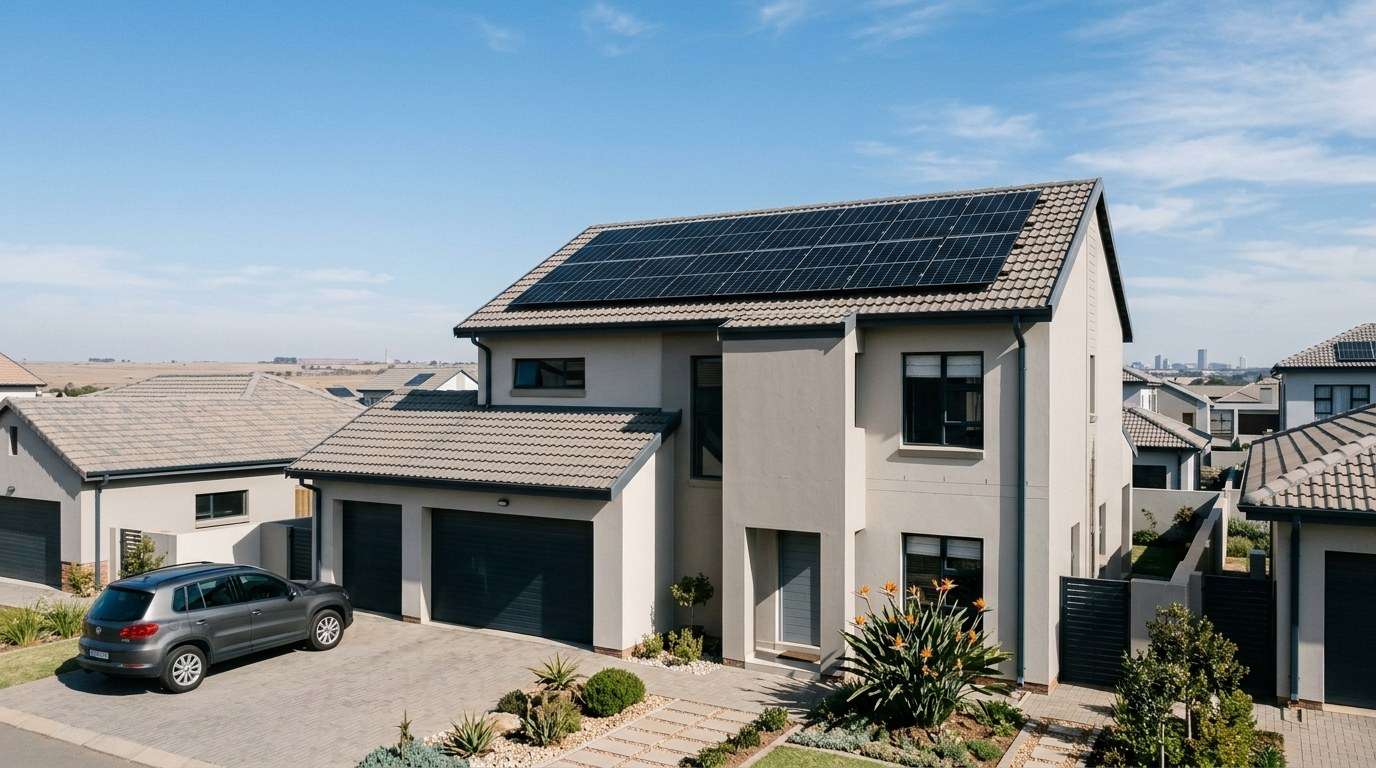
A home system in Midrand suburbs and estates like Carlswald, Vorna Valley, Noordwyk and Kyalami runs about R85,000 to R180,000 installed, depending on battery and array size. City Power does not currently pay for power you export, so the system is sized to run your own load: every unit your solar offsets is a unit you no longer buy at the top municipal tariff of around R3.95. If you grid-tie, register for SSEG and fit a compliant meter; a non-export system still needs a Certificate of Compliance. Check your bill first - a few Midrand pockets are supplied by Eskom, who you would register with instead.
Your monthly electricity bill
Average across the last 3 months - load shedding skews single months.
What does commercial solar cost in Midrand?
A commercial installation in Midrand starts around R150,000 and scales with your daytime load, from a Waterfall City office to a logistics warehouse at Grand Central or Corporate Park. Midrand sits on the N1 logistics corridor, and distribution loads draw hard through daylight hours. Because City Power pays nothing for exported power, the return has two parts rather than three: the units you stop buying from City Power, and the Section 12B tax write-off - 100% of a solar PV system under 1 MW deducted in year one, worth about R27,000 of tax for every R100,000 spent at the standard company rate. The system must belong to the business claiming it; confirm your rate with your accountant.

Estimate your business solar saving
How does the business use power?
Electrical supply

Solar for a Midrand office or shop
Office and retail loads run through the trading day, exactly when solar produces, so self-consumption is high and payback is quick even with no feed-in payout. A rooftop array keeps the lifts, lights, servers, fridges and air conditioning running through the City Power tariff hikes, and the Section 12B write-off lands in year one. Waterfall City and Corporate Park are our busiest Midrand office nodes.
From ~R150,000 · 10-50 kWp · Section 12B year one
Solar for a Midrand warehouse or distribution centre
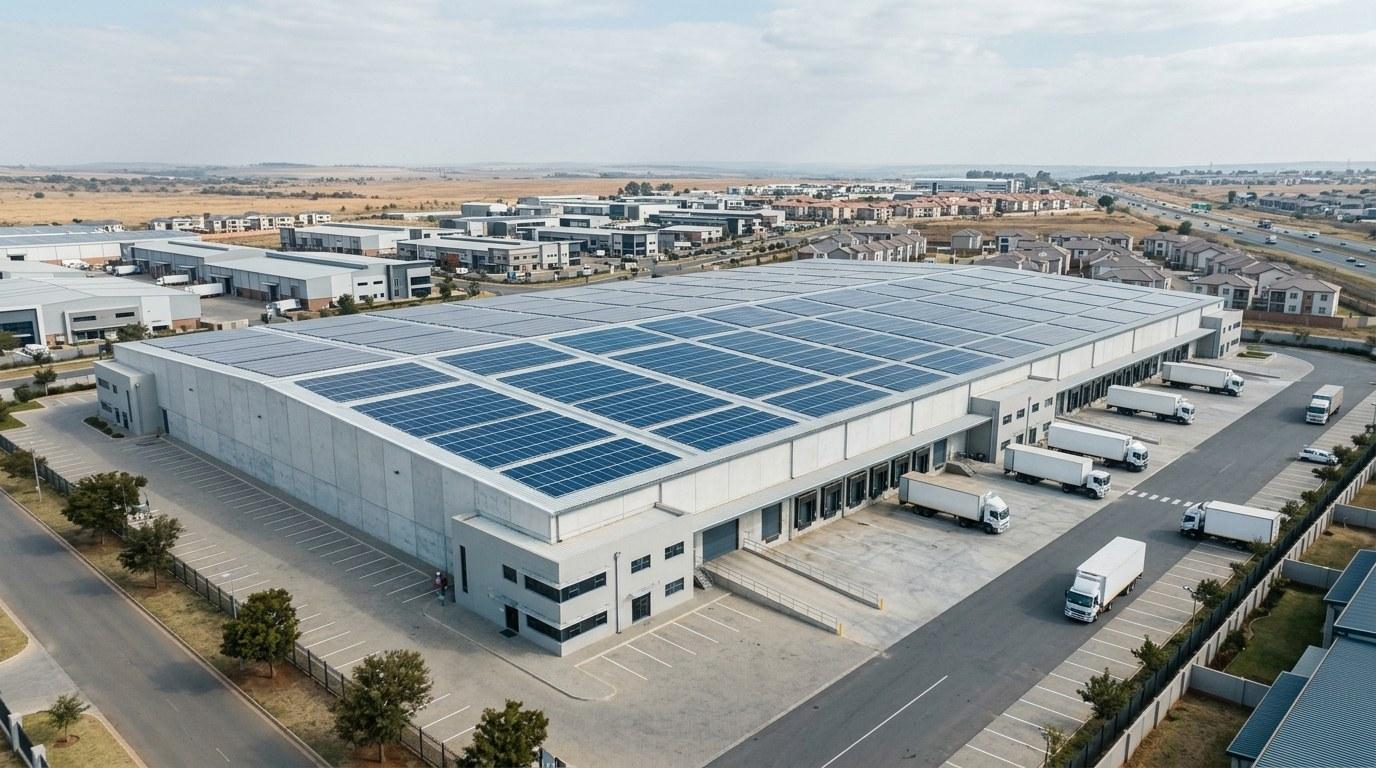
Logistics, distribution and cold-storage loads on the N1 corridor run long or round the clock, and a large warehouse roof is ideal array space - so a bigger system and often a battery or generator tie-in make sense, and heavy daytime use is exactly where self-consumption pays with or without a feed-in tariff. Systems under 100 kVA register SSEG with City Power. Roof and yard space and any existing backup shape the design.
R450,000+ · 30-500 kVA · SSEG under 100 kVA with City Power
Can you put solar on a building you lease?
Often yes, but it needs the landlord on side, because the panels fix to a roof you do not own - and much of Midrand’s office and logistics space is leased. The routes that work are a landlord-funded system, a tenant-funded system on a lease long enough to pay it back, or a shared arrangement. One tax point matters: the Section 12B deduction goes to whoever owns the system, so a tenant who buys it outright can claim it, while a tenant on a PPA or rental cannot. Tell us your remaining lease term and we will help you frame the proposal.
Midrand solar by segment, at a glance.
| Segment | Typical system | Installed price | What you get back | Key Midrand rule |
|---|---|---|---|---|
| Home / estate | 4-10 kW + battery | R85,000 - R180,000 | Self-consumption saving against the ~R3.95 City Power tariff | SSEG + compliant meter to grid-tie; check City Power vs Eskom |
| Office / retail | 10-50 kWp | R150,000 - R750,000 | Daytime saving + Section 12B 100% write-off | No feed-in payout; size for self-consumption |
| Logistics / warehouse | 30-500 kVA | R450,000 - R2,500,000+ | Load saving + Section 12B | Register SSEG with City Power under 100 kVA |
| Tenant / leased | Varies | Shared / landlord-funded | Bill saving split per the lease deal | Needs landlord consent + lease term |
Estimates for 2026, Midrand. Prices include equipment, labour, Certificate of Compliance and VAT; Section 12B is a tax deduction, not a cash grant. City Power does not currently pay for exported power, and some Midrand pockets are Eskom-supplied. Your installer quote is fixed to your roof, load and tariff.
What is your average monthly electricity bill?
Pick a band and we size a system to it, then you compare quotes for your roof and suburb. No obligation.
The local facts your quote turns on.
Figures verified 5 October 2026. City Power reviews SSEG tariffs and fees each year, so recheck before you sign.
No feed-in in effect
City Power has an approved SSEG framework but no residential buyback rate in effect - a rate proposed at ~R0.86/kWh in 2023 was never implemented - so most Midrand homes are installed non-export. Size for self-consumption, not export income.
City of Johannesburg tariff
The residential upper block is about R3.95/kWh on the 2025/26 schedule (effective to 30 June 2026). Every unit your solar offsets saves that full municipal rate, which is where the payback comes from.
Some pockets are on Eskom
Most of Midrand is City Power, but some pockets are supplied directly by Eskom. Check your latest bill to see who you pay - it decides who you register the system with and what registration costs. Eskom-supplied sites register with Eskom instead.
Register with City Power
Systems under 100 kVA must register with City Power. A grid-tied or export system needs a compliant bidirectional (smart) meter and generally a move onto a postpaid time-of-use tariff.
Highveld yield
A north-facing Midrand roof yields about 1,750 kWh per kWp a year, higher than the coast. The Highveld is summer-rainfall: dry, sunny winters and afternoon cloud with thunderstorms in summer.
Section 12B (100%)
A business writes off 100% of a solar PV system under 1 MW in year one (1 MW+ is 50/30/20 over three years). The asset must belong to the claimant; there is no residential equivalent.
Sources & methodology
Most of Midrand falls inside the City of Johannesburg and is supplied by City Power, so its tariffs, SSEG rules and the absence of a feed-in payout are the Johannesburg metro figures; some pockets are Eskom-supplied, so check your bill, because Eskom-supplied homes register with Eskom instead. Sources: City of Johannesburg 2025/26 tariff schedule and City Power SSEG documentation (via ourpower.co.za); EnergyBee’s own grid feed-in guide; SARS Section 12B renewable-energy allowance; engineeringnews.co.za / IOL (SAPVIA-City Power talks, April 2026). Verified 5 October 2026. We flag exact City Power tariff blocks, the SSEG fee and meter cost, and the size cap against City Power’s own current schedule - confirm these before you sign.
What still gets checked, and what solar will not do.
Calculator figures are estimates. A site assessment confirms usable roof area, orientation, shading, the switchboard and the inverter position before any price is fixed.
Check who supplies you first. Most of Midrand is on City Power, but some pockets are Eskom-supplied - your bill decides who you register with and what it costs, so confirm it before you design the system.
Production peaks in winter. On the Highveld the dry, sunny winter is the strongest season, and output dips under summer afternoon cloud and thunderstorms - the opposite of the winter-rainfall coast.
Export earns nothing right now. City Power does not currently pay for power you send back, so size for self-consumption, not for selling surplus - and expect a real SSEG approval backlog, so register your grid-tied system early.
Section 12B is a tax deduction, not a cash rebate, and an apartment or flat is a backup-only enquiry (inverter and battery), not a rooftop array, because the roof is shared.
Areas we cover across Midrand.
We quote and install across Midrand, residential and commercial - the estates and suburbs, Waterfall City, and the Grand Central, Corporate Park and Samrand commercial and logistics nodes on the N1 corridor. If your suburb or node is not listed, ask anyway:
Get a fixed installed price for your Midrand home or business.
Free, no obligation. Tell us your segment and bill, and we then you compare quotes - SSEG registration where you grid-tie, fitment, the Certificate of Compliance, and the Section 12B numbers where they apply - from the installer who will do the work.
Midrand solar questions.
Is my Midrand property on City Power or Eskom?
Most of Midrand is supplied by City Power, the City of Johannesburg distributor, but some pockets are supplied directly by Eskom. Check your latest bill to see who you pay: it decides who you register your system with and what the registration costs. City Power sites register SSEG with City Power and fit a compliant bidirectional meter; Eskom-supplied sites register with Eskom instead. Either way, the design leads on self-consumption, because neither pays a residential feed-in tariff in effect right now.
Can I sell solar power back to the grid in Midrand?
Not for a payout at the moment. City Power has an approved small-scale embedded generation (SSEG) framework and will connect a grid-tied system, but there is no residential buyback rate in effect - a rate proposed at about R0.86/kWh in 2023 was never implemented. So most Midrand homes are installed as non-export (self-consumption) systems, sized to run your own load rather than to sell surplus back. If a feed-in tariff is introduced later, a registered grid-tied system is ready for it.
How much does a solar system cost in Midrand?
A typical Midrand home or estate system runs about R85,000 to R180,000 installed, depending on whether you add a battery and how big the array is. A small or light commercial installation - a Waterfall City office, a Grand Central warehouse - starts around R150,000 and scales with your daytime load. Both prices include equipment, labour, the Certificate of Compliance and VAT. Your installer quote is fixed to your roof and usage.
Is solar worth it for a Midrand logistics or distribution warehouse?
Yes - a warehouse is close to an ideal solar site. A large flat roof is cheap array space, and distribution, cold-storage and logistics loads on the N1 corridor draw hard through daylight hours, when a rooftop array produces most. That means a high share of what you generate is self-consumed, which with City Power paying nothing for export is the whole return, alongside the Section 12B write-off that deducts 100% of a sub-1 MW system in year one. Systems under 100 kVA register SSEG with City Power.
Do I need to register my solar system with City Power?
If City Power supplies you and the system is grid-tied or exports, yes: systems under 100 kVA must register with City Power as SSEG, fit a compliant bidirectional (smart) meter, and generally move onto a postpaid time-of-use tariff. A non-export (self-consumption) system does not feed the grid, but it still needs a Certificate of Compliance. If your Midrand pocket is on Eskom, you register with Eskom instead - so check your bill before you start.