You asked three installers for a battery and the same name keeps coming back on the cheapest line: Dyness. It undercuts a Pylontech by thousands of rand per unit, uses the same lithium chemistry, and carries the same 10-year warranty - so is it a genuine bargain or a corner-cut you'll regret? Here's the honest 2026 breakdown of the Dyness battery: real prices, where it wins, where it doesn't, and who should actually buy it.
You did the responsible thing. You asked three installers for a quote, and now three PDFs are open on your laptop. The panels are similar, the inverters are a familiar name or two - and then you get to the battery line, and the cheapest quote keeps using a brand you half-recognise: Dyness.
It's thousands of rand cheaper per unit than the Pylontech on the pricier quote. Same lithium chemistry. Same ten-year warranty on paper. And that sets off the little alarm every South African has learned to trust: if it's this much cheaper, what's the catch?
Here's the honest answer - no hype, no brand loyalty - on whether the Dyness battery is a genuine 2026 bargain or a saving you'll pay for later.
Why Dyness is suddenly on every second quote
Two things changed in 2026, and together they put Dyness in front of you.
First, load shedding basically stopped. Eskom has strung together well over 400 days without national cuts, which quietly changed why people buy batteries. A year ago it was panic - keep the lights on at any price. Now it's arithmetic: shift your solar into the evening, dodge the 1 July municipal tariff hikes →, and make the sums work. When a battery is a savings decision rather than an emergency, price moves to the front of the table.
Second, lithium battery prices fell hard. Global LiFePO4 cell prices dropped through 2025 and into 2026, and value brands passed that on fastest. Dyness sits right in that value lane - so the moment the buying reason became "save money," the cheapest credible battery got a lot more attention.
What a Dyness battery actually costs
Let's put real numbers on it. This is the comparison that matters - Dyness against the brand it's usually quoted next to:
Battery
Usable capacity
Typical 2026 price
Rand per usable kWh
Dyness (wall module)
5.12kWh
R28,000 - R32,000
~R5,900
Pylontech US5000
4.8kWh
R30,000 - R36,000
~R6,900
Same chemistry, same ten-year warranty - and Dyness gives you more usable storage per unit for less money. Stack a few and the gap compounds: three Dyness modules give you 15.36kWh versus 14.4kWh from three Pylontechs, for a lower total. On pure rand-per-kWh, Dyness is the better-value box on the wall. That's not marketing; it's the maths installers are quietly running when they build your cheapest option.
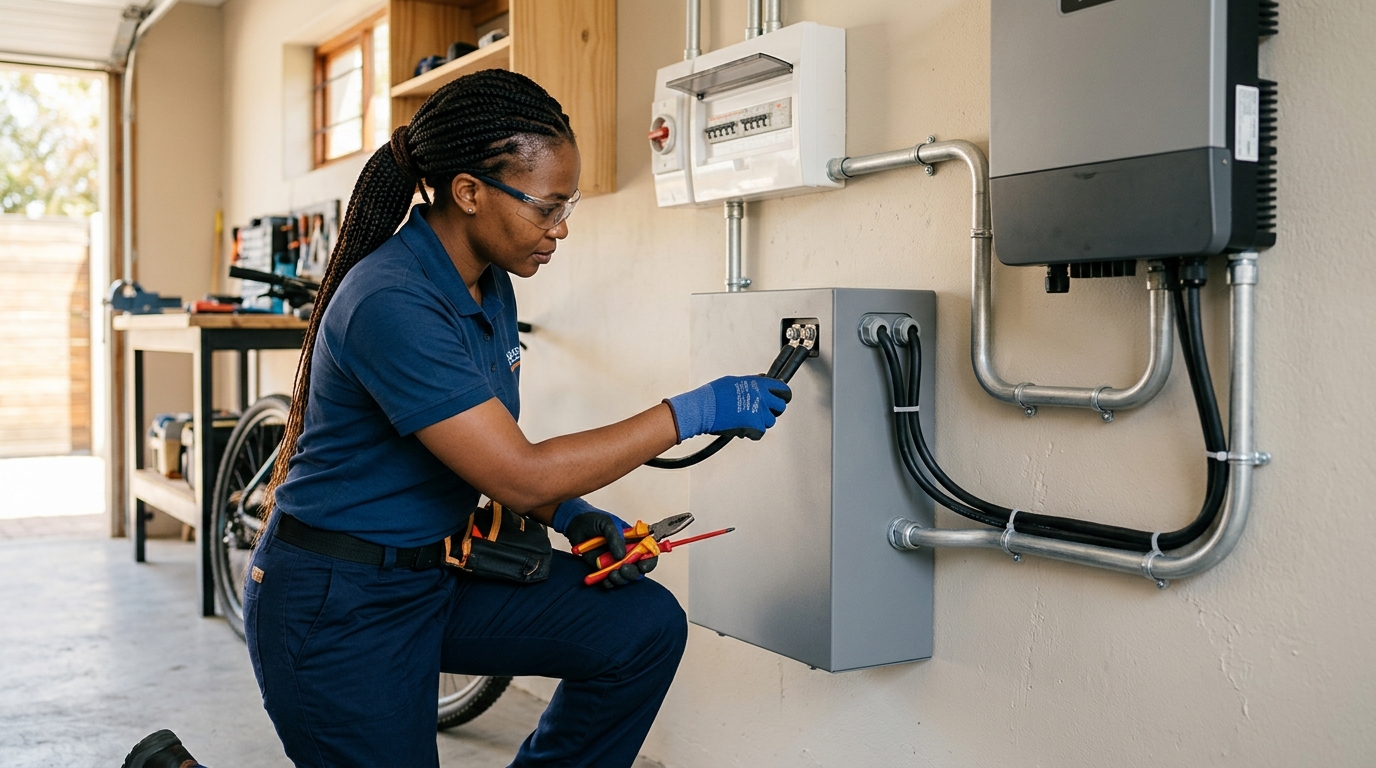
A neatly installed rectangular wall-mounted lithium battery beside a hybrid solar inverter in a tidy South African home garage, clean conduit and cabling, professional installation, soft natural daylight
See if solar makes sense for your home
Get free, no-obligation quotes. We then introduce you to the installer who will fit it.
Where the cheaper price is real value - and where it isn't
A lower price is only a bargain if nothing important got cut. Here's what you're actually getting, and what you're not.
What you keep:
The chemistry. Dyness uses LiFePO4 - the same safe, long-life lithium iron phosphate as the premium brands. It's the chemistry, not the badge, that determines safety and lifespan.
The lifespan. Rated for 6,000-plus cycles at 80% depth of discharge. At a cycle a day that's 15-20 years of useful life. You are not buying a battery that dies early.
The warranty. A standard 10-year warranty, matching what the dearer brands offer.
What you're really trading away:
Depth of local track record. Pylontech has 50,000-plus South African installations and a decade of local field data. Dyness's base here is smaller and newer - growing fast, but not the incumbent.
The thickness of the support net. More installations means more technicians who know the product cold and more spares on shelves. With a value brand, who you buy from carries more of that weight.
Notice that neither trade-off is about the cells inside the box. The saving is real, and the risk is almost entirely about the support chain, not the hardware - which is good news, because the support chain is the one thing you can control at buying time.
The one rule that makes Dyness a smart buy
Buy it through a supplier who gives you genuine, written local warranty support, and have it fitted by a certified installer who registers the system. Do that, and you've closed the only real gap between Dyness and a battery costing thousands more - you get premium-grade LiFePO4 and a matching warranty at a value price, with your back covered.
Skip it - chase the rock-bottom price from a faceless online listing with no local backing - and a ten-year warranty is only as good as the company still around to honour it. That's the sentence where a cheap battery turns expensive. The battery brand matters far less than getting the sizing, the install and the warranty support right.
For the full head-to-head on capacity, stacking and support, our Dyness vs Pylontech comparison → breaks down every number, and if you want to see where Dyness sits against the whole market, the best solar batteries in South Africa guide → ranks it against every brand. Our Dyness DL5.0C product page → covers the flagship 5.12kWh module itself - specs, real prices and who it's for. (Worth knowing: Dyness also makes a well-regarded 6kW hybrid inverter →, so you can run a matched Dyness stack end to end.)
So - should you buy the Dyness battery?
For most South African households in 2026, yes - with the one rule above. If your goal is to store your own solar, shave the evening peak off your bill and ride out the odd outage, and you want the best usable storage for your money, Dyness is one of the smartest rand-for-rand batteries you can put on the wall.
Choose the premium alternative instead if you specifically want the largest installed base and the deepest spares network behind you, and you're happy to pay a modest premium for that assurance. Both are excellent LiFePO4 batteries with 10-year warranties; this is a value-versus-track-record call, not a good-versus-bad one.
What you shouldn't do is let the cheapest number on the quote - or the scariest one - make the decision alone. Size the battery to your actual evening usage, insist on real local warranty backing, and use a certified installer. Nail those three, and the cheap battery on your solar quote stops being a gamble and becomes exactly what it looks like: a genuine bargain.
Want to know whether Dyness - or a premium battery - is the right fit and size for your home? Prices are typical 2026 South African supply ranges for wall-mounted lithium battery modules, excluding installation, and vary by supplier, capacity and whether bought as part of a full system. Capacity, cycle and warranty figures reflect standard manufacturer ratings; actual lifespan depends on system design, temperature and usage. Always confirm current pricing and written local warranty terms with a certified installer before buying.
Frequently Asked Questions
How much does a Dyness battery cost in South Africa in 2026?
A Dyness wall-mounted lithium battery costs roughly R28,000 to R32,000 for a 5.12kWh module in 2026, installed pricing excluded. That works out cheaper per usable kilowatt-hour than the comparable Pylontech US5000 (around R30,000 to R36,000 for 4.8kWh), which is exactly why it keeps landing on the cheapest line of solar quotes. Prices vary with supplier, capacity and whether it is bought as part of a full system, so always compare the rand-per-usable-kWh figure rather than the sticker price of the box.
Is Dyness a good battery, or is it cheap for a reason?
Dyness uses the same LiFePO4 (lithium iron phosphate) chemistry as premium brands, carries a standard 10-year warranty, and is rated for 6,000-plus cycles - the same fundamentals as batteries costing more. It is cheaper mainly because it is a value-focused brand with a leaner local support footprint than the market incumbent, not because the cells are inferior. The real risk is not the hardware but the support chain: buy through a supplier who offers written local warranty backing and you remove most of the downside.
Dyness vs Pylontech - which should I buy?
Dyness wins on price and gives slightly more usable capacity per unit (5.12kWh vs 4.8kWh), so on pure rand-per-kWh it is the better value. Pylontech wins on track record - it has 50,000-plus installations in South Africa and the deepest installer and spares network, which matters if you value maximum brand assurance. By mid-2026 Pylontech's price premium had narrowed to around 10-15%, so the gap is smaller than it used to be. For most value-focused households Dyness makes sense; for absolute peace of mind, Pylontech is worth the small extra.
How long will a Dyness battery last?
Dyness batteries are rated for more than 6,000 charge cycles at 80% depth of discharge. At roughly one full cycle a day that is about 16 years before the battery drops to 80% of its original capacity, and most installers expect 15 to 20 years of useful life in a normal South African home. The 10-year warranty covers the first stretch of that outright. Lifespan depends on keeping the battery in its rated temperature range and not routinely draining it flat, both of which a properly designed system handles for you.
Free - see your savings in seconds
See what you'd save - based on your actual bill
Tell us what you pay Eskom now. We'll show you what solar would cost you a month instead, and what's left over.
No cost, no obligation, no salesperson unless you ask for one.