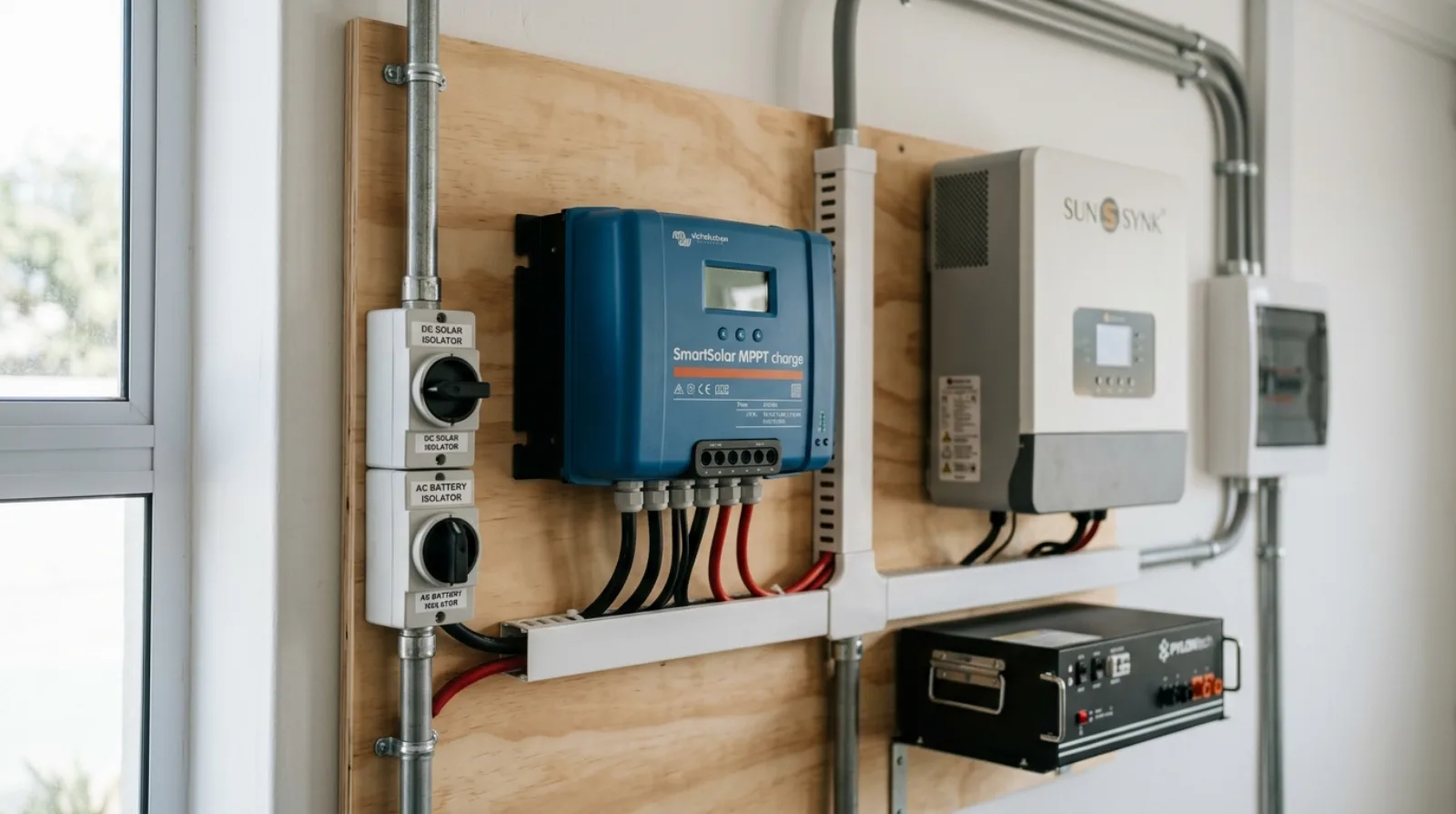
The solar charge controller is the quiet workhorse of every off-grid and DIY solar setup - the one component most first-time buyers overlook, and the one most likely to be sized wrong. It stands between your panels and your battery, deciding exactly how much power reaches the cells and protecting a battery bank that can cost more than the rest of the system combined. Get it right and your batteries last 10-15 years. Get it wrong and you can cook them in a season.
Not building it yourself? Most home systems use a hybrid inverter with the charge controller already built in. See our off-grid solar kits guide for complete, pre-matched systems - no component sizing required.
What Is a Solar Charge Controller?
A solar charge controller - also called a solar regulator or simply a solar controller - is the device that regulates the flow of electricity from your solar panels into your battery bank. Solar panels are variable: their output swings with sunlight, temperature and the angle of the sun. A battery, meanwhile, needs a carefully controlled charging profile to stay healthy. The charge controller is the translator between the two.
Its job is threefold:
- Prevent overcharging - once the battery is full, the controller tapers or stops the current so the voltage never climbs into damaging territory.
- Deliver the correct charge profile - bulk, absorption and float stages for lead-acid, or a controlled constant-current/constant-voltage curve for lithium (LiFePO₄).
- Block reverse current at night - without a controller, current can trickle backwards from the battery into the panels after dark, slowly draining the bank.
In short: the panels generate, the battery stores, and the charge controller makes sure the handover happens safely. It is the difference between a battery bank that lasts its full warranty and one that dies early. For a full breakdown of the batteries the controller protects, see our solar battery guide for South Africa.
Do You Even Need a Separate Charge Controller?
This is the first question to answer, because for most South African homes the answer is no - and it saves you buying a component you don't need.
Almost every grid-tied and hybrid home system today is built around a hybrid inverter - Sunsynk, Deye, GoodWe, Growatt, Victron, Luxpower and the like. These inverters have one, two or even three MPPT charge controllers built into the unit. That row of PV+ and PV- terminals on the inverter is exactly that: an integrated charge controller. You wire the panels straight into the inverter, and the controller inside does all the regulating. You can compare these units in our best solar inverters guide.
You need a standalone charge controller when:
- You are building a DIY 12V or 24V system - a cabin, caravan, boat, borehole pump, security installation or small off-grid load.
- You run an off-grid system with a battery-based (non-hybrid) inverter that has no PV input of its own.
- You want to add a second, separate PV array to charge a battery independently of the main inverter.
Rule of thumb: if your quote lists a hybrid inverter, you do not need to buy a separate charge controller - it's already inside. If you're assembling components yourself for a small off-grid load, you do.
PWM vs MPPT: The Only Choice That Really Matters
There are two technologies on the market, and the price gap between them tempts a lot of first-time buyers into the wrong choice.
PWM (Pulse Width Modulation)
A PWM controller is essentially a fast electronic switch. It connects the panel directly to the battery and rapidly switches the connection on and off to hold the right voltage. The catch: it drags the panel's operating voltage down to the battery's voltage. A typical 12V panel actually produces its peak power at around 18V - with a PWM controller, that extra 6V is simply thrown away as the panel is forced to run at battery voltage. PWM is cheap, reliable and fine for small, well-matched 12V systems, but it wastes a meaningful slice of your panel's potential.
MPPT (Maximum Power Point Tracking)
An MPPT controller is a small, smart DC-to-DC converter. Instead of dragging the panel down to battery voltage, it lets the panel run at its maximum power point - its most efficient voltage - and then electronically converts that higher-voltage, lower-current input into the lower-voltage, higher-current output the battery wants. Nothing is wasted. In real South African conditions, an MPPT controller typically harvests 20-30% more energy than a PWM controller from the same panels, and the gain is biggest in cold, bright weather and when panel voltage is much higher than battery voltage.
| Feature | PWM | MPPT |
|---|---|---|
| Efficiency | Lower - wastes voltage difference | High - 20-30% more harvest |
| Panel & battery voltage | Must be closely matched | Panel can be far higher than battery |
| Best for | Small 12V setups, tight budgets | 24V/48V, larger arrays, off-grid |
| Cost (SA) | R300-R1,500 | R1,500-R15,000+ |
| Verdict | Only for the smallest jobs | The default for any serious system |
The bottom line: for anything larger than a small 12V panel-and-battery combo, buy MPPT. The extra harvest pays back the price difference quickly, and it lets you use cheaper, higher-voltage panels wired in series.
How to Size a Solar Charge Controller
Sizing comes down to two numbers: the output current the controller must handle, and the maximum PV input voltage it can accept. Get both right and the rest is detail.
Step 1 - Charging current (the amps)
Divide your total panel wattage by your battery bank voltage, then add about 25% headroom for cold-weather over-performance and future expansion:
Worked examples for common South African setups:
| Array | Battery bank | Raw current | Controller to buy |
|---|---|---|---|
| 400W | 12V | ≈ 33A | 40A MPPT |
| 1,000W | 24V | ≈ 42A | 50A MPPT |
| 2,000W | 48V | ≈ 42A | 50A MPPT (e.g. 150/50) |
| 4,000W | 48V | ≈ 83A | 100A MPPT (e.g. 250/100) |
Notice how a higher battery voltage (48V) lets the same-size controller handle a much bigger array - this is one reason serious off-grid systems run at 48V rather than 12V. Our off-grid solar kits guide covers how battery-bank voltage shapes the whole system design.
Step 2 - Maximum PV voltage (the volts)
MPPT controllers are named by two numbers, for example 150/45 - the first is the maximum PV input voltage (150V) and the second is the output current (45A). When you wire panels in series their voltages add up, so you must make sure the combined cold-weather open-circuit voltage (Voc) of your string stays comfortably below that first number. Panels produce a higher Voc when it is cold, so always leave a safety margin - running right on the limit is how controllers get damaged on a frosty Highveld morning.
How to Choose: What Actually Matters
Beyond PWM-vs-MPPT and correct sizing, a few features separate a good controller from a frustrating one:
- Battery-type support - make sure it has a proper LiFePO₄ / lithium charge profile if you run lithium batteries, not just lead-acid presets.
- Monitoring & Bluetooth - the best controllers (Victron SmartSolar) pair with a phone app so you can see exactly what your panels are producing. Priceless for troubleshooting.
- Build quality & warranty - a controller runs hot and works hard every day. A reputable brand with a real local warranty is cheap insurance for the expensive battery behind it.
- Load output terminals - small controllers include a switched load output for lights or a pump with low-voltage disconnect; larger off-grid units usually don't (loads run off the inverter instead).
Charge Controllers You'll See in South Africa
These are real brands and product lines sold through South African solar suppliers in 2026. Depict the actual model on your quote - don't buy an unbranded no-name unit to save a few hundred rand next to a battery worth tens of thousands.
| Brand / range | Type | Best for | Indicative price |
|---|---|---|---|
| Victron SmartSolar MPPT (100/30, 150/45, 250/100) | MPPT + Bluetooth | The quality benchmark, 12V-48V | R2,800-R15,000+ |
| Victron BlueSolar MPPT | MPPT (no Bluetooth) | Same quality, add-on monitoring | R2,400-R12,000 |
| Epever Tracer (e.g. 4210AN 40A) | MPPT | Budget DIY 12V/24V builds | R1,500-R4,000 |
| Renogy Rover MPPT | MPPT | Caravans, campers, small cabins | R2,000-R4,500 |
| Generic / Victron PWM | PWM | Tiny 12V lights/pump loads only | R300-R1,500 |
| Sunsynk / Deye / Growatt hybrid inverter (built-in) | Integrated MPPT | Standard home hybrid systems | Included in inverter |
Prices are indicative 2026 retail ranges and vary by supplier and current-rating. Always match the controller to your array size and battery voltage rather than to price alone.
Common Mistakes to Avoid
- Buying PWM for a big array - it throttles your panels and you never see the power you paid for.
- Undersizing the current - a controller run permanently at its limit overheats and fails early. Always add the 25% headroom.
- Ignoring cold-weather Voc - series strings can exceed the controller's max PV voltage on a cold morning and damage it.
- Wrong battery profile - charging a lithium battery on a lead-acid profile (or vice versa) shortens its life dramatically.
- Buying one at all when you didn't need to - if your quote already includes a hybrid inverter, the controller is inside it.
Frequently Asked Questions
What does a solar charge controller do?
A solar charge controller (or solar regulator) sits between your solar panels and your battery. It regulates the voltage and current from the panels so the battery charges correctly and is never overcharged. Without it, the panels can push the battery past its safe voltage - boiling a lead-acid battery dry or tripping a lithium battery's protection - and current can drain back into the panels at night.
What is the difference between PWM and MPPT charge controllers?
PWM controllers are cheaper but simply pull the panel voltage down to the battery voltage, wasting the difference. MPPT controllers run the panel at its most efficient voltage and convert the excess into extra charging current - typically 20-30% more energy. For anything above a small 12V setup, MPPT is worth the extra cost.
Do I need a separate charge controller with a hybrid inverter?
No. Modern hybrid inverters from Sunsynk, Deye, GoodWe, Growatt, Victron and others have one or more MPPT charge controllers built in - that is the row of PV terminals on the unit. You only need a standalone controller for DIY, off-grid, 12V/24V or expansion setups where the panels are not wired into a hybrid inverter.
How do I size a solar charge controller?
Divide the total panel wattage by the battery bank voltage to get the charging current, then add about 25% headroom. A 2,000W array on a 48V bank is 2,000 ÷ 48 ≈ 42A, so you'd choose a 50A+ MPPT controller. Also check the controller's maximum PV input voltage against the combined open-circuit voltage (Voc) of your panel strings.
How much does a solar charge controller cost in South Africa?
A basic PWM controller costs R300-R1,500. Entry MPPT controllers (Epever, Renogy) run R1,500-R4,000. Quality Victron SmartSolar MPPT units range from around R2,800 for a 100/30 up to R7,000-R9,000 for a 150/45-150/70 and R15,000+ for a large 250/100 on bigger off-grid arrays.
Get Your Solar System Designed and Quoted
Whether you need a standalone MPPT controller for an off-grid build or a complete hybrid system, the right installer will size every component correctly the first time. Tell us your property, location and energy needs and we will introduce you to up to three installers so you can compare quotes - free, no obligation.
Get My Free Solar Quotes →