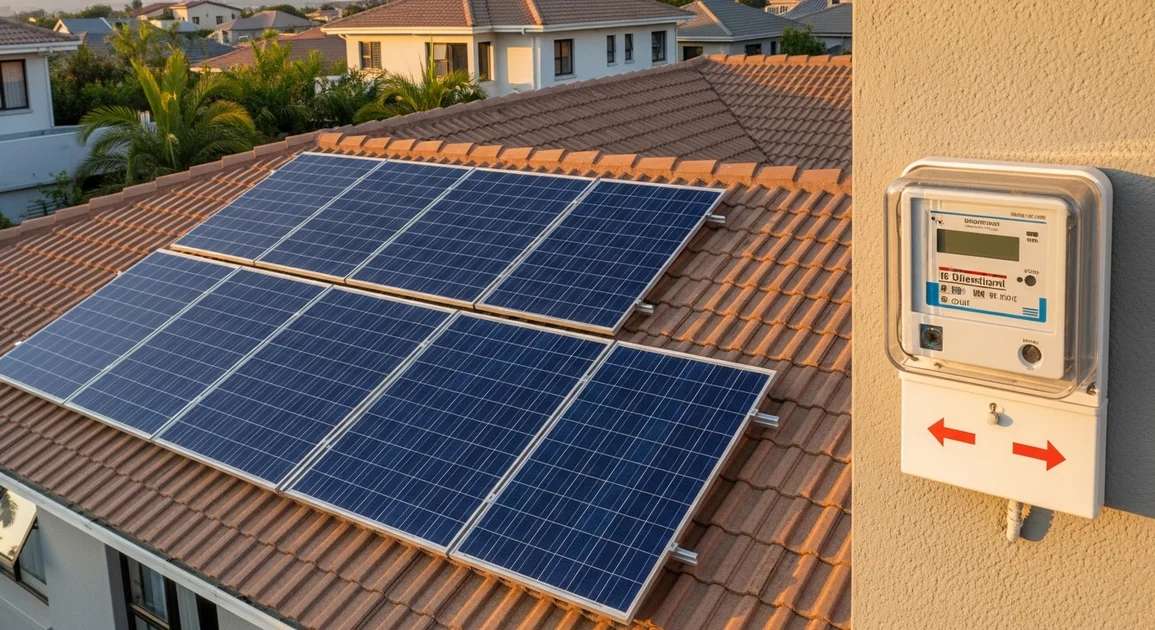
One of the most common questions from South African solar owners is: can I sell my surplus solar power back to the grid? The short answer is yes - but it's complicated, municipality-dependent, and the process is not as straightforward as it should be. This guide explains exactly how net metering and SSEG (Small Scale Embedded Generation) works in South Africa in 2026, which municipalities currently allow it, what the feed-in tariffs look like, and how to apply.
Net Metering at a Glance
R1.53-R2.32
Export credit per kWh: Cape Town (incentive included) to Eskom Gen-Offset Homeflex winter standard period (2026/27, incl VAT)
100 kW
Maximum residential SSEG capacity under NERSA rules (LV connection)
What Is Net Metering and SSEG?
Net metering (also called net energy metering or NEM) is a billing mechanism that allows solar system owners to export surplus electricity to the grid and receive a credit or payment for it. When you generate more power than you use, the excess flows back through your meter; when you use more than you generate, you draw from the grid as normal.
In South Africa, rooftop solar owners who want to export to the grid must register as a Small Scale Embedded Generator (SSEG). This is the official regulatory category under the Electricity Regulation Act and NERSA (National Energy Regulator of South Africa) guidelines. The application process involves your local municipality or, for Eskom direct customers, Eskom itself.
Important distinction: you can install solar without registering as an SSEG if you design your system not to export to the grid. Most residential battery-backup systems are installed this way, with an export limiter or anti-islanding configured at the inverter. But if you want credit for your surplus generation, you need to go through the SSEG process.
The Legal and Regulatory Framework
NERSA's Role
NERSA is the regulator responsible for licensing electricity generators in South Africa. In 2021, the licensing threshold was raised from 1MW to 100MW for embedded generators, which dramatically reduced the regulatory burden. For residential systems (typically 3-15kW), the key requirement is municipal approval, not a separate NERSA licence.
Schedule 2 of the Electricity Regulation Act
Systems under 1MW (including all residential solar) are exempt from NERSA generation licensing but must still comply with technical standards (NRS097-2-1) and obtain municipal approval before exporting. The municipality acts as the licensing body for grid-connection in its area.
SSEG Policy Framework
In 2021 the National Treasury and DMRE (Department of Minerals Resources and Energy) issued a municipal SSEG framework encouraging municipalities to adopt feed-in tariffs. However, uptake has been uneven. Some municipalities are leaders; many have still not implemented a workable process.
Which Municipalities Allow Net Metering in 2026?
Not all municipalities allow solar feed-in. The situation varies significantly by area. Here is the current state as of 2026:
Leading Municipalities (Active Feed-In Programmes)
| Municipality | Status | Feed-In Rate (approx.) | Notes |
|---|---|---|---|
| Cape Town (CoCT) | Active | 124.18c/kWh plus 28.75c incentive, about R1.53 including VAT (2026/27) | Home User tariff; most mature programme in SA |
| eThekwini (Durban) | Active | 160.52c/kWh, paid as an account credit (2026/27) | Residential net billing on Scale 3 or 4 only, less R77.43 per kVA of inverter size a month |
| Ekurhuleni | Active | R1.1461/kWh excl VAT (2026/27) | Billing via offset model |
| Tshwane (Pretoria) | Conditional | 94.13c/kWh excl VAT (City of Tshwane 2026/27 promulgated schedule) | Net consumers only, interim or pilot tariff; R324.00 excl VAT monthly fixed charge on domestic connections |
| City of Johannesburg | Conditional | 124.60c/kWh excl VAT (City Power 2026/27 embedded generator tariff) | Net consumers only, on a time-of-use tariff with a bi-directional meter |
| Stellenbosch | Active | Time-of-use: R1.23-R2.70/kWh Sep-May, R1.23-R6.16 Jun-Aug, excl VAT | From the 2026/27 draft tariff book; confirm the final rate |
| Nelson Mandela Bay | Check with the municipality | No 2026/27 rate we could verify | Confirm the programme is accepting applications |
| Eskom direct customers | Active (Gen-offset) | Homeflex, excl VAT: about 142.70c/kWh off-peak, about 707.51c/kWh in the winter peak; standard period 189.87c Sep-May, 201.65c Jun-Aug (2026/27) | Credit offsets energy bought; admin and service charges apply |
Important: Feed-in tariff rates, availability, and processes change. Always confirm with your specific municipality before planning around export revenue. Rates were checked on 26 November 2026 against the 2026/27 schedules of the City of Cape Town, eThekwini (headed as subject to NERSA and Council approval), Ekurhuleni, City Power (archived copy) (its export rate is in budget book Annexure B, headed “proposed schedule”), Stellenbosch (draft) and Eskom Gen-offset.
The application experience differs as much as the rates do. City Power credits exports only for net consumers on a time-of-use tariff with a bi-directional meter. Cape Town requires the Home User tariff. Build the admin lead time into your plans, not just the tariff.
How Net Metering (SSEG) Actually Works in Practice
Billing Method: Net Metering vs Feed-In Tariff
South African municipalities use two main methods:
- Net metering: Your exported kWh are subtracted from your imported kWh on your bill. You only pay for the net difference. If you export more than you import in a billing month, you receive a credit (carried forward, or sometimes paid out).
- Feed-in tariff (buy-back): Your exported kWh are purchased at a specific rate, billed separately from your import. You receive a payment or bill credit at the feed-in rate - typically lower than the retail import rate.
Cape Town does not offset exports at the retail rate. It credits each exported unit at the export rate, about R1.53 including VAT with the incentive (2026/27), against R3.56-R4.94 to buy a unit.
Bi-Directional Meter Requirement
To export to the grid, you need a bi-directional (smart) meter that can record both import and export separately. Most municipalities require you to apply for a meter replacement as part of the SSEG application. Some charge for this; others supply it free. Cape Town has been rolling out smart meters proactively to facilitate net metering.
The SSEG Application Process (Step-by-Step)
The process differs by municipality but follows a broadly similar structure:
Step 1: Pre-Application Check
Contact your municipality's Electrical Services department to confirm they have an active SSEG programme, check the current feed-in tariff, confirm meter requirements, and get the application form or portal link.
Step 2: System Design and Technical Documentation
Your installer must prepare a technical application package, typically including:
- Single-line diagram of the proposed installation
- Load schedule (your home's electrical loads)
- Equipment specifications (inverter model, panel specs)
- NRS097-2-1 compliance declaration
- Anti-islanding protection documentation
Step 3: Municipal Application
Submit the technical package to the municipality. Some accept online submissions; most still require paper or email. Pay the application fee if applicable (R500-R2,000 typical range).
Step 4: Approval and Installation
Wait for written approval. Do not install before receiving approval - installing without approval can result in the municipality refusing to allow export and requiring system modifications. Once approved, your certified installer installs the system.
Step 5: Commissioning Inspection
The municipality sends a technical inspector to verify the installation complies with the approved design and NRS standards. The Certificate of Compliance (CoC) from your electrical installation is required.
Step 6: Meter Upgrade and Activation
The municipality upgrades your meter to a bi-directional smart meter and activates the export measurement. From this point, your exported kWh are tracked and credited/paid.
Reality check: How long the process above takes depends on your municipality's backlog and capacity. Cape Town publishes no processing time for online applications (it says paper applications take 3-6 months to reach the Permission to Install letter). Factor the wait into your ROI calculations.
How Much Can You Earn Selling Solar Back?
Let's model a 10kW solar system in Cape Town producing 13,500kWh/year (typical for a well-oriented Cape Town rooftop). A 3-bedroom family home uses about 9,000kWh/year. Net export: 4,500kWh/year.
Annual Export Revenue Calculation
4,500 kWh x R1.5293 (124.18c plus 28.75c, including VAT). Your actual credit depends on how much you export, your tariff and the City's rules.
The higher your solar production relative to your consumption (i.e., the bigger your panels relative to your battery), the more you export - and the larger your export credit. Systems without batteries export more; systems with large batteries export less (the battery captures more surplus first).
Net Metering vs Feed-In Tariff: Which Earns You More?
The two billing methods differ in what an exported unit is worth. One-for-one net metering would value it at your purchase price. A feed-in or net billing tariff values it at a separate export rate, which on the 2026/27 schedules we checked is lower than the purchase price.
On the 2026/27 schedules we checked, exports are credited at a published export rate that is below what you pay to buy a unit: for example about R1.53 in Cape Town (incl VAT, incentive included), 160.52c in Durban (account credit, less a monthly charge per kVA), 124.60c excl VAT in Johannesburg and R1.1461 excl VAT in Ekurhuleni. A unit you use yourself is therefore worth more than one you export. Size for your own use first and treat the export credit as a bonus.
Should You Install Batteries If You Have Net Metering?
This is a nuanced question. The answer depends on your goals:
- Maximise financial return from solar alone: A large panel array without batteries exports the most kWh, but each exported unit earns less than one used at home, so compare the extra credit with the extra cost. Batteries reduce exports because they absorb surplus before it reaches the grid.
- Maximise load shedding resilience: Batteries are essential for backup during grid outages. Net metering doesn't help during load shedding because the grid is down.
- Long-term optimum: A battery + solar system with net metering gives you backup power AND earns export credits on generation that exceeds both home use and battery capacity.
In practice, most South African homeowners prioritise load shedding resilience over export revenue, so the default recommendation is a solar-plus-battery hybrid system. Net metering is the bonus on top.
Net Metering and the SARS Solar Tax Incentive
The Section 12B renewable energy tax deduction for businesses is unaffected by SSEG registration - it is based on the cost of the solar panels and system, not on your export activity, so you do not need net metering approval to claim it. Households should note there is no current personal tax credit: the old individual residential solar rebate only covered panels brought into use between 1 March 2023 and 29 February 2024 and has closed.
Read our Section 12B tax deduction guide for details on how to claim.
Future of Net Metering in South Africa
South Africa's energy policy is moving in the right direction for solar owners:
- Wheeling: A growing number of municipalities and Eskom are exploring energy wheeling - allowing large consumers to purchase solar power generated at a remote site and transmitted through the existing grid. This is mostly relevant for commercial and industrial users but will eventually trickle down.
- Time-of-use net metering: Cape Town and others are considering time-differentiated net metering rates - you earn more per kWh exported at peak times (typically 17:00-21:00) than at solar noon. This incentivises battery storage to shift exports to higher-value periods.
- Net billing as the national model: The draft Revised Electricity Pricing Policy proposes net billing plus time-of-use pricing as the national model for self-generators, alongside network charges for staying grid-connected. NERSA's decision is pending.
- National SSEG standards: NERSA is working on more standardised SSEG requirements to reduce the patchwork of municipal rules. This should simplify the process over the next few years.
For the bigger picture on where export payments for households are heading, see our SAWEM and the national feed-in tariff question guide - it explains why no national feed-in tariff exists yet, how the new wholesale electricity market works, and when residential generators are likely to take part.
Plan Your Solar System for Net Metering
If you're planning a solar installation and want to maximise net metering revenue, system sizing matters. Get a free quote from installers who understand SSEG applications in your area and can design a system optimised for both self-consumption and export.
Frequently Asked Questions
Can I sell solar back to Eskom directly?
Eskom direct customers (mostly rural areas and some suburban areas not served by municipalities) can in principle apply to Eskom for SSEG connection. Eskom's SSEG programme for residential customers is less mature than most metro municipalities. Contact your local Eskom office to check current availability.
What happens to excess solar if I don't have net metering?
If your inverter is configured to not export to the grid, surplus solar power that can't be used in the home or stored in the battery is wasted (curtailed). The inverter limits its output to match instantaneous consumption. This is the default configuration for most South African residential solar installations.
Is it worth going through the SSEG application process?
In municipalities with mature net metering programmes (Cape Town, eThekwini, Ekurhuleni) and where your system is likely to generate significant excess, yes. In municipalities with 12+ month backlogs or limited programmes, the time cost may outweigh the benefit for smaller systems.
How does net metering affect my electricity bill?
It depends on your scheme. Under one-for-one net metering, exported kWh would be subtracted from imported kWh. The 2026/27 municipal schedules we checked instead credit exports at a published export rate, lower than the purchase price, so your bill falls by the value of that credit.
What is the NMD (Notified Maximum Demand) limit for SSEG?
For low-voltage (residential) connections, you can export up to 100% of your existing NMD (typically equal to your breaker size × voltage × power factor). Most homes have a 60-100A single-phase or three-phase connection, allowing substantial export capacity. Your installer will calculate this for your application.
Which earns more, net metering or a feed-in tariff?
On the 2026/27 schedules we checked, exports are credited at a published export rate that is below what you pay to buy a unit: for example about R1.53 in Cape Town (incl VAT, incentive included), 160.52c in Durban (account credit, less a monthly charge per kVA), 124.60c excl VAT in Johannesburg and R1.1461 excl VAT in Ekurhuleni. A unit you use yourself is therefore worth more than one you export. Size for your own use first and treat the export credit as a bonus.