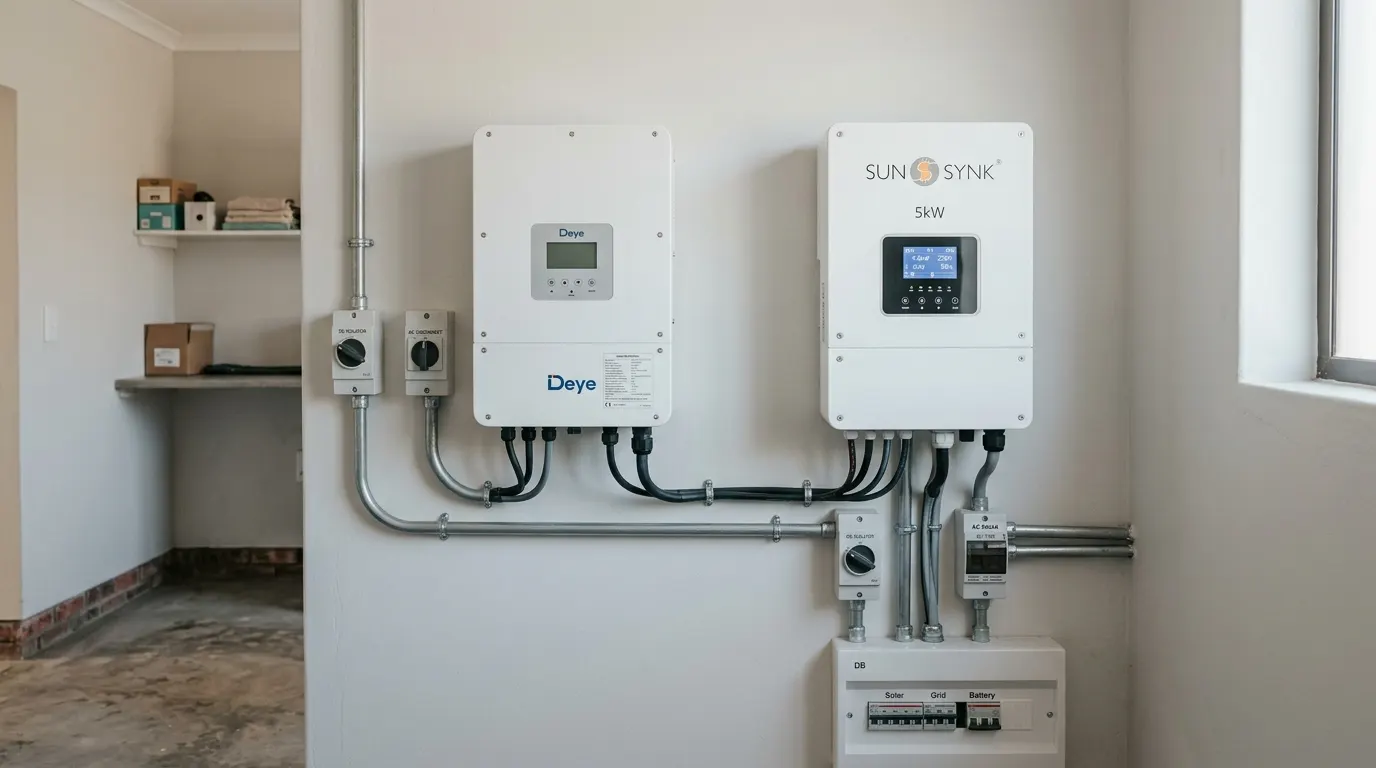
Quick Verdict: Must 6kW Hybrid Inverter
The Must PH18-6248 Plus is the cheapest way to get a 6kW hybrid inverter with dual MPPT in South Africa. At R6,999 (range R6,500-R8,500), the specs-per-rand are genuinely impressive: dual MPPT, WiFi monitoring, and BMS communication all included. But let's be frank-you get what you pay for. The 2-year standard warranty is a real concern, efficiency sits at 96% (below the 97%+ of premium brands), and build quality is noticeably lower. Fan noise is louder than competitors, and long-term reliability reports are mixed. Best for: Budget-first buyers who need basic backup power and understand they are trading longevity for upfront savings.
Must 6kW Hybrid Inverter Overview: PH18-6248 Plus Specifications
Must is a Chinese manufacturer that has carved out a niche in the budget segment of the South African solar market. The PH18-6248 Plus is their flagship residential hybrid inverter, and it has gained popularity for one simple reason: it's remarkably cheap for what it offers on paper. The PH18 series is by far the most common Must inverter you'll encounter in South Africa.
Let's be upfront: a 3.7/5 rating makes this the lowest-rated inverter in our lineup. That doesn't mean it's bad-it means it comes with significant trade-offs that buyers must understand before purchasing. The Must PH18-6248 Plus is a functional inverter that will keep your lights on during Eskom load shedding, but it demands realistic expectations about what budget pricing actually delivers.
Must PH18-6248 Plus Technical Specifications
Rated Output Power
6200W (6.2kW) continuous
Surge Power
9300W (9.3kW peak)
Maximum Efficiency
96.0%
MPPT Trackers
2 independent, 500VDC max
Grid Connection
Single phase 230V, 50Hz
Battery Voltage
48V (40-60V range)
Max Battery Current
120A charge/discharge
Communication
WiFi (included), BMS (included)
Weight
~22kg
Warranty
2 years (some distributors offer 5)
On paper, the specifications look competitive: 6.2kW continuous output is actually more than most "6kW" inverters deliver, and the 9.3kW surge capacity is among the highest in this class. The 120A battery charge current matches premium brands, and dual MPPT at this price point is genuinely uncommon.
But specifications don't tell the full story. The 96.0% maximum efficiency is notably lower than the 97%+ achieved by Growatt, Sunsynk, and GoodWe. Over a year, that 1-1.5% difference translates to real kWh losses-particularly significant in a country where every unit of solar energy matters during extended load shedding periods. The 500VDC MPPT maximum is also lower than the 550-600VDC range offered by competitors, slightly limiting panel string configurations.
Key Features: What the Must 6kW Gets Right (and Wrong)
The Must PH18-6248 Plus manages to pack in features that are genuinely surprising at its R6,999 price point. Let's examine what works well-and where the cost-cutting becomes apparent.
1. Dual MPPT Trackers at a Budget Price
Having two independent Maximum Power Point Tracking channels at under R7,000 is remarkable. This allows two separate solar panel strings, which is essential for South African homes with:
- Split roof orientations: North and west facing panels on different roof sections
- Partial shading: Trees or neighbouring buildings casting shadows on one roof section
- Phased installation: Start with one string now, add a second string later
- Mixed panel ages: Combine older panels with newer additions
Each MPPT operates independently with a maximum of 500VDC, allowing reasonable string lengths. Most budget inverters in this price range only offer a single MPPT, forcing all panels onto one string and sacrificing yield when shading or orientation differences exist. This is where Must genuinely delivers value.
2. WiFi and BMS Included-No Extras to Buy
At R6,999, the fact that WiFi monitoring and BMS (Battery Management System) communication are both included out of the box deserves recognition. Many competitors at this price require you to buy a separate WiFi dongle (R500-R1,000) and BMS communication cable (R300-R500). Must includes both, saving you R800-R1,500 on accessories.
The WiFi module connects to your home network and provides basic monitoring through a cloud platform. It's not as polished or feature-rich as Sunsynk Connect or Growatt's ShinePhone, but it gets the essential job done: you can see solar production, battery state of charge, and grid status from your phone.
3. High Surge Capacity for Motor Loads
The 9.3kW surge rating is notably higher than many competitors in the 6kW class. This is useful for starting motor-driven appliances that draw high initial current-pool pumps, compressor-based fridges, washing machines, and borehole pumps. The generous surge headroom means fewer nuisance trips when multiple appliances start simultaneously during load shedding.
However, surge capacity is only useful for brief moments. The 6.2kW continuous rating is what matters for sustained operation, and it's competitive with others in the class.
4. 120A Battery Current-Matching Premium Brands
The 120A maximum battery charge and discharge current matches what you'd find on inverters costing twice as much. This means you can charge a 5kWh battery bank from flat to full in roughly an hour during peak solar production, and discharge at full rate during heavy load periods.
This is particularly valuable in South Africa where load shedding schedules can be unpredictable. Fast charging allows you to top up batteries quickly between load shedding stages, maximizing your backup capacity when you need it most.
5. The Price-Let's Not Overlook the Obvious
At R6,999, the Must PH18-6248 Plus costs less than many 3kW inverters from premium brands. For a family that needs load shedding backup but simply cannot afford R12,000-R20,000 for a Sunsynk or Victron, the Must makes solar accessible. This matters enormously in South Africa where energy poverty is a real issue and Eskom tariff increases put grid electricity further out of reach for many households.
The question isn't whether the Must is as good as a Sunsynk-it isn't. The question is whether R6,999 for basic solar backup is better than R0 for no solar backup at all. For many South African families, the answer is obvious.
Performance Analysis: Where Budget Meets Reality
This is where honesty matters most. The Must PH18-6248 Plus performs adequately for its price, but falls short of what premium brands deliver. We've gathered data from installers and users across Gauteng, Western Cape, and KwaZulu-Natal to paint an accurate picture.
Efficiency: The 96% Reality
The 96.0% maximum efficiency rating is real-world achievable under optimal conditions, but it tells a concerning story when you look deeper. At partial loads (20-40% of capacity), efficiency drops to around 92-93%, compared to 95-96% for premium brands. This matters because inverters spend most of their time at partial load-early morning, late afternoon, and during light household consumption.
Over a year, the efficiency gap between the Must (96% peak) and a Growatt or Sunsynk (97%+ peak) can cost you 200-400 kWh of energy production. At R2.50/kWh, that's R500-R1,000 per year in lost production. Over 10 years, the "savings" from buying cheaper start to look less compelling.
Real-World Numbers: Johannesburg Installation
A 3-bedroom home in Roodepoort with 5kW of solar panels connected to a Must PH18-6248 Plus produces an average of 19-21 kWh per day in summer and 13-15 kWh in winter. A comparable installation with a Growatt 6kW ES Plus produces 20-23 kWh and 14-16 kWh respectively. The 1-2 kWh daily difference is directly attributable to the efficiency gap.
Noise: The Fan Problem
This is a commonly reported issue with the Must PH18-6248 Plus. The cooling fans are noticeably louder than premium brands-described by users as a persistent "whirring" that's clearly audible in a quiet garage. At moderate to full load, the fan noise can be heard from an adjacent room.
Premium inverters like Sunsynk and Growatt use variable-speed fans with better bearings that only spin up when needed and run much more quietly. The Must uses simpler fan assemblies that tend to run more often and at higher speeds. If your inverter will be installed near living areas or bedrooms, this is a genuine consideration.
Installation tip: Mount the Must in a garage, outdoor enclosure, or utility room as far from living spaces as cable runs allow. Do not install in or adjacent to bedrooms.
High-Temperature Performance
South African summers regularly push ambient temperatures above 35°C, and enclosed installation spaces can exceed 45°C. The Must PH18-6248 Plus has a rated operating range of -10°C to +50°C, but it begins thermal derating earlier than premium brands:
- Derating threshold: Begins reducing output above 40°C ambient (vs 45°C for premium brands)
- At 45°C: Output reduces to approximately 5kW (from 6.2kW rated)
- At 50°C: Output can drop to 4.2-4.5kW
- Thermal shutdown: Possible above 55°C in poorly ventilated spaces
The earlier derating and louder fans are related: the cooling system is less efficient, so the inverter runs hotter and derates sooner. In South Africa's warm climate, this is not a trivial issue. Proper ventilation around the Must is even more important than with premium brands.
Load Shedding Switchover
The Must PH18-6248 Plus switches to battery backup in approximately 20 milliseconds-functional, but noticeably slower than the under-10ms switchover of Sunsynk and Growatt. Most household appliances won't notice the 20ms gap, but:
- Desktop computers: Generally fine, but may show a brief screen flicker
- Digital clocks: May reset during the transition
- Sensitive lab/medical equipment: Not recommended without a UPS buffer
- WiFi routers, TVs, fridges: Typically no issues
For basic household backup during Eskom load shedding, the switchover performance is acceptable. If you run a home office with mission-critical equipment, consider adding a small UPS between the Must and your workstation for the cleanest possible transition.
Battery Compatibility: More Limited Than Premium Brands
Battery compatibility is an area where the Must PH18-6248 Plus shows its budget origins. While it includes BMS communication (a genuine positive), the list of officially tested and supported batteries is shorter than what you'll find with Sunsynk, Growatt, or GoodWe.
Confirmed Compatible Batteries
Based on installer reports and distributor confirmations, the following 48V lithium batteries work reliably with the Must PH18-6248 Plus:
Compatible Battery Brands
Pylontech (Best Tested)
Models: US3000C (3.55kWh), US5000 (4.8kWh)
Price Range: R18,000-R28,000 per unit
Compatibility: Good BMS communication via CAN bus, widely tested
Hubble Lithium
Models: AM-2 (2.56kWh)
Price Range: R16,000-R20,000 per unit
Compatibility: Works but some users report occasional communication dropouts
Dyness
Models: B4850 (4.8kWh)
Price Range: R17,000-R26,000 per unit
Compatibility: Generally works, confirm firmware version with distributor
Generic 48V Lithium Packs
Various Chinese-manufactured 48V LiFePO4 battery packs
Price Range: R8,000-R15,000 per unit
Compatibility: Often used together in budget installations, but BMS communication may be basic or absent
Important: Limited Compatibility List
Unlike Sunsynk or Growatt which maintain extensive tested battery databases with dozens of brands, Must's officially supported battery list is relatively short. Premium brands like Freedom Won, BSL, and some Hubble models may work but are not formally tested. Always confirm compatibility with your specific distributor before purchasing, and insist on a written compatibility guarantee.
Battery Sizing for the Must 6kW
Given the Must's budget positioning, most buyers pair it with affordable battery options. Here's a realistic sizing guide:
Battery Sizing Guide for Must PH18-6248 Plus
5 kWh (Budget Minimum)
Covers: 2-3 hours load shedding, lights, WiFi, TV, fridge only
Cost: R18,000-R28,000
10 kWh (Standard Backup)
Covers: 4-6 hours load shedding, most essential household loads
Cost: R35,000-R55,000
15 kWh (Extended Backup)
Covers: 6-8+ hours load shedding, full essential household loads
Cost: R50,000-R80,000
A word of caution: spending R50,000+ on batteries paired with a R6,999 inverter creates an imbalanced system. If your budget allows for 15kWh of lithium batteries, you should strongly consider investing in a more reliable inverter to protect that battery investment. The inverter is the brain of the system-skimping on it while splashing out on batteries is penny wise, pound foolish.
For detailed battery comparisons, see our Best Solar Batteries South Africa 2025 guide.
Installation Requirements: Mounting, Wiring & Setup
Installing the Must PH18-6248 Plus follows the same general process as any hybrid inverter. In South Africa, all solar installations must be performed by a qualified electrician who will issue a Certificate of Compliance (CoC) upon completion. This is a legal requirement, not optional.
Physical Installation
Location: Given the Must's noisier fan operation, location selection is more important than with quieter inverters. Recommended mounting locations:
- Garage (preferred): Good ventilation, away from living spaces, protected from weather
- Outdoor enclosure: Must be IP65 rated or better, with ventilation slots
- Utility room: Acceptable if well-ventilated and away from bedrooms
- Avoid: Direct sunlight, rain exposure, enclosed spaces without airflow, near bedrooms
Mounting: The Must weighs approximately 22kg-heavier than some competitors-and requires secure wall mounting using the included bracket. Ensure at least 300mm clearance on all sides, and consider 500mm clearance above the unit to allow hot air to rise away freely. The heavier weight means the wall must be solid brick or concrete; drywall mounting is not recommended without additional reinforcement.
Safety Warning
All electrical work must be performed by a licensed electrician. Solar DC voltages up to 500V and AC mains power are lethal. DIY installation voids your warranty, violates South African electrical regulations, and risks fire or electrocution. Always hire a qualified professional.
Electrical Connections
The Must PH18-6248 Plus requires four main connections:
1. Solar PV Input (DC): Two MPPT inputs, each accepting up to 500VDC. Use 4-6mm solar cable with MC4 connectors. The two MPPT channels allow independent string configurations for maximum flexibility.
2. Battery Connection (DC): 48V battery input supporting up to 120A. Use 16-25mm cable depending on distance. Install a DC isolator between inverter and battery bank for safety. BMS communication is via included cable.
3. Grid Connection (AC): Single phase 230V input via a dedicated 32A breaker in your distribution board. Use 4-6mm cable. The inverter synchronizes with the 50Hz grid frequency standard used in South Africa.
4. Backup Load Output (AC): Connect your essential loads to the backup output via a separate sub-distribution board. This circuit remains powered during load shedding. Keep backup loads within the 6.2kW continuous rating.
Typical Installation Cost
Installation costs for the Must PH18-6248 Plus are similar to any hybrid inverter:
- Labour: R4,000-R7,000
- Materials (cables, breakers, mounting hardware): R2,500-R4,500
- Certificate of Compliance: R1,500-R2,500
- Total installation cost: R8,000-R14,000
Note that installation costs are roughly the same regardless of which inverter brand you choose. This means the total system cost difference between Must and competitors is primarily the inverter price itself.
For how to choose a qualified installer, see our Best Solar Installation Companies in South Africa guide.
Monitoring: Basic WiFi Monitoring Included
The Must PH18-6248 Plus includes a WiFi module for remote monitoring-a genuine selling point at this price. However, the monitoring experience is noticeably more basic than what you'll get from Sunsynk Connect, Growatt's ShinePhone, or GoodWe's SEMS portal.
What You Can Monitor
The Must monitoring platform provides:
- Solar production: Current PV power (kW) and daily/monthly totals
- Battery status: State of charge (%), charge/discharge power
- Grid status: Connected/disconnected, import/export power
- Load consumption: Current household power draw
- Basic energy flow: Simple diagram showing power direction
What's Missing Compared to Premium Brands
Compared to Sunsynk Connect or Growatt ShinePhone, the Must monitoring platform lacks:
- Detailed historical data: Limited graphing and data export options
- Remote settings control: Most settings require physical access to the inverter
- Push notifications: Limited or unreliable alert system
- Financial calculations: No built-in savings or ROI tracking
- Third-party integration: Limited compatibility with home automation platforms
- App polish: Interface is functional but dated, with occasional connectivity issues
For basic "is my system working?" monitoring, the Must app is adequate. If you're the type who wants detailed analytics, historical charts, or remote control of inverter settings, you'll find it frustrating. Some tech-savvy users work around this by adding a third-party monitoring solution, but that adds cost and complexity.
Warranty & Support: The Elephant in the Room
Let's address this directly: the Must PH18-6248 Plus comes with a 2-year standard warranty. This is the single biggest concern with this inverter and the primary reason for our 3.7/5 rating. To put this in perspective:
- Sunsynk: 10 years standard
- Growatt: 5 years standard
- GoodWe: 5 years (extendable to 10)
- Victron: 5 years standard
- Must: 2 years standard
A 2-year warranty on an inverter that's expected to operate for 10-15 years is a significant red flag. If the inverter fails in year 3, you're paying for a full replacement out of pocket-which effectively doubles the total cost of ownership and eliminates any savings from buying cheap.
The Distributor Warranty Extension
Some South African distributors offer extended warranties of up to 5 years at their own cost. This is worth seeking out, but understand the distinction:
- Manufacturer warranty: Backed by Must's global operations-but Must's SA presence is minimal
- Distributor warranty: Backed by the local distributor's financial stability-if they close, the warranty is gone
If you're buying a Must, always confirm in writing: who backs the warranty, for how long, and what the claims process looks like. Get it on paper before handing over money.
Support Network in South Africa
Must does not have a dedicated South African office or support center. Support is handled entirely through the distributor network, which means:
- Response time: Varies greatly depending on your distributor-some are responsive, others are not
- Technical expertise: Distributors may not have deep technical knowledge of the product
- Spare parts: Availability depends on distributor stock; can be weeks for uncommon parts
- Firmware updates: Less frequent and less accessible than premium brands
Compare this to Sunsynk, which has a dedicated South African support team, local warehousing, and a nationwide installer network. The support gap is significant and should factor into your purchase decision.
Pricing Analysis: The Cheapest 6kW with Dual MPPT (2026)
Pricing is, without question, the Must PH18-6248 Plus's strongest selling point. At R6,999, it undercuts virtually every 6kW hybrid inverter in South Africa-and many 5kW inverters too.
Must 6kW Pricing (2026)
Must PH18-6248 Plus Retail Pricing
Inverter Only
R6,500 - R8,500 (most common: R6,999)
Complete System (Inverter + 5kW Panels + 5kWh Battery)
R35,000 - R50,000 installed
Price Per Watt
R1.05 - R1.37 per watt (inverter only)-lowest in class
The price-per-watt of R1.05-R1.37 is extraordinary. For comparison, the Sunsynk Lynks 6kW at R11,999 works out to R2.00/watt-nearly double. This makes the Must the clear choice for installations where initial cost is the primary constraint.
Total Cost of Ownership Warning
However, purchase price and total cost of ownership are different things. Consider this scenario:
Cost of Ownership: 10-Year Comparison
Must PH18-6248 Plus: R6,999 purchase + potential R6,999 replacement in year 3-5 (if warranty has expired) = R14,000 over 10 years. Plus R500-R1,000/year in lost efficiency = R19,000-R24,000 total.
Growatt 6kW ES Plus: R6,999 purchase + 5-year warranty + higher efficiency = R6,999-R13,998 over 10 years (if replacement needed after warranty). Better efficiency saves R500-R1,000/year = net cost R6,999-R8,998 for first 5 years.
This is not to say the Must will definitely fail-many units run fine for years. But the shorter warranty period reflects the manufacturer's own confidence in the product's longevity. Factor this into your decision.
Must 6kW vs Growatt 6kW vs Growatt 5kW vs Sunsynk Lynks 6kW: Comparison
Let's compare the Must against its direct competitors in the budget and mid-range 6kW segment. This is where the trade-offs become crystal clear.
| Feature | Must 6kW | Growatt 6kW ES Plus | Growatt 5kW ES Lite | Sunsynk Lynks 6kW |
|---|---|---|---|---|
| Price | R6,999 | R6,999 | R6,699 | R11,999 |
| Continuous Output | 6.2kW | 6kW | 5kW | 6kW |
| Surge Power | 9.3kW | 8.5kW | 7.5kW | 9kW |
| Efficiency | 96.0% | 97.0% | 97.0% | 97.5% |
| MPPT Trackers | 2 (500VDC) | 2 (500VDC) | 1 (500VDC) | 2 (550VDC) |
| Warranty | 2 years* | 5 years | 5 years | 10 years |
| WiFi Included | Yes | Yes | Yes | Yes |
| BMS Included | Yes | Yes | Yes | Yes |
| Battery Compatibility | Limited | Good | Good | Excellent |
| Monitoring App | Basic | ShinePhone (good) | ShinePhone (good) | Sunsynk Connect (excellent) |
| SA Support | Distributor only | Growing network | Growing network | Excellent nationwide |
| Noise Level | Noticeable | Moderate | Moderate | Quiet |
| Build Quality | Basic | Good | Good | Very good |
| Our Rating | 3.7/5 | 4.1/5 | 4.0/5 | 4.4/5 |
| Best For | Absolute budget buyers | Best value 6kW | Budget 5kW option | Quality + support |
*Note: Some Must distributors offer extended 5-year warranties at their own cost. Always confirm warranty terms in writing before purchase.
Our honest recommendation: At the identical R6,999 price, the Growatt 6kW ES Plus is the objectively better buy for most people-higher efficiency, longer warranty, better build quality, and stronger support. The Must only makes sense if you cannot find a Growatt in stock, need the slightly higher 6.2kW/9.3kW ratings, or find one discounted below R6,500. If your budget stretches to R12,000, the Sunsynk Lynks 6kW is a far more reliable long-term investment.
Pros & Cons: The Honest Breakdown
We believe in giving readers the full picture. Here's our candid assessment of the Must PH18-6248 Plus after consulting with installers and users across South Africa.
Pros
- Unbeatable price: Cheapest 6kW hybrid with dual MPPT in South Africa (R6,999)
- Dual MPPT included: Two independent solar inputs at a price where most competitors offer one
- WiFi + BMS included: No extra accessories to buy-saves R800-R1,500
- High surge capacity: 9.3kW peak handles motor starts well
- 120A battery current: Matches premium brands for fast charging
- Makes solar accessible: Brings load shedding backup within reach for more families
- 6.2kW continuous: Slightly higher than many "6kW" competitors
Cons
- 2-year warranty: Significantly shorter than all competitors-our biggest concern
- Lower efficiency: 96% vs 97%+ from premium brands-loses 200-400 kWh/year
- Noisy fans: Audibly louder than Sunsynk, Growatt, and GoodWe
- Lower build quality: Cheaper components, less refined finish
- Limited battery compatibility: Shorter tested list than premium brands
- Basic monitoring app: Functional but lacks features and polish
- No local support office: Entirely dependent on distributor network
- Slower switchover: ~20ms vs <10ms for premium brands
- Long-term reliability unknown: Fewer years of track record in SA market
Who Should Buy the Must 6kW?
The Must PH18-6248 Plus makes sense for a specific type of buyer:
- Absolute budget priority: Every rand counts and you need load shedding backup now
- Basic backup only: You just need lights, WiFi, TV, and fridge during Eskom outages
- Rental properties: Where you don't want to invest heavily in a property you don't own
- Temporary solution: Planning to upgrade to a better inverter in 2-3 years
- Secondary/backup system: Adding a second inverter for non-essential circuits
- DIY-minded users: Comfortable troubleshooting without extensive manufacturer support
Who Should Choose Alternatives?
Consider other inverters if you:
- Can stretch to R6,999 for a Growatt 6kW ES Plus: Same price, better everything-this is the obvious choice
- Value long-term reliability: The 2-year warranty is a real risk for a 10-15 year asset
- Need quiet operation: If the inverter is near living spaces, fan noise will bother you
- Want premium battery compatibility: Planning to use Freedom Won, BSL, or other less common brands
- Expect good after-sales support: Must's distributor-only support is a gamble
- Plan to invest heavily in batteries: Pairing expensive batteries with a budget inverter is risky
- Run a home office: The slower switchover and basic monitoring may be problematic
For help choosing the right inverter for your situation, see our Complete Solar Inverter Guide for South Africa.
Where to Buy the Must 6kW in South Africa
The Must PH18-6248 Plus is widely available through online solar retailers and local distributors across South Africa. Because Must relies on its distributor network for both sales and support, choosing the right seller is even more important than with premium brands.
Where to Find Must Inverters
Must products are available through:
- Online solar retailers: Several Takealot marketplace sellers and dedicated solar e-commerce sites stock Must
- Local solar distributors: Regional distributors in Gauteng, Western Cape, and KZN
- Solar installers: Some budget-focused installers carry Must as their entry-level option
- Facebook Marketplace/Gumtree: Common on second-hand platforms (buy with extreme caution)
What to Verify Before Buying
Because Must's support structure relies heavily on distributors, verify the following before purchasing:
- Warranty terms in writing: Confirm exactly what's covered, for how long, and by whom
- Distributor reputation: Check Google reviews, ask for references from previous customers
- Return policy: Understand the process for DOA (dead on arrival) units
- Battery compatibility confirmation: Get written confirmation that your chosen battery brand is supported
- Firmware version: Ensure you're getting the latest firmware for best compatibility
- Installation support: Some distributors include basic installation support or can recommend installers
Buying Tip: Always Use a Reputable Installer
Even with a budget inverter, professional installation is non-negotiable. The Must PH18-6248 Plus requires the same quality wiring, protection devices, and configuration as any inverter. A poorly installed budget inverter is far worse than a properly installed one. Budget R8,000-R14,000 for professional installation with CoC. See our Best Solar Installation Companies guide for what to check before you hire.
Final Verdict: Must 6kW Hybrid Inverter
The Must PH18-6248 Plus is the cheapest way to get a 6kW hybrid inverter with dual MPPT and WiFi monitoring in South Africa. At R6,999, the specification sheet reads impressively-but specifications and real-world experience are different things.
The 2-year warranty is a genuine concern for an appliance expected to run 24/7 for a decade. Lower efficiency, noisier operation, limited battery compatibility, and basic monitoring all remind you that R6,999 is, well, R6,999. You're getting what you pay for-no more, no less.
Here's the uncomfortable truth: at the exact same price, the Growatt 6kW ES Plus offers better efficiency, a longer warranty, superior build quality, and stronger support. Unless you specifically need the Must's slightly higher output ratings or can't find a Growatt in stock, the Growatt is the objectively better purchase.
That said, the Must still serves an important role in the market. For families who genuinely cannot afford more, it brings solar backup within reach. Some load shedding protection is infinitely better than none. If you buy with realistic expectations, understand the warranty limitations, and install it properly, the Must PH18-6248 Plus will keep your essential loads running during Eskom outages.
Our rating: 3.7/5 - Acceptable for strict budget buyers, but spend the same R6,999 on a Growatt 6kW ES Plus if you can find one.