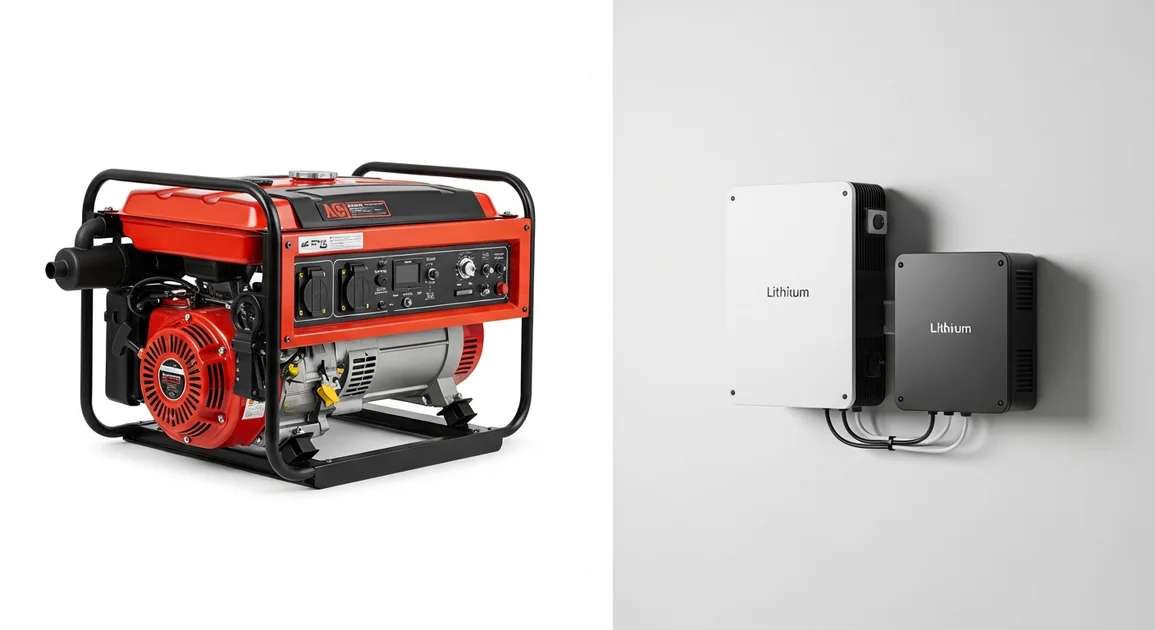
If you're tired of load shedding and trying to decide between a generator and an inverter, you're not alone. The honest answer: they solve different problems. A generator is a fuel-burning engine. An inverter converts stored battery power to usable AC electricity. Both keep your lights on during Stage 6 - but at very different costs, with very different trade-offs. This guide breaks it all down so you can make the right call for your home, budget, and usage pattern.
Generator vs Inverter: Quick Verdict
Inverter + Battery
- Silent operation
- No fuel cost (if solar-charged)
- Instant switchover
- Safe indoors
- Limited runtime (battery capacity)
- Higher upfront cost
Best for: Daily load shedding, apartments, suburbs
Generator (Petrol/Diesel)
- Unlimited runtime (add fuel)
- Powers heavy loads
- Lower upfront cost
- Noisy and smelly
- High ongoing fuel cost
- Must be outdoors
Best for: Extended outages, farms, construction, emergencies
What Is an Inverter (Battery Backup System)?
An inverter in the South African backup power context is typically a battery inverter system - a unit that takes stored DC power from a battery bank and converts it to 230V AC power for your home. The battery is charged either from solar panels or from the grid during cheap/off-peak periods.
Modern hybrid inverters (like the Deye, Sunsynk, and GoodWe range) combine the inverter, solar charge controller, and battery management in one unit. You plug in solar panels, connect a lithium battery, and you have a completely silent, automated backup system that cuts in within milliseconds when Eskom trips.
EnergyBee kit prices, battery included: Family Essential 5kW with a 10kWh battery R74,500-R90,500; Family Plus 8kW with a 10kWh battery R94,500-R110,500; Family Max 12kW with a 14kWh battery R150,500-R177,000.
What Is a Generator?
A generator is an internal combustion engine coupled to an alternator - it burns petrol, diesel, LPG gas, or dual-fuel to produce electricity. You start it manually (or automatically with an auto-start model) when the power goes out and it runs until you switch it off or run out of fuel.
Head-to-Head Comparison
| Factor | Inverter + Battery | Petrol Generator | Diesel Generator |
|---|---|---|---|
| Upfront cost | Solar kits from R74,500 (28 November 2026) | - | - |
| Noise level | Silent | Very loud | - |
| Switchover time | Instant | - | Auto-start |
| Runtime limit | Battery size | Unlimited (add fuel) | Unlimited (add fuel) |
| Indoor safe? | Yes | No (CO risk) | No (CO risk) |
| Maintenance | Low (annual service) | High (oil, plugs, carb) | Medium (oil changes) |
| Emissions | Zero (if solar-charged) | High (petrol fumes) | High (diesel fumes) |
| Suitable for apartments? | Yes | No | No |
Running Cost Deep Dive: The Number That Really Matters
Most people look at upfront cost and stop there. That's a mistake. Running costs determine the true cost of ownership.
Inverter Running Costs
Grid-charged backup costs R3.34 to R5.12/kWh across the major metros from 1 July 2026, VAT included, so a session using 4kWh costs about R13-R20 - or about R400-R615 over 30 sessions.
Noise: A Deal-Breaker in Suburbs
This is non-negotiable for many South Africans. At 11pm during Stage 6 in a suburban neighbourhood, a petrol generator is making enemies of your neighbours and potentially violating your municipality's noise bylaws.
Many body corporates and estates outright ban generators or restrict running hours. If you live in a sectional title property, an inverter-battery system is almost certainly your only viable option.
Inverters are completely silent. You won't hear a thing when they cut in.
Load Capacity: What Can Each System Power?
What an Inverter Can Power
A 5kW hybrid inverter with a 10kWh battery can comfortably run:
- LED lights throughout the house
- WiFi router and TV
- Fridge and freezer
- Laptop and phone charging
- Security system
- Fans
It cannot run high-draw appliances simultaneously - electric kettle, oven, or electric geyser will quickly drain a 10kWh battery. On a 5kW inverter, you can run the kettle briefly but not all day.
What a Generator Can Power
A petrol generator can run most of what an inverter can, but also handles high-draw appliances as long as total load stays within its continuous rating. You can boil a kettle, run the microwave, and charge an EV trickle charger simultaneously - as long as there's enough fuel.
Heavy diesel generators can run entire homes including geysers, air conditioning, and kitchen appliances.
The Hybrid Approach: Inverter + Generator as Backup-to-Backup
Many serious load-shedding survivors use both: a solar hybrid inverter system for daily load shedding (silent) with a generator kept on standby for genuine emergencies - extended grid failures, winter storm damage, or business-critical situations where battery runtime isn't enough.
In this configuration the generator only runs a few times per year, so fuel and maintenance costs are negligible. You get the best of both worlds: daily silent operation from the inverter, and unlimited runtime insurance from the generator.
Which Should You Choose?
Choose an Inverter + Battery if:
- You experience daily load shedding
- You live in an apartment or estate
- Noise is a concern
- You want to add solar panels later (or now)
- You want instant, automatic switchover
Choose a Generator if:
- You have occasional long outages
- You run high-draw appliances (welder, pump, oven)
- You're on a farm or in a rural area
- Budget is very tight upfront
- You need emergency backup only (rarely used)
- You're on a construction site or temporary setup
Total Cost of Ownership
| Cost Item | 3kVA Petrol Generator | 5kW Inverter + 10kWh Battery | Hybrid Solar (Family Essential 5kW kit) |
|---|---|---|---|
| Upfront cost | - | - | R74,500 (28 November 2026) |
| Annual fuel cost | - | Grid charging | R0 |
| Annual electricity savings | - | - | R15,600 |
Note: Calculations are illustrative. Actual costs vary by system size, fuel prices, and electricity tariffs. The hybrid column uses our Family Essential 5kW kit's entry price and its year-one bill saving, estimated for a home using 600 units a month, with solar replacing 65% of them (our assumption) at City Power's 2026/27 prepaid R3.34-R4.37 a unit including VAT (Johannesburg 2026/27 tariff, from 1 July 2026).
Safety Considerations
Every year South Africans are killed or hospitalised by carbon monoxide poisoning from indoor generators. CO is colourless and odourless - you won't know it's killing you. Never run a generator in a garage, enclosed patio, or near an open window or door. A proper outdoor standby generator requires professional installation with a transfer switch.
Inverter-battery systems are completely safe indoors. Lithium batteries should be installed in a ventilated area and away from heat sources, but they produce no dangerous gases under normal operation.
What About Load Shedding Schedules and Automation?
Inverters with smart charge controllers can be programmed to charge from the grid during off-peak tariff periods (if you're on a time-of-use tariff) and automatically switch to battery during load shedding. Many modern units integrate with apps like EskomSePush to pre-charge before a scheduled outage.
A generator with an auto-start module can switch on automatically when grid power fails - but there's still a gap, your sensitive electronics see a power interruption, and the generator still needs to be started warm to avoid flooding the engine.
Get a Solar Backup Quote
Not sure which system size you need? Get a free personalised quote - we introduce you to up to three installers so you can compare quotes. Compare inverter-battery and hybrid solar options side-by-side with actual Rand figures for your home.
Get my free quote →Compare Solar Inverters for Your Home
Ready to see which solar inverter is the right fit? We've reviewed every major brand available in South Africa - with real prices, specs, and EnergyBee ratings.
View all solar inverters →Financing & Installation: What to Expect
The inverter and battery mount in your garage or utility room, panels go on the roof, and you're operational immediately. A generator has zero installation time, but constant operational overhead: extension cables, fuel management, and manual starting every outage.
A 5kW hybrid system with a battery is R74,500-R90,500 installed for our Family Essential 5kW with a 10kWh battery. The solar battery price depends on capacity, so sizing storage to your real backup needs - rather than over-buying - is the fastest way to bring that number down.
Financing options are widely available for South African homeowners:
- Solar loans from major SA banks (Standard Bank, FNB, Nedbank)
- Rent-to-own / solar rental
Key Takeaways
- For daily load shedding in a suburb or apartment: an inverter-battery system (ideally with solar) wins on noise, safety, automation, and convenience.
- For occasional extended outages, farms, or heavy industrial loads: a diesel generator is hard to beat for raw reliability and unlimited runtime.
- The generator-inverter decision isn't always either/or. Many households keep both: inverter for daily use, generator for emergency insurance.
Frequently Asked Questions
Can an inverter replace a generator completely?
For typical South African load shedding, yes. For extended outages or high-draw loads like welding equipment, a generator is still the better tool.
What size inverter do I need for my home?
Size the inverter to cover the loads you want to run at the same time. Running an air conditioner, full kitchen, or pool pump simultaneously needs a larger inverter. Read our solar system sizing guide for a detailed calculation.
Is a generator or inverter better for a small business?
For businesses that need uninterrupted power (POS systems, refrigeration, computers), an inverter provides instant switchover that generators cannot. For manufacturing or heavy equipment, a diesel generator may be more appropriate. Many businesses use both.
What is the cheapest backup power for load shedding?
The cheapest upfront option is a small petrol generator. For Stage 4+ load shedding experienced daily, break-even for a solar hybrid against a generator depends on the system price and the running cost of the generator.