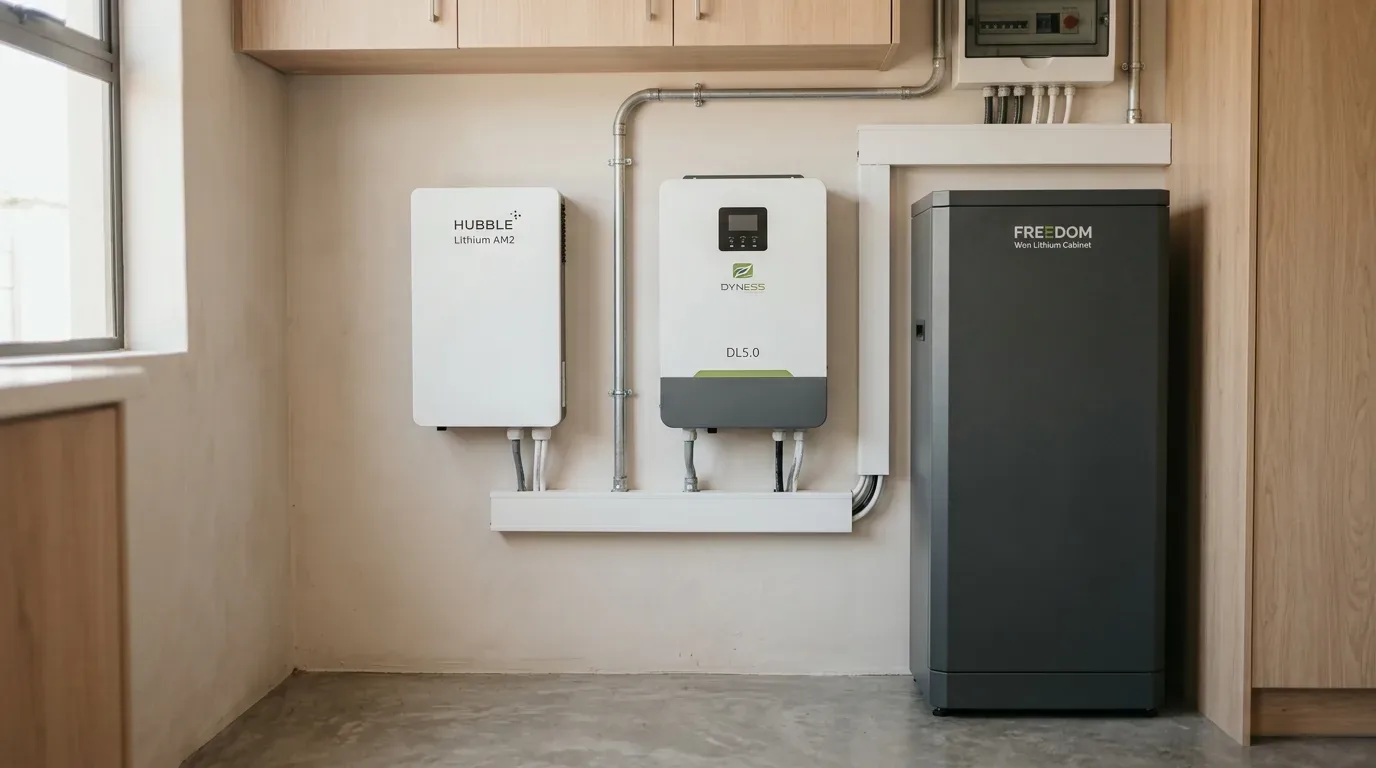
Dyness vs Hubble: the quick answer
Dyness is cheaper - its BX51100 5.12kWh unit runs R16,499 against the Hubble AM-5 at R19,999 for similar capacity. Hubble wins on local support - it is designed, assembled and warrantied in South Africa. The AM-2 and the Dyness DL5.0C are both rated 100A continuous discharge, as is the AM-5, against 75A on the BX51100. The Dyness DL5.0C, AM-2 and AM-5 carry a 10-year warranty on LiFePO4 cells. DL5.0C and DL5.0C V2 cover is 3 years if the battery runs without inverter communication. Dyness and Hubble catalogue prices checked 26 November 2026.
At a glance:
- 1. Dyness BX51100 (5.12kWh): R16,499 - lowest price per kWh in this comparison.
- 2. Hubble AM-5 (5.12kWh): R19,999 - South African design, local warranty support.
- 3. Hubble AM-2 (5.5kWh): R23,999 - 100A continuous discharge.
Dyness and Hubble are two lithium battery brands that show up together constantly in installer quotes because they serve overlapping system sizes at different price points. Dyness is an imported, dedicated battery manufacturer that competes hardest on price per kWh. Hubble is a South African-designed and assembled brand that competes on local warranty turnaround.
Both brands sell 48V-class LiFePO4 batteries that work with the same hybrid inverters - Deye, Sunsynk, Victron and Growatt - over CAN bus, so compatibility is rarely the deciding factor. The decision usually comes down to budget versus local support, which this guide breaks down model by model.
Dyness vs Hubble: Specifications Compared
| Specification | Dyness BX51100 | Hubble AM-5 |
|---|---|---|
| Price (catalogue, 26 November 2026) | R16,499 ✓ | R19,999 |
| Nominal capacity | 5.12kWh | 5.12kWh |
| Usable capacity | 4.61kWh (90% DoD) | Not published |
| Continuous discharge current | 75A (50A recommended) | 100A ✓ |
| Cycle life | 6,000+ @ 80% DoD | Unlimited within 10-year warranty (Ts & Cs apply) |
| Warranty | 5 years full cover, plus 5 years limited (excludes BMS and labour), registration required (terms, PDF) | 10 years |
| Local (SA) design and support | No - imported | Yes ✓ |
Prices and specs from our own battery catalogue (Dyness BX51100, Hubble AM-5) and the Hubble brand page, specs checked 27 November 2026, prices 26 November 2026.
Dyness vs Hubble: Every Model, Priced
Beyond the headline 5kWh units, both brands scale to larger single boxes. Here is the full line-up each brand sells in South Africa today.
| Brand & model | Capacity | Price |
|---|---|---|
| Dyness BX51100 | 5.12kWh | R16,499 |
| Dyness DL5.0C | 5.12kWh | R16,599 (26 November 2026) |
| Hubble AM-4 | 2.75kWh (24V) | R11,499 |
| Hubble AM-5 | 5.12kWh | R19,999 |
| Hubble AM-2 | 5.5kWh | R23,999 |
| Hubble AM-10 | 10kWh | R38,899 |
What inverter are you using, and how much backup load do you need?
Tell us your setup and we match you to the right battery - Dyness, Hubble or another brand - and then you compare quotes.
Which Should You Choose?
Choose Dyness If:
- Lowest price per kWh is your main priority
- You are matching an existing Dyness installation
- You want a published 90% depth of discharge on a budget unit
Choose Hubble If:
- Local South African support and fast warranty turnaround matter most
- You want the Hubble AM-2 for a 3-4 bed home
- You want a single wall-mounted unit up to 10kWh (AM-10) without stacking
Before You Buy: Caveats
Never mix brands in one bank
Parallel batteries must be identical models from the same manufacturer. A Dyness-Hubble mix causes BMS communication conflicts and uneven charging.
Unit price is not the installed price
Every price above is the battery alone. Add installation, wiring, and inverter integration - our battery installation cost guide breaks that down.
Check parallel limits before scaling
The Hubble AM-2 datasheet allows up to 15 units in parallel. Confirm the exact model's parallel limit before planning a large bank on either brand.
Frequently Asked Questions
Which is better, Dyness or Hubble battery?
Dyness wins on price per kWh - its BX51100 5.12kWh unit is R16,499 against the Hubble AM-5 at R19,999 for a similar 5.12kWh. On continuous discharge the AM-2 and the Dyness DL5.0C are both rated 100A, as is the AM-5 (the BX51100 is 75A). Hubble wins on local South African support - Hubble is designed, assembled and warrantied in SA, while Dyness support runs through importers. Choose Dyness for the lowest cost; choose Hubble if local warranty turnaround matters more than price.
Is Hubble or Dyness more reliable?
All use LiFePO4 cells, and the Dyness DL5.0C, AM-2 and AM-5 carry a 10-year warranty, but the datasheet cycle ratings differ: at least 6,000 cycles for the Dyness DL5.0C (90% DoD) and BX51100 (80% DoD), about 3,000 at 1C to 80% capacity for the Hubble AM-2, and unlimited cycles within the 10-year warranty (Ts & Cs apply) for the AM-5. The practical difference is support: Hubble is a South African company, so warranty claims and replacements are handled locally without overseas shipping. Dyness batteries are imported and supported through local distributors and installers rather than a local Dyness office, which can mean a longer turnaround on a warranty claim.
Can I mix Dyness and Hubble batteries in one system?
No. Batteries in parallel must be identical models from the same manufacturer - mixing brands causes BMS communication conflicts and uneven charging that can damage the cells. If you need more capacity than one brand's single unit provides, add more units of the same brand and model rather than switching brands.
What is the price of a Hubble battery versus a Dyness battery in South Africa?
Dyness catalogue prices, 26 November 2026: the BX51100 (5.12kWh) is R16,499 and the DL5.0C (5.12kWh) is R16,599. Hubble catalogue prices, 26 November 2026: the AM-5 (5.12kWh) is R19,999 and the AM-2 (5.5kWh) is R23,999. At the larger end, the 10kWh AM-10 is R38,899. These are supplied-unit prices, excluding installation.
Which battery is best in South Africa, Dyness, Hubble or Pylontech?
There is no single best - it depends on priority. Hubble leads on local (SA-made) support and warranty turnaround. Pylontech has the longest SA track record. All three use LiFePO4 chemistry; check the warranty term, because the Pylontech US5000 carries 7 years (10 if registered), while Dyness gives the DL5.0C 10 years and the separate DL5.0C V2 model 7 years basic (10 with a paid extension). See our full 14-brand comparison in the best solar batteries guide for every option side by side.
Our Verdict
For the lowest cost per kWh, Dyness wins. For local warranty support, Hubble wins. Both are proven LiFePO4 brands - there is no wrong choice here, only a different trade-off. Want to see all 14 brands side by side? Read our best solar batteries guide.
Ready to choose your battery?
Tell us your home size and backup needs. We help you compare quotes matched to a real battery brand and capacity.