Updated 13 November 2026. Written by Neil Berrow.
What changed since 8 July 2026: the July edition said a 5kVA inverter delivers about 4,000W at 0.8 power factor and allowed 2x surge (8kW); the datasheets say all five hybrids we list are rated 5,000W continuous and their peak rules differ by model, so the per-model table replaces both claims. The R15,000-R28,000 inverter-only range ignored the budget tier, so the price section now has two tiers with retailer URLs and a 13 November 2026 check date, and brand prices read from our product pages. New: the geyser answer with element ratings and the wiring-code reference, the three-question fit test, the fit qualifier, and what the wrong size costs.
Whether a 5kVA inverter is the right buy comes down to three things, and the sections below settle them in order: what the five models actually state on their datasheets, whether your geyser stays off backup, and which price tier you are looking at. Then a fit test. If you already know you need more, go up to the inverter sizing guide.
Is a 5kVA inverter enough? The short answer
- Backup for the essentials (lights, fridge, Wi-Fi, TV, plugs, about 1,000-2,000W together): yes, with more than half of the 5,000W rating to spare.
- Geyser on backup as well: no. A 3kW element plus the kitchen is about 5,500W. Put the geyser on a timer or size up to 8kW (8,000W continuous). 8kW system price guide.
- Inverter only: R5,220-R7,750 budget off-grid, R18,000-R28,000 branded hybrid. Why one costs a third of the other.
- Complete system: R74,500-R90,500 installed for our Family Essential 5kW with a 10kWh battery. Full 5kW system price breakdown →
- Single-phase only. Three main breakers on your DB board means a three-phase unit instead; see the three-phase section of the sizing guide.
Figures are the datasheet ratings of the Deye SUN-5K, Sunsynk 5K, GoodWe GW5000-EH, Growatt SPH 5000 and Luxpower SNA5000, retailer listings read on 13 November 2026, and our kit records. Browse the units themselves in our inverter range.
Want a 5kVA system priced for your home?
Tell us your bill and what has to stay on during an outage. We confirm 5kVA or 8kW against your DB board and then you compare quotes for the matching kit - not a generic table.
Is a 5kVA inverter the same as a 5kW inverter?
For the hybrids sold in South Africa today, yes. All five models we list state 5,000W of continuous output on their datasheets, so the badge and the usable number agree. The “a 5kVA only gives you 4kW at 0.8 power factor” rule is real, but it belongs to the older Axpert-class off-grid units: the original RCT Axpert 5K was sold as 5,000VA / 4,000W, and its MK2 successor is 5,000VA / 5,000W. That one retired unit is where the folklore comes from.
Where the five do differ is everything after the headline number, and that is what the price spread is paying for:
| Model | Continuous / backup | Peak rule | Battery bus | Parallel | BMS comms | Warranty | Datasheet |
|---|---|---|---|---|---|---|---|
| Luxpower SNA5000 WPV (off-grid) | 5,000W | 2 times rated power within 5 seconds | 48V (46.4-60V lithium), 110A | up to 16 units | CAN / RS485 to the battery BMS | 2 years (retailer-stated) | Luxpower SNA 3000-6000 WPV user manual, Oct 2025, table 2, p.52 (PDF p.56); parallel on p.6 |
| GoodWe GW5000-EH | 5,000W (5,500VA max) | 6,000VA for 60 seconds on backup | high-voltage (85-460V) lithium only, 25A | not stated on the datasheet | RS485 / CAN | 5 years, extendable to 10 (not on the sheet) | GoodWe EH series datasheet, Jan 2023, p.2 |
| Deye SUN-5K-SG03LP1-EU | 5,000W (5,500VA max) | 2 times rated power, 10 s | 48V (40-60V), 120A | up to 16 units | RS485 / RS232 / CAN | 5 years, 10 years by site | Deye SUN-3.6/5/6K-SG03LP1-EU datasheet, p.2 (parallel on p.1) |
| Sunsynk SUN-5K-SG04LP1 | 5,000W | 2 times rated power for 10 seconds | 48V (40-60V), 120A | not stated on the datasheet | RS485 / CAN | 5 years | Sunsynk 5kW SG04LP1 datasheet, p.1 |
| Growatt SPH 5000TL BL-UP | 5,000W / 4,000W on backup | no backup peak figure on the datasheet | 48V (42-59V), 85A | not stated on the datasheet | RS232 / RS485 / CAN / USB | 10 years | Growatt SPH 3000-6000TL BL-UP datasheet, p.2 (backup output 4,000W row) |
Three rows matter more than the rest. The Growatt SPH 5000 is a 5,000W inverter on the grid side but its datasheet caps the backup port at 4,000W, so during an outage it is a 4kW unit. The GoodWe GW5000-EH runs a high-voltage battery (85-460V), not the 48V packs the rest take, so a Pylontech or Hubble 48V module will not connect to it. And the Luxpower SNA5000 is an off-grid unit: it cannot feed the grid or register under NRS 097, which is part of why it costs what it does.
Checked 13 November 2026. A newer revision of any of these can state a different rule; read the sheet for the unit on your quote. How peak ratings work across the 5kW-to-12kW ladder is in the sizing guide’s surge section; which brand to pick is the best inverters guide.
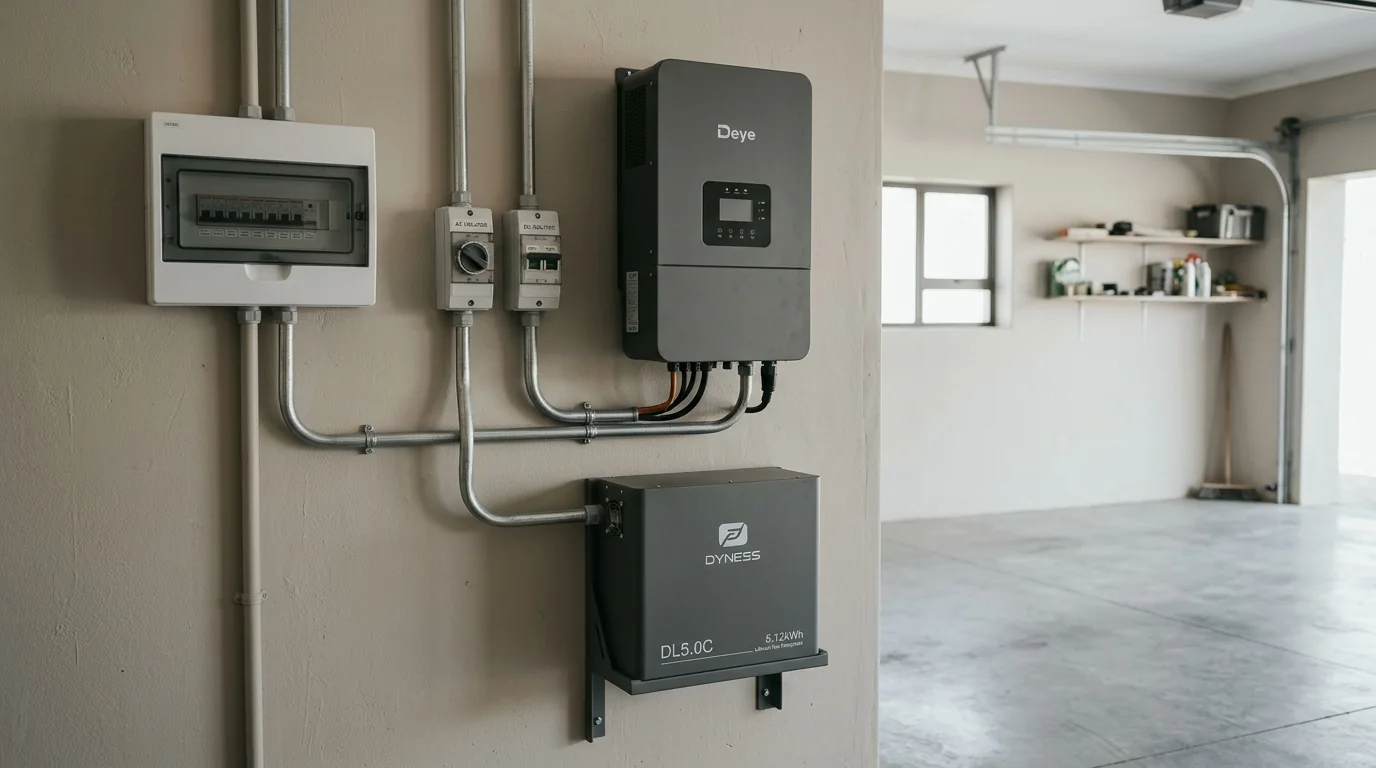
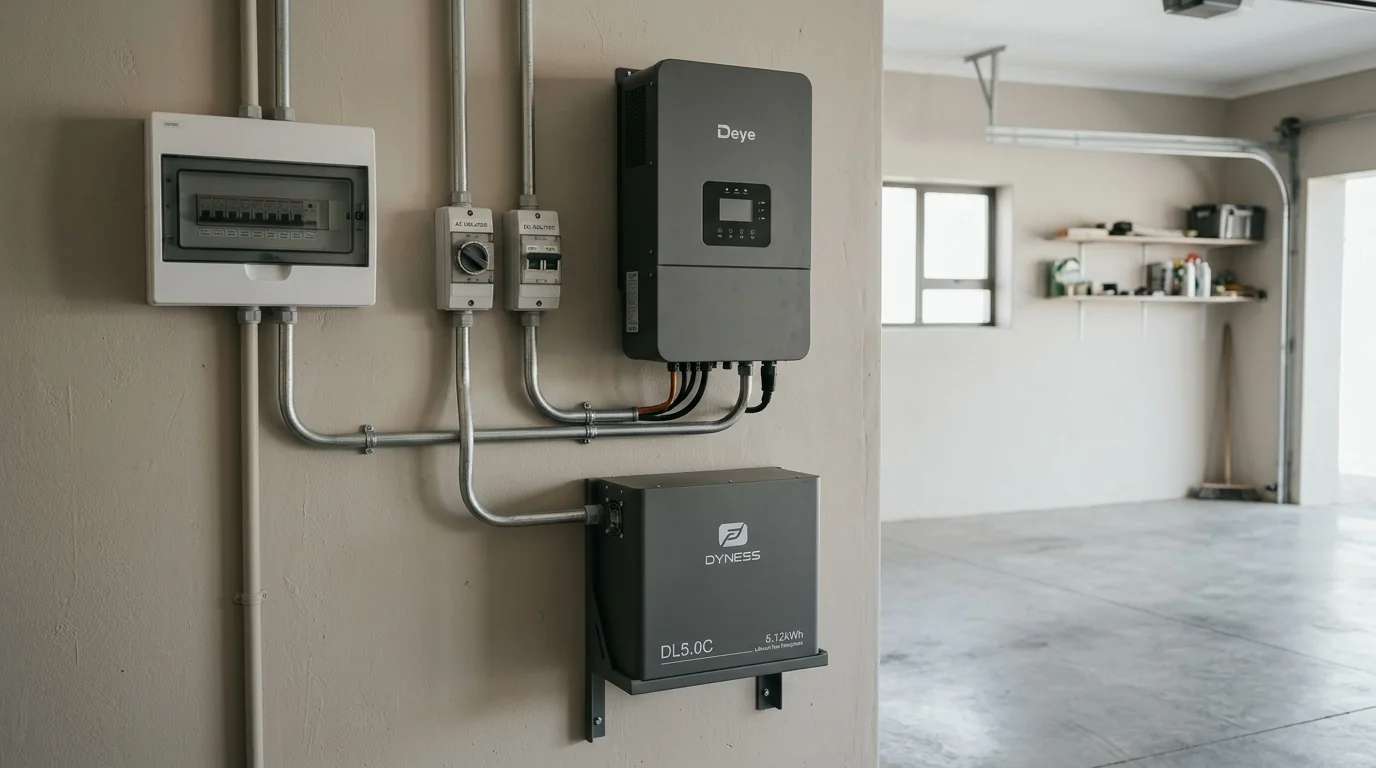
The usual 5kVA install: one 5kW hybrid at chest height, one 5kWh pack below it, DC and AC isolators beside the unit. A second pack is the 10kWh our 5kW kit ships with.
What can a 5kVA inverter actually run?
Everything a home needs to stay lit, cold and connected, at the same time, with headroom left. The budget is 5,000W of simultaneous load (4,000W on the Growatt’s backup port); every appliance draws from it at once, so the question is never “can it run X” but “what else is on when X starts”.
| Appliance | Running power | On a 5kVA? | Notes |
|---|---|---|---|
| LED lights (15 x 15W) | 225W | Yes | Whole-home lighting |
| Fridge + freezer | 270W | Yes | 600-1,000W surge each on start-up, inside the peak rating |
| TV + DStv decoder | 130W | Yes | Add a sound bar comfortably |
| Wi-Fi + security system | 65W | Yes | Router and alarm stay up |
| Laptops + phone chargers | 160W | Yes | Work-from-home ready |
| Microwave (1,000W) | 1,000W | Yes* | Fine on its own; count it against the total |
| Washing machine | 500W | Yes* | Not on a hot-water cycle |
| Kettle (2,000W) | 2,000W | Brief | Boils; the one load that collides with the geyser |
| Geyser (150L element) | 2,000W-3,000W | Alone only | See the geyser section below |
| Electric stove / oven | 2,000-3,500W | Alone only | One plate is fine; a full stove plus oven is not |
| Air-con (12,000 BTU) | 1,200-1,500W | One unit | 3-4x surge on start-up, inside a 10-second peak rating |
| Pool pump (1HP) | 750W | One unit | 4-6x surge; stagger it with the fridge |
* Fine on its own; count it against the 5,000W total before adding anything that heats. Running figures are typical nameplate values, so read the sticker on your own appliance. Motors (fridge, pump, aircon) surge for a second or two on start-up, which the peak rating absorbs: 10,000W for 10 seconds on the Deye and Sunsynk, 6,000W for 60 seconds on the GoodWe, and none stated on the Growatt.
This table is the inverter’s limit, not the system’s. What a whole 5kW solar system runs across a day, with the panels and battery doing the work, is a different question with its own page: what a 5kW solar system can run →
Can a 5kVA inverter run a geyser?
Alone, yes. On a timer, sensibly. With the kettle, never. A 150L geyser element is 2kW on a standard tank and 3kW on a high-pressure one (Kwikot’s own 150L element is 3kW; our Kwikot 150L page records both), and a 200L tank takes a 4kW element. All three sit inside 5,000W continuous, and because an element is a resistive load it has no start-up surge, so the peak rating never comes into it.
The arithmetic that trips people is the second appliance. A 3kW element plus the fridge, lights and Wi-Fi is about 3,500W: fine. Add one 2kW kettle and it is about 5,500W, over the rating on every model here and well over the Growatt’s 4,000W backup port. That is why the answer on the SERP is contested: the people saying “yes” are testing the geyser alone and the people saying “no” are testing it with the house.
The wiring makes the timer easy
A geyser is a fixed appliance under the wiring code, and SANS 10142-1:2017 (Edition 2), clause 6.16.1 requires that a fixed appliance is supplied through a disconnecting device that breaks both live conductors on a single-phase supply (6.16.1.2), positioned within 1.5 m of the appliance or in the distribution board if it can be locked open (6.16.1.4) (as summarised by the ECA(SA) technical note on SANS 10142-1 fixed appliances; clause numbers move between editions, so your electrician’s copy wins). In practice that means the geyser already has its own breaker and isolator, so a DIN-rail timer or a PV geyser diverter drops in beside it on the DB board, and the installer can leave the geyser circuit off the backup side entirely.
There is a battery cost too. A 3kW element heating for an hour takes 3kWh, nearly a third of a 10kWh pack. A timer that heats before the evening peak keeps both the inverter under its rating and the battery for the night.
If the geyser must run through outages with the rest of the house, that is the 8kW case: 8,000W continuous on the Sunsynk 8K carries the element and the kitchen together. The side-by-side table is in the sizing guide’s geyser section, and the installed price step is below.
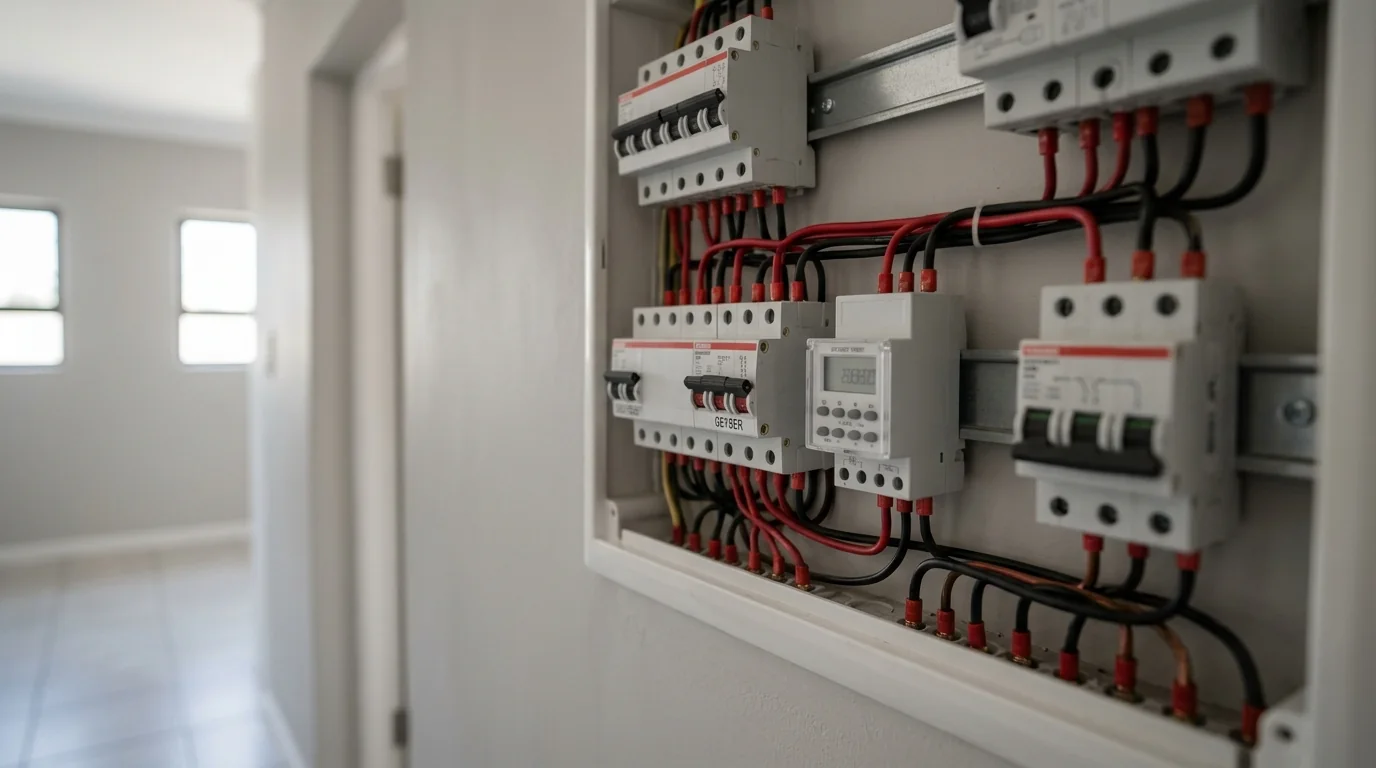
Because the code gives the geyser its own disconnecting device, a timer sits beside it on the DB board and the geyser circuit stays off the backup side.
Will a 5kVA inverter fit your home? The three-question fit test
Three yes answers and a 5kVA is the right buy. One no, and the question tells you which way to go. We call it the 5kVA fit test, and it is what the qualifier further down runs for you against your bill.
- Is your supply single-phase? Open the DB board: one main breaker is single-phase, three side by side is three-phase. Every 5kVA here is single-phase. A “no” means a three-phase hybrid, covered in the sizing guide.
- Is the geyser handled? On a timer, on a PV diverter, on gas, or simply off the backup side. A “no” (it must heat during outages with the house running) is the 8kW case.
- Is your evening load under about 3kW at once? Lights, fridge, TV, Wi-Fi, a laptop and a microwave together are about 2kW. Keeping the steady total under 3kW leaves 40% of the 5,000W rating for a fridge compressor or pool pump to start on. A “no” (an electric stove and oven, two aircons, or a pump and a geyser) is also the 8kW case.
One more thing the test does not ask but the bill does: a monthly bill above about R5,000 points to more panels than a 5kVA inverter will use (6,500W of PV on the Deye), so a reader who wants to cut that bill rather than only back it up ends up at 8kW for the array, not the loads. How bill and loads combine into a size is the system sizing pillar.
How much does a 5kVA inverter cost in South Africa in 2026?
R5,220-R7,750 for a budget off-grid unit; R18,000-R28,000 for a branded grid-tied hybrid. Both are inverter-only. The first set are retailer listings read on 13 November 2026; the second are the price bands on our own product pages, with a retailer check beside each where we found one.
Budget tier: off-grid 5kVA units (retailer listings, 13 November 2026)
| Unit | Retailer price (inverter only) | Rated | Surge | Warranty |
|---|---|---|---|---|
| RCT Axpert 5K MK2 (48V, 5,000VA / 5,000W, off-grid) | R5,220 incl. VAT, ComX Computers | 5,000VA / 5,000W | 10,000VA (listing) | local supplier |
| Luxpower SNA5000 5kW off-grid | R7,750 incl. VAT, Solar Panel Energy | 5,000W | 2x rated, 5 s (manual) | 2 years |
Branded tier: grid-tied 5kW hybrids (our listed bands, retailer check beside each)
| Model | EnergyBee listed price | Retailer check, 13 November 2026 | What the money buys |
|---|---|---|---|
| Luxpower SNA5000 WPV (off-grid) | R7,500-R10,000 | R7,750 (incl. VAT), Solar Panel Energy | Off-grid only, 2-year warranty, parallel to 16 |
| GoodWe GW5000-EH | R18,000-R24,000 | No SA retailer listing found on the check date | Grid-tied, high-voltage battery only, 60-second peak |
| Deye SUN-5K-SG03LP1-EU | R18,500-R24,000 | R14,850 (VAT basis not stated), JC Solar Panels | Grid-tied, up to 16 units, 2 times rated power, 10 s, 5 years, 10 years by site |
| Sunsynk SUN-5K-SG04LP1 | R20,000-R26,000 | R15,700 (VAT basis not stated), Invert Solar | Grid-tied, not stated on the datasheet, 2 times rated power for 10 seconds, 5 years |
| Growatt SPH 5000TL BL-UP | R22,000-R28,000 | No SA retailer listing found on the check date | Grid-tied, 10-year warranty, 4,000W backup port |
The inverter is a small share of a working system. With a battery, panels and installation, a complete 5kW system is R74,500-R90,500 installed for our Family Essential 5kW with a 10kWh battery, from our kit records. The line-by-line breakdown, what the battery adds and what a battery-only backup costs are on the 5kW solar system price guide → and the kit itself is on our solar power kits page.
Why does one 5kVA cost a third of another?
Because “5kVA” is the one thing the two tiers share. The R5,220 RCT Axpert and the R7,750 Luxpower are off-grid units: they take panels and a battery and feed the house, but they do not synchronise with Eskom, cannot export, and carry no NRS 097 grid certification, so they are installed as a backup island behind a changeover. The branded hybrids are grid-tied: NRS 097-2-1 certified (the Sunsynk sheet lists it; the Deye and Growatt sheets list NRS 097), able to blend solar, battery and grid at once, registered with Eskom or the municipality, with a 5- to 10-year warranty, lithium BMS communication and an app. Half the price gap is certification and warranty, the rest is the battery handling and the software.
Neither tier is wrong. A budget off-grid unit with a 5kWh pack is an honest backup system for a flat or a small home that will never register with the municipality. A branded hybrid is the unit for a system that is meant to cut the bill, be registered, and still be supported in year six. Compare brands properly in the best inverters guide.
Does a 5kVA inverter fit your home?
Two answers settle it: your monthly bill and which appliances must keep running when the power is off. We return a fit-or-size-up verdict with the datasheet figures behind it and the kit that covers it. No contact details needed to see it.
What does buying the wrong size cost?
Going up a size now costs R20,000 to R20,000 installed: our Family Essential 5kW (10kWh battery, 12 panels) is R74,500-R90,500 and our Family Plus 8kW (10kWh battery, 16 panels) is R94,500-R110,500, from the kit records on 13 November 2026. That step is mostly four more panels and the bigger inverter; the battery is the same.
Bought 5kVA, needed 8kW
The inverter trips the first evening the geyser and the kettle overlap, so the geyser goes on a timer anyway. If that is not acceptable, the fix is a second inverter in parallel (the Deye and Luxpower allow it, the Sunsynk sheet does not say) or a swap: the 5kW unit is resold second-hand, the DB work is partly redone and the Certificate of Compliance is reissued. We do not publish a rand figure for that because it depends on the installer and the board; ask for it as a line item if you are weighing 5kVA now against 8kW later.
Bought 8kW, 5kVA would have done
You paid the R20,000 to R20,000 step for headroom you do not use, and an inverter running at a fraction of its rating idles a little less efficiently. That is the cheaper mistake, which is why the sizing rule is to go up one step when you are between bands, never two. The 8kW breakdown is on the 8kW system price guide.
What battery pairs with a 5kVA inverter?
5-10kWh of 48V lithium, in one or two packs. The Deye and Sunsynk 5K charge and discharge at up to 120A (5.8kW at 48V), so one 5kWh pack is already matched and two give the 10kWh our Family Essential 5kW ships with. The GoodWe is the exception again: a high-voltage pack only. Which pack, and how many hours it buys, is the battery sizing guide.
The inverter sets how much, the battery sets how long
Runtime is usable kWh divided by the load. A 10kWh pack at a 1,500W evening load lasts about six hours; the same pack with a 3kW geyser element running lasts under three. That is the other reason the geyser goes on a timer.
Caveats: what a 5kVA inverter will not settle
Your DB board decides, not this page
An installer reads the main breaker, counts the phases and checks which circuits can move onto backup. That visit is free as part of a quote and it is what confirms 5kVA or 8kW.
The five models are not interchangeable
The GoodWe needs a high-voltage battery, the Growatt gives 4,000W on backup, the Luxpower is off-grid only and the Sunsynk sheet does not state a parallel rating. Read the datasheet linked in the table for the exact unit on your quote, checked 13 November 2026.
Retailer prices move weekly
The retailer figures were read on 13 November 2026 at the URLs in the table; the two branded retailer checks do not state their VAT basis. Treat them as the shape of the market on that day, not a quote.
A grid-tied 5kVA gets registered; an off-grid one does not
A grid-tied hybrid is registered with Eskom or your municipality. Eskom waives its registration and connection fees for systems up to 50kVA, a waiver it extended until further notice on 1 October 2026 (checked 13 November 2026; recheck before you rely on it). The steps are in our SSEG registration guide.
Flats never get panels
An apartment is a backup-only enquiry: inverter and battery, no rooftop build. A 5kVA with a 5kWh pack is the usual flat system, and the quote will say so.
Ready for a 5kVA quote?
The fit test above is a shortlist. An installer walking your DB board is what confirms 5kVA or 8kW, and it is free as part of a quote.
Get a 5kVA system quote for your home
Free, no obligation. Tell us your bill and what must stay on during an outage; we match you to the 5kW or 8kW kit and then you compare quotes.