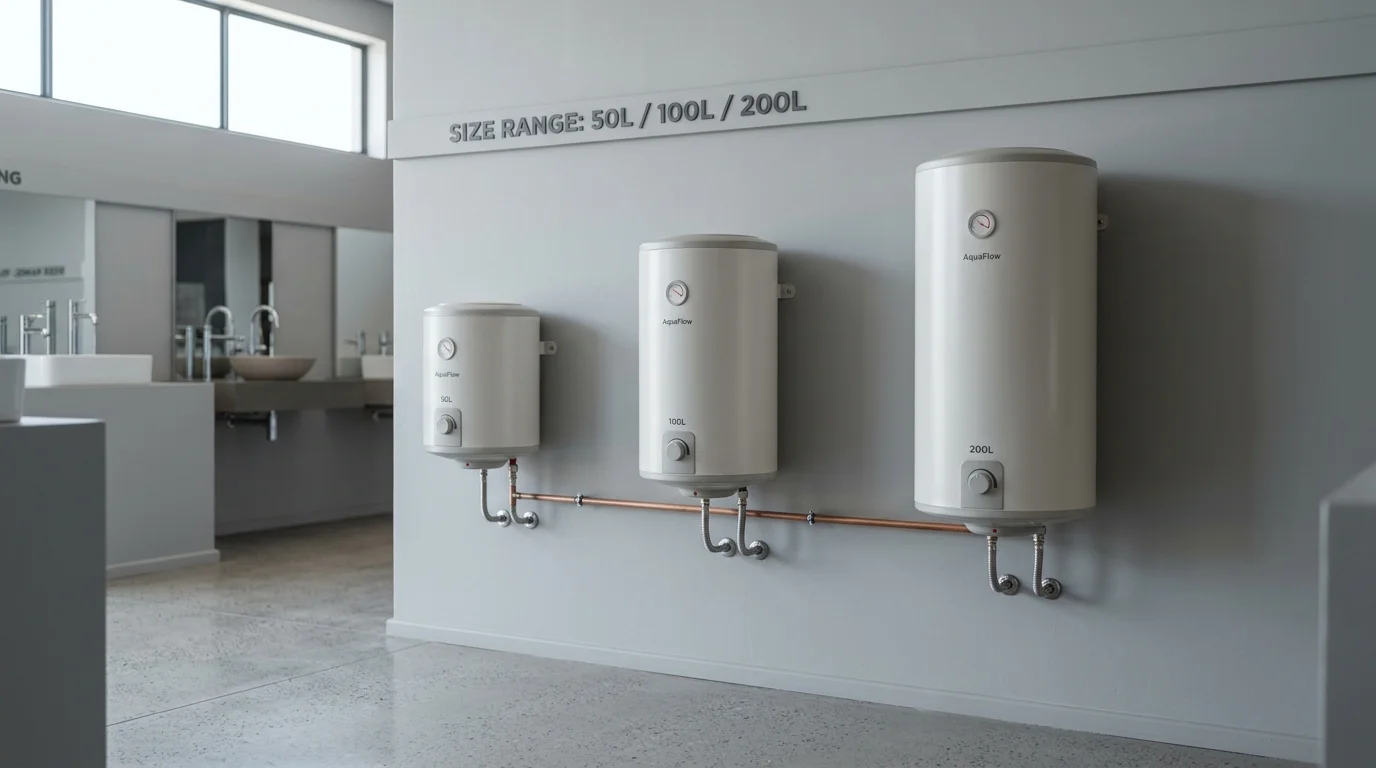
Quick Answer: Which Geyser Size Do You Need?
For most South African households: A 200L geyser is the optimal choice for families of 3-4 people, costing R5,000-R7,000 and providing balanced capacity. Choose a 150L geyser (R3,500-R5,500) for 1-2 people or small apartments, and a 250L geyser (R6,500-R8,500) for families of 5+ or high hot water usage.
Rule of thumb: Allow 40-50 litres per person for standard usage. Factor in baths (100L each), multiple showers per day, and laundry frequency when sizing up.
Geyser size by household, at a glance
- 1-2 people: 150L (R7,500 installed)
- 3-4 people: 200L (R10,000 installed) - the default for most SA homes
- 5+ people, teenagers, or baths over showers: 250L (R12,500 installed)
Rule of thumb: Allow 40-50L of hot water per person per day. Multiple bathrooms used at the same time, or a household that prefers baths (100L+ each), pushes you up a size.
How many people live in the house?
How much hot water do I actually get from a 150L, 200L or 250L geyser?
When South Africans talk about geyser sizes-150L, 200L, 250L-they're referring to the total water storage capacity in litres. But this number doesn't tell the full story of how much usable hot water you actually get.
A geyser typically heats water to 60-65°C for safety and efficiency. When you use hot water, it mixes with cold water at the tap to reach a comfortable 38-42°C for showering. This means a 150L geyser doesn't give you 150 litres of shower-temperature water-it gives you approximately 200-250 litres of mixed usable water once diluted.
Usable Hot Water Calculation
- 150L geyser: ~200-250L mixed water (sufficient for 3-4 showers)
- 200L geyser: ~270-330L mixed water (sufficient for 5-6 showers)
- 250L geyser: ~330-410L mixed water (sufficient for 6-8 showers)
Assumes 60°C geyser temperature mixed to 40°C usage temperature. Actual yield depends on incoming cold water temperature (varies by season and region).
In South Africa's climate, cold water inlet temperatures range from 10°C in winter (Johannesburg, Pretoria) to 20°C in summer (Durban, Cape Town coastal areas). Colder inlet water means your geyser works harder and you get slightly less mixed hot water from the same capacity.
How do I calculate my household's hot water needs?
Choosing the right geyser size starts with understanding your household's daily hot water consumption. Here's a practical calculation method used by South African plumbers and energy consultants:
Daily Hot Water Usage Guide
| Activity | Hot Water Used |
|---|---|
| Shower (8-10 minutes) | 50-70L |
| Bath (full) | 80-120L |
| Dishwashing (manual) | 10-20L |
| Washing machine (hot cycle) | 30-50L |
| Hand washing / face wash | 2-5L |
Example calculation for a family of 4:
- 4 morning showers: 4 × 60L = 240L
- Evening dishwashing: 15L
- Hand washing throughout day: 10L
- One hot laundry load: 40L
- Total daily need: ~305L mixed hot water
This family needs a geyser that can provide 305L of mixed water, which translates to approximately 180-200L of stored hot water at 60°C. A 200L geyser is the perfect match. A 150L would be marginal (running out during peak usage), while a 250L would be oversized and waste energy.
Peak Usage Consideration
Don't just calculate average daily usage-consider peak demand periods. If everyone showers within a 2-hour morning window, you need a geyser that can supply that concentrated demand. Recovery time between uses becomes critical (covered below).
Is a 150L geyser big enough for my household?
The 150L geyser is South Africa's most popular choice for smaller households, bachelor pads, granny flats, and apartments. It strikes an excellent balance between capacity and energy efficiency for 1-2 person households.
150L Geyser: Best For
- 1-2 person households with standard usage patterns
- Bachelor apartments and granny flats
- Couples without children who shower at different times
- Holiday homes with intermittent occupancy
- Households prioritizing lower electricity bills (saves R200-R300/month vs 200L)
- Homes with limited ceiling space (150L geysers are more compact)
Real-world performance: A 150L geyser comfortably handles 3-4 consecutive showers when fully heated. If you're a couple who showers at different times (morning and evening), you'll never experience shortages. The geyser recovers quickly-reheating in 2-2.5 hours-so it's ready for evening use after morning showers.
When 150L falls short: Families of 3+ people, households with teenagers (longer showers), homes where multiple people shower simultaneously, or households that frequently run hot laundry loads. In these scenarios, you'll experience hot water shortages during peak times, leading to frustration and cold showers.
For detailed pricing and brand comparisons, see our 150L Geyser Prices South Africa 2026.
Is a 200L geyser right for my family?
The 200L geyser is the default recommendation for most South African family homes. It's the Goldilocks size-not too small, not too large-and handles the typical 3-4 person household with room to spare.
200L Geyser: Best For
- 3-4 person families (the South African average household size)
- Couples with 1-2 children in primary/high school
- Households with moderate to high hot water usage
- Homes with 2 bathrooms where simultaneous usage may occur
- Households planning to add a child in the next few years
- Standard suburban homes (most common installation in SA)
Why 200L is the sweet spot: It provides enough capacity for morning rush hour (multiple showers, dishwashing) without excessive energy waste. During load shedding, a 200L geyser retains heat for 6-8 hours with a geyser blanket, ensuring hot water availability even during extended power outages.
Real-world performance: A 200L geyser handles 5-6 consecutive showers comfortably. For a family of 4, this means everyone gets a hot shower even if they all shower within a 90-minute window. The geyser recovers in 2.5-3 hours, ready for evening baths or laundry.
Cost consideration: A 200L geyser costs R5,000-R7,000 (R1,500-R2,000 more than 150L) but uses only 15-20% more electricity monthly. For most families, this extra R150-R200/month is worthwhile for the added capacity and convenience.
When do I need a 250L geyser instead of 200L?
The 250L geyser is the heavy-duty option for large families, high-usage households, or homes with specific hot water demands. While less common than 150L and 200L, it's essential for certain scenarios.
250L Geyser: Best For
- Families of 5+ people with high simultaneous usage
- Households with teenagers (notoriously long showers)
- Homes with multiple bathrooms in regular simultaneous use
- Households that prefer baths over showers (baths use 100L+ each)
- Homes with guest accommodation or frequent visitors
- Households running businesses from home (B&Bs, home salons)
Real-world performance: A 250L geyser provides 6-8 consecutive showers or 2-3 full baths. It's the go-to choice for families where everyone showers in the morning before school and work, or for homes with teenagers who take 15-20 minute showers.
The downside: A 250L geyser uses 20-30% more electricity than a 200L unit (R200-R300 extra monthly). It also requires more ceiling space and stronger roof support. Recovery time is longer (3-3.5 hours), though this matters less since the larger capacity means you're less likely to deplete it.
Avoid Oversizing
Many South Africans oversize their geysers "just in case," but this wastes energy. A 250L geyser keeping 250 litres hot 24/7 for a 2-person household is throwing away R300-R400 monthly. Size appropriately for your actual needs, or consider a heat pump which is more efficient at any size.
150L vs 200L Geyser: Which Should You Buy?
Choose 150L if you're 1-2 people; choose 200L if you're 3-4. A 200L geyser costs R1,500-R2,000 more to buy and 15-20% more to run, but gives you 5-6 showers back to back against 3-4 for a 150L.
Household size and capacity
A 150L geyser serves 1-2 people, delivering 200-250L of mixed water once diluted - 3-4 showers per cycle. A 200L geyser serves a 3-4 person family, delivering 270-330L of mixed water - 5-6 showers back to back, enough for everyone to shower within a 90-minute morning window.
Energy and running costs
A 200L geyser uses 450-550 kWh per month against 350-450 kWh for a 150L (R900-R1,100 vs R700-R900 at R2/kWh). Installed, expect R10,000 vs R7,500. The extra R150-R200/month is worth paying the moment a third person joins the household.
Space and installation
A 150L geyser is the compact option at 1100-1200mm tall and 450-500mm in diameter. A 200L unit needs 1300-1400mm of ceiling space, which most suburban ceilings handle. Recovery is 2-2.5 hours for a 150L against 2.5-3 hours for a 200L.
200L vs 250L Geyser: Which Should You Buy?
Stick with 200L unless you're 5+ people, have teenagers, or run a home business with guest accommodation. A 250L geyser costs R1,500-R2,000 more upfront and 20-30% more to run (R200-R300/month) than a 200L.
Household size and capacity
A 200L geyser covers a 3-4 person family with 270-330L of mixed water - 5-6 showers back to back. Move to 250L when there are 5+ people, teenagers taking 15-20 minute showers, or two bathrooms in use at once: 330-410L of mixed water covers 6-8 showers or 2-3 full baths.
Energy and running costs
A 250L geyser uses 550-650 kWh per month against 450-550 kWh for a 200L (R1,100-R1,300 vs R900-R1,100 at R2/kWh). Installed, expect R12,500 vs R10,000 - and over 10 years, R161,500 vs R134,400 in total cost of ownership.
Space and installation
A 250L geyser is 1500-1600mm tall and 550-600mm in diameter, weighing ~350kg full against ~300kg for a 200L. Ceiling cavities under 1800mm can't take it without structural work, and body corporates often cap installations at 150L. Recovery stretches to 3-3.5 hours, though the larger buffer means you rarely notice.
How much more does a bigger geyser cost to buy?
Geyser prices in South Africa vary by brand, element type (standard vs low-pressure), and warranty. Here's a comprehensive price comparison for February 2026:
| Brand | 150L Price | 200L Price | 250L Price |
|---|---|---|---|
| Kwikot | R3,800 - R4,500 | R5,200 - R6,200 | R6,800 - R7,800 |
| Geyserwise | R4,200 - R5,000 | R5,800 - R6,800 | R7,500 - R8,500 |
| Plex | R3,500 - R4,200 | R5,000 - R5,900 | R6,500 - R7,500 |
| Sunbeam | R4,000 - R4,800 | R5,500 - R6,500 | R7,200 - R8,200 |
| Heattech | R3,600 - R4,400 | R5,100 - R6,100 | R6,700 - R7,700 |
Price trends: Upgrading from 150L to 200L costs approximately R1,500-R2,000 extra (30-40% increase). Upgrading from 200L to 250L costs R1,500-R2,000 extra (25-30% increase). The price-per-litre decreases as you go larger, making 200L the best value proposition.
Premium features that increase cost: Stainless steel elements (add R300-R500), built-in timers (add R400-R600), vitreous enamel lining (add R200-R400), and extended warranties (5-year vs 2-year standard).
For comprehensive pricing across all brands and sizes, visit our 150L Geyser Prices South Africa 2026 guide.
Does installation cost more for a bigger geyser?
Many homeowners assume installation costs scale with geyser size, but the reality is more nuanced. Labor costs are relatively similar across sizes, but supporting infrastructure may differ.
Installation Cost Breakdown (2026)
| Component | 150L | 200L | 250L |
|---|---|---|---|
| Plumber labor | R1,500-R2,000 | R1,500-R2,200 | R1,800-R2,500 |
| Electrician (COC) | R800-R1,200 | R800-R1,200 | R1,000-R1,500 |
| Drip tray | R250-R400 | R300-R500 | R400-R600 |
| Piping & fittings | R300-R500 | R350-R600 | R400-R700 |
| Roof reinforcement | R0 (rarely needed) | R0-R500 | R500-R1,500 |
| Total installation | R2,850-R4,100 | R2,950-R5,000 | R4,100-R6,800 |
Key differences: The main installation cost variable is roof reinforcement. A 250L geyser weighs approximately 350kg when full (vs 250kg for 150L), which may require additional ceiling joists or support beams in older homes. Most modern homes (post-2000) can support 250L without modification.
Hidden costs to consider: If upgrading from 150L to 250L, you may need to upgrade your electrical circuit breaker (from 16A to 20A) to handle the larger element. This adds R500-R1,000 to the installation. Always get a site inspection before purchasing to identify these requirements.
For detailed installation cost breakdowns, see our 150L Geyser Prices South Africa 2026.
How much more electricity does a bigger geyser use?
Energy consumption is where geyser size has the most significant long-term financial impact. A larger geyser doesn't just cost more upfront-it costs more every single month for its entire 10-15 year lifespan.
Monthly Energy Consumption Comparison
| Geyser Size | kWh/Month | Cost @ R2/kWh | Cost @ R2.50/kWh |
|---|---|---|---|
| 150L | 350-450 kWh | R700-R900 | R875-R1,125 |
| 200L | 450-550 kWh | R900-R1,100 | R1,125-R1,375 |
| 250L | 550-650 kWh | R1,100-R1,300 | R1,375-R1,625 |
Assumes thermostat set to 60°C, no geyser blanket, and average South African usage patterns. Actual consumption varies by household usage, insulation, and ambient temperature.
Why the difference? Larger geysers have more surface area, leading to greater standing heat loss. A 250L geyser loses approximately 2-3 kWh per day just maintaining temperature, compared to 1.5-2 kWh for a 150L unit. Over a month, this "wasted" energy adds up to 30-60 kWh (R60-R150).
Energy-Saving Tips for Any Size
- Install a geyser blanket: Reduces heat loss by 30-40%, saves R150-R300/month
- Use a geyser timer: Heat only during off-peak hours, saves R200-R400/month
- Lower thermostat to 55°C: Still hot enough, saves 5-10% energy
- Fix dripping taps immediately: A slow drip wastes 20-30L hot water daily
- Install low-flow showerheads: Reduces hot water usage by 30-50%
Load shedding impact: During Eskom load shedding, larger geysers take longer to reheat after power restoration. A 250L geyser needs 3-4 hours to fully reheat after a 4-hour outage, while a 150L geyser recovers in 2-2.5 hours. With a geyser blanket, all sizes retain heat for 6-8 hours, making load shedding less disruptive.
How long does each geyser size take to heat up?
Recovery time-how long it takes to reheat after use-is a critical factor often overlooked when choosing geyser size. A smaller geyser with fast recovery can outperform a larger geyser with slow recovery in certain usage patterns.
Recovery Time Comparison
| Scenario | 150L | 200L | 250L |
|---|---|---|---|
| Cold to 60°C (full heat) | 2-2.5 hours | 2.5-3 hours | 3-3.5 hours |
| After 50L usage | 45-60 min | 50-70 min | 60-80 min |
| After 100L usage | 90-120 min | 100-130 min | 120-150 min |
| Post-load shedding (4 hours) | 2 hours | 2.5 hours | 3 hours |
Why recovery time matters: If your household has staggered usage (morning showers, then evening showers), a 150L geyser with 2-hour recovery can serve 4 people across the day. But if everyone showers within 2 hours, you need the capacity of a 200L or 250L geyser.
Element power matters: Most South African geysers use 3kW elements (standard) or 4kW elements (high-power). A 4kW element reduces recovery time by approximately 25%, making a 200L geyser with 4kW element recover as fast as a 150L with 3kW element. Ask about element power when purchasing.
What size ceiling space does each geyser need?
Physical dimensions and space requirements often dictate geyser size choices, especially in older homes, apartments, or homes with limited ceiling space.
Geyser Dimensions (Typical)
| Size | Diameter | Height | Weight (Full) |
|---|---|---|---|
| 150L | 450-500mm | 1100-1200mm | ~250kg |
| 200L | 500-550mm | 1300-1400mm | ~300kg |
| 250L | 550-600mm | 1500-1600mm | ~350kg |
Ceiling height requirements: You need approximately 200mm clearance above the geyser for installation and maintenance. A 250L geyser (1600mm tall) requires a minimum ceiling height of 1800mm. Many older South African homes have ceiling cavities of only 1500-1700mm, making 250L installation impossible without structural modifications.
Horizontal vs vertical installation: Most geysers are installed vertically, but horizontal models exist for low-ceiling spaces. Horizontal geysers are 10-15% more expensive and have slightly reduced efficiency due to increased surface area exposure.
Apartment and Townhouse Considerations
Body corporates often restrict geyser sizes due to structural load limits. Many sectional title schemes limit geysers to 150L or require engineer approval for 200L+. Always check your body corporate rules before purchasing.
Alternative: Consider a heat pump water heater which can provide 200L+ equivalent capacity in a compact 100L tank due to continuous heating.
Does geyser size affect my water pressure?
Water pressure is a frequently misunderstood aspect of geyser sizing. Geyser size doesn't directly affect pressure, but the installation type and household demand do.
High-pressure vs low-pressure geysers: Most South African homes use high-pressure geysers connected to municipal mains (300-600 kPa). Low-pressure geysers are used in areas with poor municipal pressure or tank-fed systems. Low-pressure geysers cost R500-R1,000 less but require different installation and provide lower flow rates.
Simultaneous usage and pressure drop: When multiple taps draw hot water simultaneously, you experience pressure drop regardless of geyser size. A 250L geyser doesn't provide higher pressure than a 150L-it just provides more volume. If you have pressure issues, the solution is a pressure pump (R3,000-R6,000), not a larger geyser.
Flow rate considerations: A standard shower uses 8-12 litres per minute. If two people shower simultaneously, that's 16-24 L/min demand. Your geyser must supply this flow rate while maintaining temperature. A 150L geyser can supply this flow rate, but it depletes capacity faster-running out of hot water in 6-7 minutes vs 10-12 minutes for a 200L geyser.
Which size fits my type of household?
Let's examine real South African household scenarios to illustrate the right geyser size choice:
Scenario 1: Young Professional Couple, Sandton Apartment
Household: 2 people, both work full-time, shower in morning and evening, minimal laundry
Usage pattern: Morning showers (staggered by 30 min), evening showers (staggered), dishwashing once daily
Recommendation: 150L geyser
Reasoning: Staggered usage means recovery time covers gaps. 150L provides 3-4 showers per cycle, more than sufficient. Saves R150-R200/month on electricity vs 200L.
Scenario 2: Family of 4, Pretoria Suburb
Household: 2 adults, 2 children (ages 8 and 12), everyone showers in morning before school/work
Usage pattern: 4 showers within 90-minute morning window, evening dishwashing, 2-3 laundry loads weekly
Recommendation: 200L geyser
Reasoning: Peak morning demand requires 4 consecutive showers. 200L provides 5-6 showers, ensuring everyone gets hot water. Perfect capacity for typical SA family.
Scenario 3: Family of 5 with Teenagers, Durban
Household: 2 adults, 3 teenagers (ages 14, 16, 18), high hot water usage
Usage pattern: Teenagers take 15-20 min showers, multiple people shower simultaneously, frequent laundry
Recommendation: 250L geyser
Reasoning: Teenagers use 70-90L per shower. 5 people need 350-450L mixed water daily. 250L geyser provides 6-8 showers, handling even excessive usage. Alternative: 200L geyser + heat pump for efficiency.
Scenario 4: Retired Couple, Cape Town
Household: 2 people, home all day, prefer baths over showers, frequent guests
Usage pattern: 1-2 baths daily (100L each), guest room used monthly, flexible timing
Recommendation: 200L geyser
Reasoning: Baths use 100L+ each. 200L provides 1 bath + 2 showers per cycle. Flexible timing allows recovery between uses. Guest accommodation covered. 250L would waste energy when guests aren't present.
When should I upgrade or downsize my geyser?
Life circumstances change, and your geyser size should adapt. Here's when to consider upgrading or downsizing:
When to Upgrade to a Larger Geyser
- Family expansion: Adding a child or extended family member
- Frequent hot water shortages: Regularly running out during peak times
- Lifestyle changes: Switching from showers to baths, home gym with shower
- Adding bathrooms: Renovations that increase simultaneous usage
- Running a home business: B&B, salon, or other water-intensive business
When to Downsize to a Smaller Geyser
- Empty nest: Children moved out, household reduced to 1-2 people
- High electricity bills: Oversized geyser wasting R300-R400 monthly
- Downsizing home: Moving to apartment or smaller property
- Load shedding impact: Smaller geyser recovers faster after outages
- Switching to solar: Pairing with solar geyser or heat pump (smaller backup needed)
Cost-benefit of changing size: Replacing a geyser solely to change size costs R6,000-R12,000 (unit + installation). This investment pays back through energy savings in 3-5 years if downsizing from 250L to 150L (saving R300/month). If your current geyser is 8+ years old and nearing replacement anyway, sizing correctly is a no-brainer.
Should I buy a bigger geyser for future family growth?
When purchasing a geyser, consider your 5-10 year household trajectory. Geysers last 10-15 years, so your choice today should accommodate foreseeable changes.
Future-Proofing Decision Matrix
Planning to have children in next 3-5 years?
→ Choose 200L now even if currently 2 people. Upgrading later costs R6,000-R10,000.
Children approaching teenage years?
→ Upgrade to 200L or 250L now. Teenage hot water usage increases 50-100%.
Planning home renovations (adding bathrooms)?
→ Size for post-renovation needs. Easier to install larger geyser during construction.
Considering solar or heat pump in 2-3 years?
→ Don't oversize now. Solar geysers and heat pumps change the equation entirely. See our solar geyser guide.
The oversizing trap: Many South Africans buy 250L geysers "just in case," then waste R3,000-R4,000 annually on unnecessary heating costs. A better strategy: size appropriately now, and if needs change dramatically, consider a heat pump upgrade which provides efficiency at any capacity.
What does each geyser size cost over 10 years?
The true cost of a geyser extends far beyond the purchase price. Let's calculate total cost of ownership over a typical 10-year lifespan:
| Cost Component | 150L | 200L | 250L |
|---|---|---|---|
| Purchase price | R4,000 | R6,000 | R7,500 |
| Installation | R3,500 | R4,000 | R5,000 |
| Electricity (10 years @ R2/kWh) | R96,000 | R120,000 | R144,000 |
| Maintenance (element, thermostat) | R3,000 | R3,500 | R4,000 |
| Geyser blanket | R800 | R900 | R1,000 |
| Total 10-year cost | R107,300 | R134,400 | R161,500 |
Key insights: Over 10 years, a 250L geyser costs R54,200 more than a 150L geyser-enough to buy 7 new 150L geysers! The vast majority (85-90%) of total cost is electricity, not the purchase price. This is why sizing correctly matters so much.
With energy-saving measures: Adding a geyser blanket (R800-R1,000) and timer (R1,500-R2,500) reduces electricity costs by 30-40%, saving R3,000-R4,000 annually. Over 10 years, this saves R30,000-R40,000-far exceeding the investment cost.
Alternative: Heat Pump Total Cost Comparison
A 200L heat pump costs R27,500-R37,500 installed (vs R10,000 for electric geyser) but uses 60-70% less electricity. Over 10 years:
- Heat pump 200L: R35,000 (purchase + install) + R36,000 (electricity) = R71,000 total
- Electric geyser 200L: R10,000 (purchase + install) + R120,000 (electricity) = R134,400 total
- Savings: R63,400 over 10 years (R6,340 annually)
For detailed heat pump comparisons, see our Heat Pump Complete Guide and Heat Pump vs Geyser Comparison. Ready to compare specific models? View heat pump geyser prices and reviews → Going solar instead? Compare solar geyser prices - 100L to 300L fully installed →
Which geyser size should I actually choose?
After analyzing all factors-capacity, cost, energy consumption, recovery time, and real-world usage-here are our evidence-based recommendations for South African households in 2026:
Choose 150L if:
You're a 1-2 person household, live in an apartment/granny flat, have staggered usage patterns, prioritize low electricity bills, or have limited ceiling space. Best value for small households.
Choose 200L if:
You're a 3-4 person family, have standard to moderate usage, want balanced capacity and efficiency, or are unsure about future needs. The safe default choice for most SA homes.
Choose 250L if:
You're a family of 5+ people, have teenagers with high usage, prefer baths over showers, have multiple simultaneous users, or run a home business. Only if you genuinely need the capacity.
The smart approach: Size for your current needs plus a 20-30% buffer. Don't oversize by 100% "just in case"-you'll waste thousands in electricity. If your needs change dramatically, that's when to consider upgrading or switching to a heat pump.
Ready to Purchase?
Now that you know which size suits your household, explore our comprehensive guides for detailed pricing, installation costs, and brand comparisons: